
Chiba flood vehicles: road clearance, storage and return
August 2026 operations on city- and prefecture-managed roads, and Chiba City’s storage and collection guidance updated November 2
Around 2,500 vehicles left on roads, around 500 moved to road shoulders and 384 removed by the city describe different operations. Official Chiba records and two diagrams separate access, removal, storage and collection from evidence of recovery in owners’ daily lives.
TL;DR
- Around 2,500 counts flood-affected vehicles left on roads, not ordinary illegal parking.
- Road-shoulder movement and off-road removal differ; the city’s 384 removals have their own scope and dates.
- Removal, return to owners and recovery of daily travel require separate records and handovers.
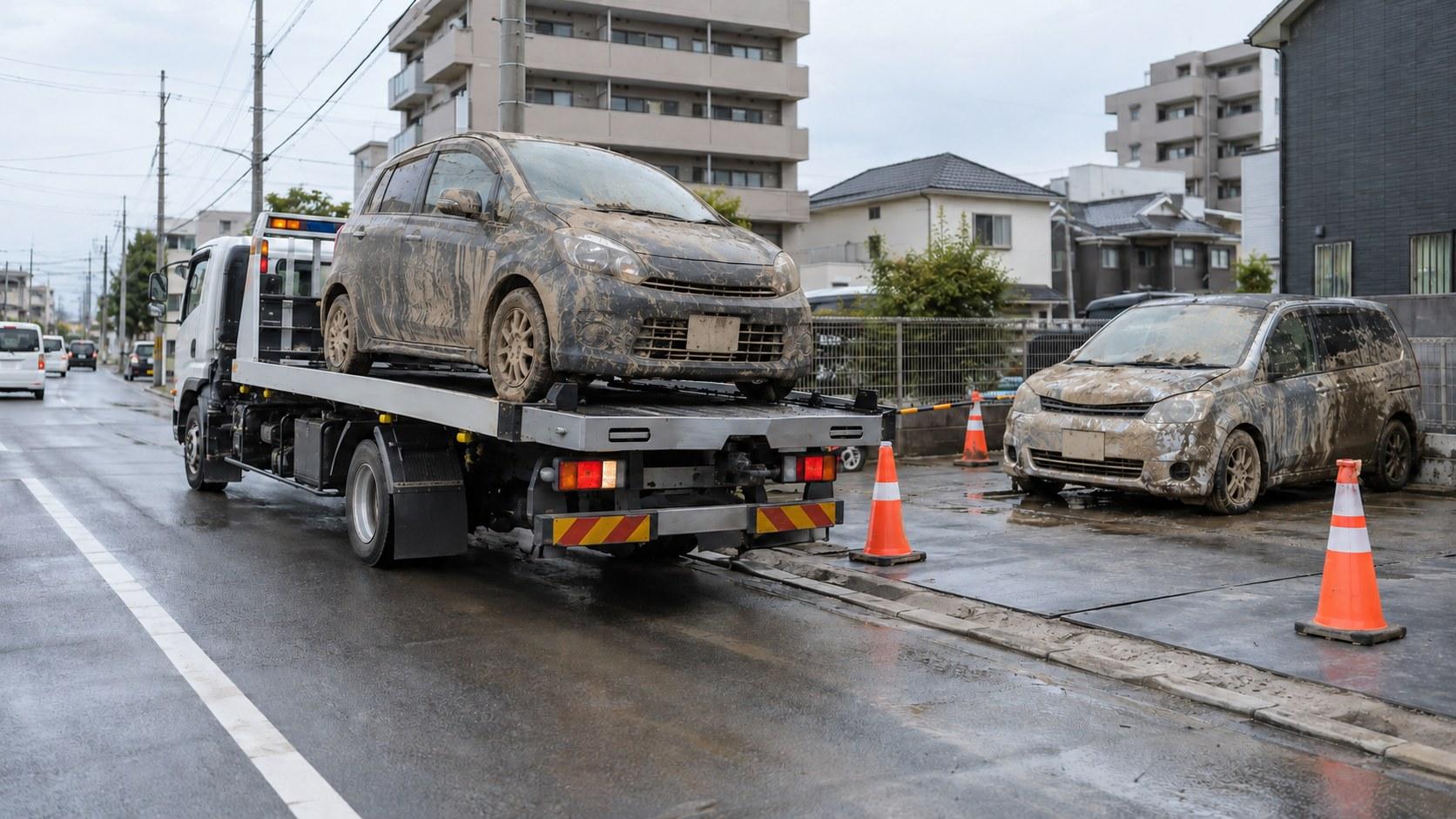
The cover is an AI-generated conceptual image. It is not a photograph of the actual Chiba flood or vehicle-removal operations.
This general explanation uses public records checked November 4, 2026. It is not legal advice on an individual compensation claim. Confirm location and collection with the road administrator and seek a qualified lawyer for legal decisions.
What Is Happening
Distinguish the populations and operations behind around 2,500, 500 and 384 vehicles.
Vehicles left on roads after the flood
When a vehicle disappears from a road, how far have public access and its owner’s daily life recovered? Reading the record of moving vehicles requires checking what was counted and which stage was reached.
The Japan Meteorological Agency reported record-setting heavy rain centered on Chiba Prefecture on August 13 and 14, 2026. It named the event the August 2026 Chiba Heavy Rain. This article examines the response to vehicles left on roads after that rainfall.
令和8年8月千葉豪雨 — Japan Meteorological Agency (2026). Japan Meteorological Agency
Chiba City’s August 22 announcement described around 2,500 vehicles left on city-managed roads after the flood. This was not a count of routine illegal parking or a measure of parking-space shortages. Vehicles remaining on roads do not establish that parking policy worsened inundation.
The city began moving vehicles on August 14 and removing them on August 17. Its said around 500 vehicles obstructing traffic had been moved to road shoulders by the morning of August 17. Securing space for traffic preceded the work of taking vehicles off the roads.
The populations behind around 2,500 and 384
The August 22 announcement reported that the city had removed 321 vehicles from arterial roads and 63 from local roads, totaling 384. Removal from arterial roads was completed on August 19 and from local roads on August 22. This differs from a finding that the city itself removed all of the approximately 2,500 vehicles.
市管理道路上の被災車両の撤去が完了しました~令和8年8月千葉豪雨に伴う対応~ — Chiba City (2026). Chiba City
The August 18 record also mentions vehicles driven away or removed by tow trucks arranged by owners. Tow trucks pull or transport vehicles that cannot be moved normally. Subtracting the city’s removal count from the original estimate cannot establish how many remained.
That August 18 record said the number on arterial roads had fallen to around 200 and aimed to complete removal on August 19. The August 22 record confirms August 19 as the completion date for those roads. Comparing an interim remaining count with a later cumulative city-removal count still requires checking the roads and reporting times.
A vehicle may also be counted at different stages when it is moved to a shoulder and later removed from the road. Adding around 500 and 384 would therefore not establish the number of unique vehicles handled. Listing figures by publication date alone can confuse the operation each figure describes.
Background & Context
Distinguish access from removal, and city-managed roads from prefectural roads.
Opening access and restoring a road
In the , emergency road clearance means the minimum work needed to open relief routes for emergency vehicles. Removing debris and making simple corrections to uneven surfaces secure access before emergency restoration.
Chiba City’s announcements similarly separate movement to road shoulders to secure traffic space from off-road removal. This general definition helps distinguish the stages, while the account of this disaster remains limited to what the city’s records show. Completion of vehicle removal does not establish completion of repairs to road surfaces or drainage facilities.
The city says it designated city-managed roads on August 13 under Article 76-6 of the Disaster Countermeasures Basic Act, which sets rules for disaster response. Its guidance explains that when emergency-vehicle passage cannot be secured, drivers may be asked to move vehicles and road administrators may move them in certain circumstances.
災害対策基本法に基づく道路区間の指定 — Chiba City (2026). Chiba City
A road administrator is the body responsible for maintaining and managing that road. The city’s designation and conditions should not be read as unconditional authority to move vehicles on any road or private property. The removal-count announcement does not resolve individual questions about damage, costs or compensation.
Secure space for traffic
- Population
- Obstructing vehicles
- Operation
- Move to shoulders
- By Aug 17 morning
- Around 500
City’s off-road removal
- Arterial, done Aug 19
- 321 vehicles
- Local, done Aug 22
- 63 vehicles
- City-removal total
- 384 vehicles
Based on Chiba City’s August 18 and 22 announcements. Around 500 and 384 concern different stages and counted populations. Adding them cannot establish unique vehicles handled, and subtracting them from around 2,500 cannot establish the remaining count.
Different road administrators and contact points
Chiba Prefecture announced on August 20 that off-road removal of vehicles left on prefectural roads was complete. It reported a decrease from 93 at 9 a.m. on August 18 to zero at 5 p.m. on August 20. This does not count the same scope as the city’s 384 removals.
県管理道路における放置車両の撤去について — Chiba Prefecture (2026). Chiba Prefecture
The prefecture asks owners to contact the civil-engineering office responsible for the municipality where the vehicle was left. These offices serve as regional contact points for prefectural roads and related management. A vehicle being within the city’s geographical limits does not mean it can be located by checking only the city’s storage site.
The city’s records acknowledge help from MLIT and the Chiba Prefecture towing-business cooperative. An organization assisting an operation and the roads covered by a report are different fields of information. National assistance does not change the city’s removal count into a regional total including national highways. Accounts of who helped should retain the roads each source reports on.
When combining city and prefectural announcements, retaining the administrator and observation time would help readers. Separating a location within a city from a road managed by that city can help an owner choose a contact point. The same distinction must be checked before adding figures into a claimed regional outcome.
The city’s response-status page(外部サイト、新しいタブで開きます) says patrols to locate affected vehicles on local roads began on August 20 after arterial-road removal. It records a separate search stage on local roads. An announcement that arterial-road work is complete does not establish that roads near a home have also been checked.
Reading the Structure
Examine storage and collection information and records needed to assess daily travel.
Connecting stored vehicles with their owners
Chiba City’s provides telephone, email and an inquiry form. The page updated November 2 covers Typhoon No. 25 as well as the August flood. Vehicles covered by the current guidance should not all be treated as the same population as the August removal count of 384.
The stated telephone hours are Monday to Friday, 9 a.m. to 5 p.m. The form is available around the clock. Being able to submit an inquiry at night is different from receiving an immediate answer or collecting a vehicle then. Collection arrangements need to be checked with the current official contact point.
The guidance asks collectors to bring a driver’s license or another document identifying them. It allows a representative to collect a vehicle with the representative’s identification. A collection-request form can be filled in before arrival or at the counter that day. The guidance therefore does not describe only a process requiring the owner to attend personally.
The collection-request document serves a different stated purpose from the inquiry form. Making contact through the form should not be treated as evidence that the documents for collection are ready. A proposed handover record could distinguish receipt of an inquiry from confirmation of the required documents.
千葉豪雨・台風第25号による被災車両の保管・引取り — Chiba City (2026). Chiba City
The page also says the storage location may change as circumstances develop. Contacting the office beforehand to confirm the location and procedures can address changes that an old image or news report would miss. Availability of a contact point and completion of an individual handover remain different outcomes.
The August 22 announcement says weekend handovers would also be accommodated. The current page, meanwhile, states weekday daytime telephone hours. An arrangement immediately after the disaster should not become a guarantee that the same days and times are available now. Inquiry hours and the agreed collection time need to be checked separately with the office.
The November 2 guidance says collection notices are being mailed progressively to owners whose addresses could be confirmed and asks recipients to contact the office stated in the notice. Describing a mailing process does not establish how many notices reached owners or how many collections were completed.
Choosing the unit of completion
While announcing removal completion, the city’s August 22 record also acknowledges that vehicles not yet identified may remain. Completion should be read as concerning the work on city-managed roads known at that stage. Publication of the announcement does not guarantee absence of affected vehicles in locations that had not been checked.
For example, someone reporting progress could distinguish roads checked from sections not yet checked. Recording which information was updated after a new report could help the next person trace earlier decisions. This is a proposal for reading and maintaining records, not a finding about what the city actually implemented.
Known case counts and circumstances that remain unconfirmed could also be recorded separately. An unknown contact address differs from a case in which contact has been made but a date is still being arranged. This distinction would allow examination of checks needed on the guidance side, rather than treating every incomplete case as a matter of the owner’s convenience.
Likewise, a vehicle being in storage does not establish contact with its owner. Even after contact, completion of collection arrangements requires another check. Investigating returns calls for identifying the storage population and reporting period separately from the number taken off roads.
Work shown in reports
- Road coverage
- Manager and scope
- Operation stage
- Movement or removal
- Vehicle records
- Population and date
Questions for later stages
- Contact with owners
- Did guidance arrive?
- Collection arrangements
- What is incomplete?
- Daily travel
- What is needed?
The article’s proposed checks draw on the city and prefectural announcements and collection guidance. The right-hand side does not show measured return counts or implemented support outcomes. Removal completion and recovery in daily life cannot be replaced by one number.
What is needed to resume daily travel?
After collection, whether a vehicle can again be used for commuting or medical appointments is not answered by a removal announcement. Damage and alternative transport leave further questions about owners’ circumstances. The sources checked here do not compile repair status or the number of people receiving travel support.
An inquiry into difficulties during the loss of a vehicle could record travel purposes separately from available alternatives. Someone with continuing medical appointments and someone whose employer can provide transport may need different advice despite both having an unusable car. This is a hypothetical example for designing an inquiry, not an evaluated support case.
Public reporting could consider grouping reasons why collection arrangements remain open without identifying individual owners. This is a proposal to separate information needed for support from information used in a public progress report. Publishing license plates or personal contact details widely should not become a prerequisite for coordination.
Reducing vehicles left on roads supports public passage. Looking at subsequent storage and handover also draws attention to the conditions for owners’ next steps. Records that examine administrators’ operations separately from owners’ daily lives could help identify situations needing further advice.
Related Guide
Designing outcome indicators(このサイトの記事): Distinguish operation counts from changes in daily life.
Further reading
Amazon links are advertising links.
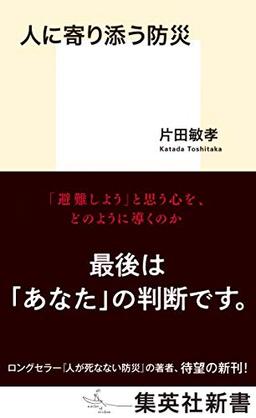
For disaster communication, Toshitaka Katada’s 人に寄り添う防災(外部サイト、新しいタブで開きます) (an explanatory translation: Disaster Preparedness Attuned to People) is a related reading option. Shueisha’s public introduction and contents(外部サイト、新しいタブで開きます) describe communication by information providers in emergencies. Only those public materials were consulted; the full book has not been read. The suggestion concerns the difference between establishing a contact point and making guidance usable. It does not substantiate Chiba City’s current collection conditions or vehicle-return results.
Remaining Questions
Examine cross-boundary information, collection support and records for future disasters.
When the city and prefecture manage different roads, can an owner identify the appropriate contact point? Showing the administrator and operation date alongside the location could help someone looking for a different storage site. There is also room for road administrators to consider how newly discovered vehicles and unchecked sections could be shared separately from the scope of completed work, in preparation for another disaster.
Who checks each step from storage after removal to return? For people who cannot be reached or cannot attend personally, arrangements for representation and the guidance needed deserve examination. Research into time before return or reasons for incomplete cases requires comparable populations and periods. Can evaluation avoid turning the mere existence of a form into evidence that information reached people in difficulty? Can records distinguish referring someone to an office, identifying the vehicle and arranging a collection time? Sending a message alone would not establish that the next office completed the handover. Could the time an owner spent explaining the same circumstances again also be recorded?
After a vehicle disappears from the road, removal counts cannot show what an owner needed to continue commuting or attending medical appointments. Is there an opportunity to ask about repair or alternative travel separately from road restoration? The account of storage and handover conditions is limited to the guidance updated November 2 and checked November 4, 2026. It does not establish later reception arrangements or completed returns. Recording the remaining work between public access and recovery of daily life raises questions about staff handovers and preparation for the next event.
References
- Japan Meteorological Agency’s public overview of the August 2026 Chiba Heavy Rain. The linked full weather PDF and abnormal-weather analysis were not adopted.
- Chiba City’s August 18 and 22, 2026 announcements, road-section designation, response-status page and storage and collection guidance.
- Chiba Prefecture, “Removal of vehicles left on prefecture-managed roads,” August 20, 2026.
- MLIT’s public explanation of emergency road clearance plans.
- Toshitaka Katada, 人に寄り添う防災 (集英社新書), Shueisha, 2020. Public publisher introduction and contents consulted.
令和8年8月千葉豪雨に関する車両移動について — 千葉市 (2026). Publictextreadingscope;2026isaccessyearforguidancepage
道路啓開計画 — 国土交通省 (2026). Publictextreadingscope;2026isaccessyearforguidancepage
道路上の豪雨による被災車両の対応状況 — 千葉市 (2026). Publictextreadingscope;2026isaccessyearforguidancepage
Statistics cited in this article
- 1Chiba City(August 22, 2026) Open source
Questions to Reflect On
- Can a removal announcement explain which roads and operations are complete?
- Who checks and communicates each step before an owner can collect a vehicle?
Related Content
Who Decides on Reentry After a Shopping Centre Evacuation?
Aeon Mall Kumamoto’s August and September 2026 notices and preparedness guidance on requests, safety checks, communication and drills
A stronger bridge pier still needs a checked foundation
407 of 496 examined bridges had findings after deduplication; this is not a national danger rate. 214 missing checks and 161 out-of-range results without appropriate redesign require different responses. Follow column and foundation checks through response plans and reinforcement.

Practical Guide to Social Vulnerability Mapping During Disasters — Lessons from the Noto Peninsula Earthquake
Disaster damage concentrates on socially vulnerable groups. A guide to vulnerability mapping, inclusive shelter management, and community resilience building.
Series: Organization Design & Resilience

Phase-free Preparedness: How Can Everyday Public Facilities Stay Usable in Disasters?
National proposals from 2026 and Naruto City’s FY2024 to FY2030 plan on procurement, inspection, repair and access conditions
Get new columns by email
1-2 social structure analysis columns per week. Free to subscribe.
Join our activities
Sign up to receive the latest research and activity reports. Feel free to reach out about collaboration or project participation.
Support our research and activities
Support our research and publications with JPY5,000 per year. There is no automatic renewal.