
Phase-free Preparedness: How Can Everyday Public Facilities Stay Usable in Disasters?
National proposals from 2026 and Naruto City’s FY2024 to FY2030 plan on procurement, inspection, repair and access conditions
Read national phase-free proposals and Naruto City planning within their stated scope. Two diagrams connect everyday facilities with emergency operating conditions, maintenance responsibilities, costs, access and annual evaluation.
TL;DR
- Read national proposals and municipal plans within scope
- Separate shared use from emergency usability
- Examine maintenance duties, costs and access for people unable to use facilities
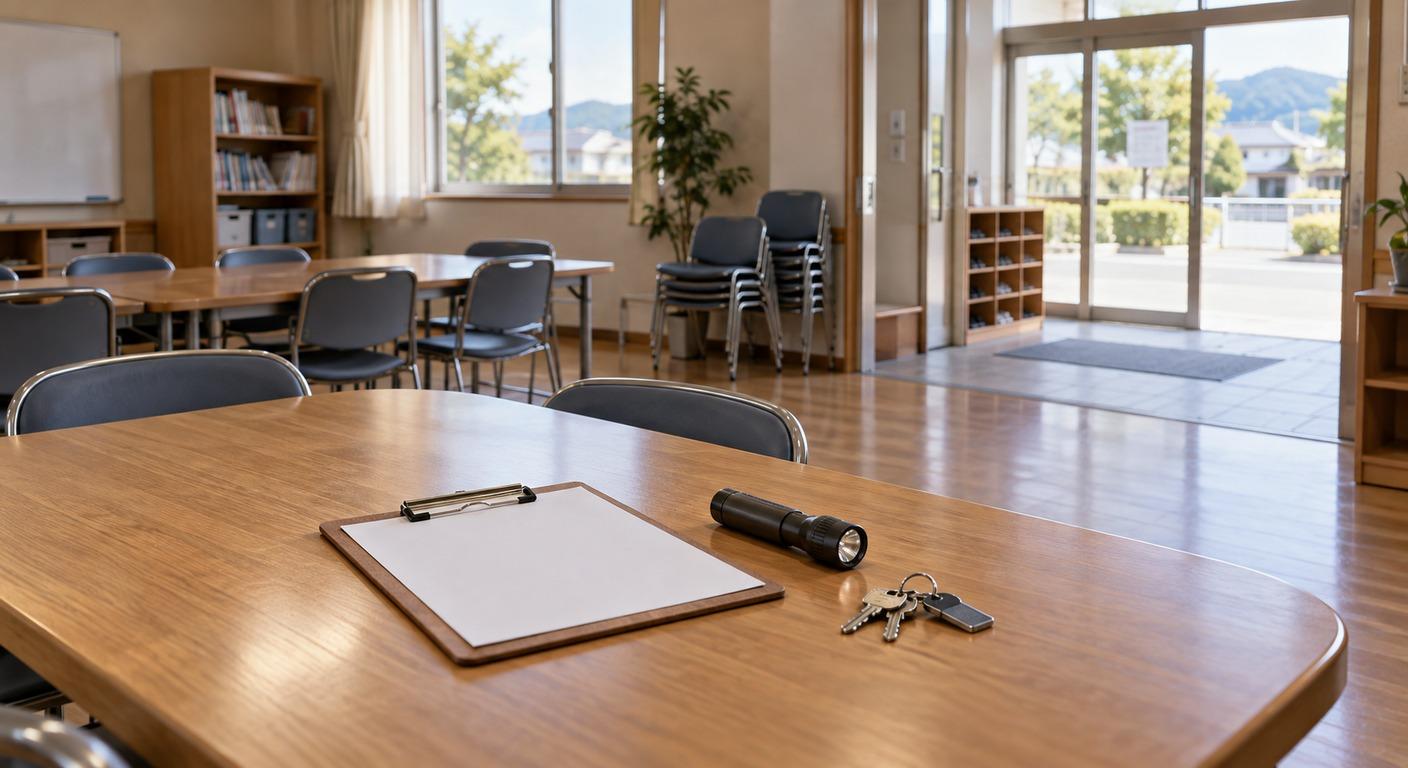
The image is an AI-generated fictional public learning room. It does not document a Naruto City facility or inspection results.
What Is Happening
Read national consideration and municipal planning
Public facilities and services used every day can be designed to serve people during disasters too. In Japan, phase-free preparedness connects these uses rather than treating preparedness as separate from ordinary life. Familiarity, however, does not establish that a service will remain usable during a power failure, water outage or staff absence. Municipalities considering this approach need to examine purchasing equipment alongside the work of keeping it usable.
The records a first meeting on June 3 and a second on July 23. July materials present proposed directions for integrating preparedness into daily life. They concern future policy and interministerial work; they do not announce a completed nationwide operating system.
The links to a disaster prevention and mitigation plan with a seven-year period from fiscal 2024 through fiscal 2030. It discusses routine inspections, preventive maintenance, schools, welfare and coordination between departments. Statements of policy need to remain distinct from evidence that individual facilities have performed successfully.
Background & Context
Distinguish definition, operating conditions and schedules
Sharing a use differs from establishing usability
The describes designing familiar goods and services to be useful in both ordinary times and emergencies. Design is the relevant step: repurposing something already available does not establish the conditions under which it works. Everyday experience should be assessed alongside those conditions.
For example, a proposal to use a community meeting room during a disaster would need to address opening hours, keys, power, water and access routes as well as floor area. This is the author's planning example, not a description of a particular Naruto facility. An entrance familiar to regular users may also need examination under different operating conditions.
Everyday use
- Purpose
- Learning/social
- Check
- Use/hours
- Maintain
- Inspect/repair
Emergency use
- Purpose
- Needed support
- Check
- Power/routes
- Maintain
- Staff/alternatives
Familiarity alone does not guarantee emergency usability
The first national meeting's summary records a view that discontinuities between everyday and emergency arrangements need examination. It also records a view that phase-free thinking belongs within a broader strategy. Read together, these opinions caution against treating convenient equipment as grounds to dispense with other measures such as structural reinforcement, stockpiles or exercises. They are meeting opinions, rather than binding requirements adopted for every municipality.
Read schedules separately from later records
June's proposed schedule placed a second meeting around August and a third around October. The later meeting list records the second on July 23. Comparing the documents helps show why dates and document stages matter. The July proposal aimed for an interim synthesis around autumn, with interministerial coordination described as future work.
The meeting list checked on November 5 displays materials through the second meeting. That list alone cannot establish the absence of results everywhere else. This article uses the proposals and opinions actually available to examine municipal decisions. It does not treat them as a completed national guideline already imposed on local authorities.
Reading the Structure
Examine procurement, upkeep, costs, access and evaluation
Connect specifications to continuing maintenance
Naruto's plan calls for public facilities to work in both ordinary times and emergencies, and for routine inspections and preventive maintenance of existing facilities. The approach therefore extends beyond new construction. In its account of earlier work, the city says it incorporated the idea into its regional disaster plan in fiscal 2017. Time since adoption does not reveal the current condition of each asset.
A municipal buyer and a supplier may hold different knowledge about a product and its maintenance. Reducing this could involve agreeing at procurement which functions will be checked under which conditions. Alongside descriptions of shared uses, ask about operating limits, necessary inspections, responsibility for repairs and replacement. These are the author's procurement proposals.
Additional equipment may create additional management work. When everyday and emergency responsibilities lie with different people, an inspection finding needs a route to the people who will depend on the equipment. Specifications and contracts could identify what is handed over when managers change. Establishing that route does not necessarily require merging departments into a single organization.
Consider an inspection showing that a power unit is unavailable. Everyday room use might continue while an emergency function is restricted. The author's proposal is to record those conditions separately and identify who updates the information until repair is complete. The date a repair was commissioned differs from the date someone checked that the relevant function could be used again.
Procurement comparisons could put quotations on the same basis when they cover different maintenance and explanation duties. Alongside purchase price, specify who provides staff instructions and records at handover. This is a planning proposal: choosing the least expensive quotation alone does not establish the cost of continued usability.
Account for interruptions caused by inspection
Equipment used every day also needs a plan for periods when inspection makes it unavailable. If a check requires temporarily closing a room, managers could consider its method and timing, then explain the affected activities and contact route to users. This is an operational proposal, rather than instructions for creating an actual power failure or findings from a particular facility.
Skipping a necessary check to avoid interruption would leave emergency usability inferred from ordinary use. Adding checks alone, however, can also create scheduling burdens for users. The same discussion could ask which function needs examination, why, and whether another place or information route is usable during closure. After the check, compare the manager's reopening decision with the conditions communicated to users. Recording the number of inspections should not obscure restrictions imposed on everyday activities. The purpose is to discuss those conditions alongside the functions that were actually examined.
Avoid counting the same benefit twice
A room serving several purposes requires an explanation of costs across those purposes. One approach is to distinguish ordinary-use improvements, added emergency functions, and continuing inspections and exercises. A shared-use label cannot establish a reduction in the total cost. It also cannot show that continued upkeep has a funded owner.
At procurement
- Scope
- Uses/conditions
- Cost
- Base/additions
- Duty
- Management
After use
- Condition
- Faults/inspection
- Access
- People/routes
- Change
- Repair/options
Equipment counts differ from conditions of usable support
Simply adding everyday attendance to emergency user counts would require care. The same person may appear under different purposes, and observed attendance differs from a projected emergency population. An evaluation could distinguish measured use, capabilities checked in an exercise and assumptions still untested. Before combining numbers, specify what each one measures.
This distinction also supports discussion of priorities. A project may improve an ordinary activity while leaving an emergency condition unresolved. Explaining both findings gives residents more useful information than presenting one total benefit. It permits a discussion about the next improvement without claiming a tested effect for a function nobody has examined.
Everyday and emergency activities may also compete for the same room. A proposal to switch a scheduled meeting space to another purpose would need a decision-maker, a communication sequence and conditions for resuming ordinary use. This is a planning example. A room serving both purposes does not necessarily support both activities at the same time.
Include people unfamiliar with the place
Consulting only regular users can miss the conditions facing people unable to reach a facility. The first meeting summary includes an opinion about considering people for whom preparing is difficult. July's proposed directions discuss reaching people with little interest in preparedness and creating easier opportunities to participate. Those are directions for consideration, rather than evidence that a participation effect has already been demonstrated.
The discusses combining paper and social media for different age groups, community welfare, school environments and everyday mobility. This connects facilities to questions about who can receive information and reach assistance.
A smartphone service familiar to everyday users could still require another route for someone without a device or with no way to charge it. This is a planning example, not a finding of deficiency in a particular municipality. Evaluation might examine whether a person can obtain directions through an ordinary counter and whether paper and in-person explanations convey consistent conditions. Availability of a digital function alone does not answer these questions.
After revising directions, evaluation could examine whether first-time visitors understand the same conditions as managers. Reading opening hours, eligibility and unavailable functions with users is one possible method, rather than a survey conducted for this article. Check a contact route for someone unable to read the explanation.
Let annual progress inform the next change
Naruto's plan calls for annual progress management and consideration of developments in society and disaster assumptions. This article has not examined every annual implementation table or all facilities' test results. The plan's commitment identifies evidence to look for next, rather than proving completed performance.
The author's evaluation proposal includes recording unavailable functions identified at inspection, time until repair, and alternative routes actually usable. Hearing from people who could not participate in an exercise could help inform the next specifications or explanation. That would follow improvements distinct from the number of activities held. The scope of questions should reflect the purpose of evaluation, rather than making detailed collection of personal circumstances an end in itself.
Inspection records could connect the person identifying a fault with the person checking repair, restricted functions and an alternative location. Include whom staff can consult when a responsible person is absent. This is an operational proposal. Its purpose is consistency between management decisions and user information, rather than increasing the number of records.
Related Guide
- Designing outcome indicators(このサイトの記事): Separate activities delivered, changes observed and effects still unverified.
Further reading
Amazon links are advertising links.
Toshitaka Katada’s 人に寄り添う防災(外部サイト、新しいタブで開きます) (an explanatory translation: Disaster Preparedness Attuned to People) is related reading on considering usable guidance alongside prepared equipment. Shueisha’s public introduction and contents(外部サイト、新しいタブで開きます) cover community preparedness and information providers’ communication in emergencies. Only those public materials were consulted; the full book has not been read. This 2020 book does not establish current phase-free standards, inspection specifications, maintenance costs or effects of a particular project.
Remaining Questions
Ask about responsibility, access and priorities
The first question is how precisely everyday and emergency value can be expressed in procurement and management conditions. Thorough purchase explanations may lose practical value when managers change and faults remain unresolved. Identify who checks functions and operating limits, repairs equipment and updates directions. Connecting these tasks to contracts and annual budgets matters alongside establishing a forum for coordination between departments.
The second question is whether improvements for regular users also reach people who need assistance in an emergency. Conditions facing those who rarely visit or struggle to obtain information deserve examination. Can users and managers understand the same operating limits and choose another route? Where adding an emergency function restricts an ordinary activity, explain why and how the competing uses can be adjusted.
Finally, what deserves priority within limited resources, and what requires further testing? Existing equipment, inspections and better explanations may offer options when new construction is difficult, but effects and burdens need local assessment. Distinguish additional management work from the burden on users adjusting to closures or changes. Providing directions to an alternative place does not establish that people could use it. Distinguish installation counts, exercise findings and support actually received. Examining unusable conditions before another annual cycle passes is part of turning an appealing label into preparedness sustained through everyday work.
References
フェーズフリー等促進検討会 — 防災庁 (2026). Official document and scope stated in this article
「フェーズフリー等促進検討会」(第1回)議事要旨 — Cabinet Office (2026). Official document and scope stated in this article
今後の進め方について — Cabinet Office (2026). Official document and scope stated in this article
災害への備えを当たり前にするための方向性 — Cabinet Office (2026). Official document and scope stated in this article
鳴門市南海トラフ地震等防災・減災対策推進計画 — Naruto City (2024). Official document and scope stated in this article
鳴門市南海トラフ地震等防災・減災対策推進計画 ~2030年に向けての地震津波対策~ — Naruto City (2024). Official document and scope stated in this article
フェーズフリーとは — Phase Free Association (accessed 2026). Official document and scope stated in this article
Statistics cited in this article
- 1Cabinet Office Phase-free Promotion Study Group(2026) Open source
- 2Naruto City disaster prevention and mitigation plan, printed page 14(2024) Open source
- 3Cabinet Office second meeting, material 2, proposed near-term process(July 2026) Open source
- 4Naruto City disaster prevention and mitigation plan, printed page 1(2024) Open source
Questions to Reflect On
- Who checks everyday and emergency operating conditions?
- Who continues inspection, repair and communication?
- Can people unfamiliar with the facility reach support?
Key Terms in This Article
- Information Asymmetry
- A state in which two parties to a transaction hold different amounts or qualities of information. The gap grows when the seller does this every day while the buyer does it a handful of times in a lifetime. The wider it is, the more the better-informed side can set price and terms in its favour. Fraud and inflated quotes work by exploiting that gap.
Related Content
Before charging for Fuji rescues, measure delayed calls
Yamanashi targets September 2027; the announcement does not finalize fees or exemptions. Saitama currently charges ¥8,000 per five minutes, with distinct exclusions and relief. Six first-year cases and ¥350,000 in fees do not establish a causal effect on accidents or calls.
Fukushima Holds About 14 Million Cubic Metres of Removed Soil. Reuse Outside the Prefecture Began With Flower Beds at Two Government Buildings
Soil removed during decontamination in Fukushima must be finally disposed of outside the prefecture by March 2045, an obligation written into law. About 14 million cubic metres sit in interim storage. On 29 August 2026 the first reconstruction reuse outside Fukushima began at a government building in Sendai, followed by one in Saitama. The volume used across both sites was about 2 cubic metres. The government's basic policy and roadmap say that selecting and surveying candidate sites for final disposal begins around 2030. This piece reads the distance between the deadline and the start, using the government's own documents.

Digital Society Vision Council, 12th Meeting (May 22, 2026) — Briefing on the Next Priority Plan and ISVD's Reading
A briefing on the 12th meeting of Japan's Digital Society Vision Council (Digital Agency, held May 22, 2026), with materials submitted by two local government heads (Miyakonojo City, Yamaguchi Prefecture) and one industry leader (Rakuten). ISVD reads the agenda against its own scope of social vision design.

Stranded by Heavy Rain: What Do Temporary Stay Notices Tell Us?
An examination of Japan’s 2026 guidance and Chiba’s historical heavy-rain records, facility designation, opening, reception, closure and cross-boundary updates.
Get new columns by email
1-2 social structure analysis columns per week. Free to subscribe.
Join our activities
Sign up to receive the latest research and activity reports. Feel free to reach out about collaboration or project participation.
Support our research and activities
Support our research and publications with JPY5,000 per year. There is no automatic renewal.