
Drink-driving: How Should Japan Assess Legal Changes and Recurrence Prevention?
Japan's July 2026 reform, 2025 fatal-crash statistics, recorded offences and referral to consultation or treatment.
Japan changed drink-driving provisions in July 2026. Separate those changes from the 125 fatal drink-driving crashes recorded in 2025, and examine criminal liability, enforcement counts, driver courses and links to advice or treatment through primary sources.
TL;DR
- The July 2026 changes clarified legal elements; this is different from increasing maximum sentences
- Fatal crashes, people killed and recorded offences are different counts; 2025 figures cannot measure a 2026 change
- Courses and routes to advice or treatment exist; plans, delivery and demonstrated effects need separate checks
The image is AI-generated. It does not depict or reconstruct the crash scene or the people affected.
What Is Happening
Establish the timing of the family's appeal and the legal changes
This article provides general information about the legal framework, rather than legal advice. Consult a qualified lawyer for judgments about an individual case.
Does the law respond adequately when drink-driving takes a life? An dated 21 September 2026 covered a bereaved family's appeal for tougher punishment following a fatal crash in Koriyama the previous year. Its publicly visible opening identifies the woman who died as 19 and says her mother spoke to NHK for the first time. That does not mean this was her first interview with any news organisation. Statements or details of a judgment cannot be supplied from parts of the report we could not read.
information places the crash near the station on 22 January 2025. The of the relevant legal changes was on 21 July 2026. The crash and the new law therefore belong to different periods. The Q&A also explains that the new provisions apply to acts on or after the commencement date. They should not be described as having applied retrospectively to this earlier crash.
Taking a family's appeal seriously and evaluating whether a policy prevented another crash are both necessary tasks. Criminal proceedings that determine responsibility, measures that prevent driving after drinking, and support addressing repeated behaviour serve different purposes. One statistic cannot represent all three. Before settling on a position about harsher punishment, it helps to establish what the law changed and which problems require other measures.
Background & Context
Separate legal elements, crash counts and recorded offences
Legal elements differ from the severity of punishment
The 2026 changes to Japan's Act on Punishment of Acts Inflicting Death or Injury on Others by Driving a Motor Vehicle clarified elements of dangerous driving causing death or injury and added new categories. For alcohol, the ministry's Q&A gives numerical criteria of at least 0.5 milligrams per litre of breath, or at least 1.0 milligram per millilitre of blood. Clarifying conditions for criminal liability is different from raising the maximum sentence.
Alcohol concentration alone does not determine whether this offence is established. Other legal elements, including death or injury, must also be considered. The ministry explains that conduct below the numerical criteria can still fall within the offence depending on the circumstances. Assessing how the new criteria change decisions requires records of their application and judgments concerning conduct after commencement.
The Road Traffic Act's provisions on driving while intoxicated and driving with alcohol above the specified limit also need to be distinguished. The amendment leaflet explains the addition of a breath-alcohol criterion of 0.5 milligrams per litre for driving while intoxicated. The existing assessment of a condition that could prevent normal driving remains. The 0.15-milligram-per-litre criterion for driving with alcohol above the specified limit has not changed. These provisions prohibit driving behaviour; their elements are not identical to those of an offence involving death or injury. Nor does being below a numerical threshold mean it is acceptable to drive after drinking.
Falling counts do not, by themselves, measure a legal change
The agency reports 2,283 drink-driving crashes in 2025, including 125 fatal crashes. The latter is a count of crashes, not people killed. The statistics cover the primary party driving a general moped or larger vehicle. Omitting the scope of the count can lead to misleading comparisons with other statistics.
Unit: fatal crashes, not people killed
- 2021152
- 2022120
- 2023112
- 2024140
- 2025125
Source: National Police Agency, trend in fatal drink-driving crashes. Covers the primary party driving a general moped or larger vehicle, including below-limit and unmeasurable alcohol levels. These values precede the July 2026 changes and do not measure their effect.
The latest five years do not move consistently in one direction: fatal crashes rose from 112 in 2023 to 140 in 2024, then fell to 125 in 2025. All these values precede July 2026. They cannot be presented as an outcome of that month's changes. Even a long-term decline does not isolate one amendment's effect without examining other changes, such as enforcement, traffic volumes, transport home and drinking patterns.
The agency also describes the proportion of drink-driving crashes that are fatal as 6.9 times the proportion for crashes without drinking. This compares the fatal share among crashes. It does not directly measure the risk of death per driver or per distance travelled. A statistic describing the seriousness of drink-driving crashes should not be substituted for an individual's probability of a particular outcome.
As a starting point, this article proposes records with matching populations and observation periods. National annual crash counts and offences detected in one city cannot establish what changed in the same place. An annual total for the year of a legal change can also contain conduct before and after commencement. An evaluation should identify the period during which the new rules applied, rather than treating a single annual figure as sufficient.
When comparing local measures, it would also help to record their start dates, target populations and actual content. If a new advice service and changes in enforcement began together, a change in counts should not be assigned to either one alone. Identifying the records that can be compared and those still missing would clarify what the next evaluation needs. This is a proposal for evaluation, rather than a claim that an effect has already been calculated.
Recorded offences also reflect enforcement
Koriyama's table shows recorded drink-driving offences rising between 2024 and 2025, from 300 to 336 across Fukushima Prefecture and from 59 to 80 within the city. Recorded offences differ from crashes. Alongside a possible increase in offending, a change in enforcement locations, times or targets could affect how many violations are found.
The table examined here does not establish which explanation accounts for the change. Using these counts in an evaluation calls for information about the scope of enforcement and comparable periods. A target expressed only as fewer recorded offences could also make it difficult to recognise improved detection. Preventing crashes and ensuring offences are not missed are distinct objectives that need to be stated clearly.
Reading the Structure
Ask what is known after a course or referral
A course exists; subsequent change is another question
Measures to prevent recurrence already exist. The agency's 2024 white paper describes a drink-driving cancellation course for people whose licences were cancelled for drink-driving and other eligible participants. It includes AUDIT, a questionnaire screening drinking habits, together with drinking records, goal-setting and discussion. Screening is not a confirmed diagnosis of alcohol dependence. People who drive after drinking should not all be assumed to have dependence.
At a meeting on 30 June 2025 recorded by the , police representatives described a two-day course totalling 13 hours. The second day takes place after 30 days have elapsed from the first, with participants reviewing progress towards their goals. They also described referring people to medical institutions and other services with consent where consultation appeared necessary.
At that meeting, however, the police agency said it did not hold data on first-time versus repeat offences, motives, the proportion with dependence, or drinking after the course. Examples of local follow-up on attendance at medical services were mentioned. The statement therefore does not establish that no institution has any follow-up information. Nor can a 2025 response prove the information is still unavailable today. An evaluation should check what has been collected since then.
From a referral to access to support
The third basic plan on alcohol-related health problems was approved by the Cabinet on 27 March 2026 and covers fiscal years 2026 to 2030. Its drink-driving provisions include connecting people with suspected dependence to consultation or treatment, supporting families on request, reviewing course content and investigating actual conditions. Commitments in a plan differ from evidence of how many people accessed support or whether reoffending changed.
Referral counts alone do not show what happens afterwards. Of those wanting help, how many reached an appointment or consultation? If cost, travel time or a lack of local services became barriers, where could they return for assistance? The proposal here is to consider ways of establishing access after referral and subsequent progress while respecting consent and protecting personal information. Access to care is not presented as a substitute for punishment.
Such a design should distinguish people who wanted a consultation, chose another source of support, or could not be contacted after referral. No reply is not evidence that difficulties were resolved or that no further offence occurred. Choosing not to seek consultation, including declining to explain that choice, should not automatically be treated as equivalent to being unable to obtain help. A possible approach would explain the questions and contact arrangements in advance, while leaving information on how to return for advice later.
The proposed cooperation between agencies does not require broad sharing of medical details. It would first identify the minimum information needed to establish whether a service was found, an appointment was reached or travel became a barrier. People would be told the intended use and recipients of information, and individual support records would be kept distinct from published aggregates. Small local groups also require attention to whether combinations of aggregate figures could identify someone. Results restricted to people reached at follow-up must say that those not reached are excluded.
Punishment
Clarified legal elements in July 2026
Which acts and legal elements does the change cover?
Distinguish this from an increase in maximum sentences.
Enforcement
Detecting and recording offences
Did the scope of enforcement affect the count?
Recorded offences alone do not reveal all offending.
Preventing recurrence
Courses and links to advice or treatment
Did referrals lead to support and less reoffending?
Separate plans, delivery and demonstrated effects.
The article's proposed questions, not a mandatory sequence or evidence of effectiveness. Sources: Ministry of Justice Q&A, National Police Agency materials, and the health ministry's 34th meeting record and third basic plan.
As discussed in our guide to designing outcome indicators(このサイトの記事), activity counts differ from changes resulting from that activity. Delivering a course or making a referral is an activity. Receiving needed support and no longer driving after drinking are separate outcomes. need to be designed to establish these changes. Even if less reoffending is observed, attributing that change to the course alone requires attention to comparison groups, the observation period and participants who could not be followed up.
Arranging transport home before drinking is another possible preventive measure. Last-train times, taxi availability and costs differ between communities, and someone must bear the expense. This proposal should not be turned into a finding about the cause of an individual crash or an assertion of proven preventive effectiveness. The contribution of transport, local safety work and support services needs to be examined concretely. For example, a local initiative could check transport availability at the time people leave a restaurant and explain fares and booking arrangements. It should consider options and costs for avoiding driving without assuming that relatives alone will provide lifts or supervision.
Reference Books
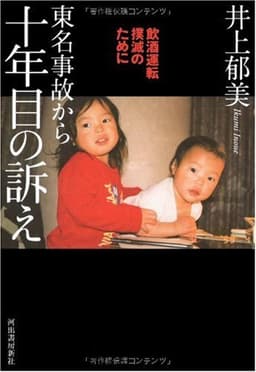
- 『東名事故から十年目の訴え--飲酒運転撲滅のために』(外部サイト、新しいタブで開きます) (An Appeal Ten Years after the Tomei Crash: Towards Eliminating Drink-driving, an unofficial translation; Ikumi Inoue, Kawade Shobo Shinsha, 2009). The publisher presents it as a record of a family's campaigning after losing their children in a crash. It offers related reading on the time and effort behind such appeals, rather than an account of current law or empirical evidence of deterrence.
Related guide
Designing outcome indicators(このサイトの記事) provides a general starting point for distinguishing activity counts from changes experienced by people. It helps frame follow-up records and comparison conditions; it does not determine the need for treatment or legal obligations.
Remaining Questions
Consider who is responsible for fair punishment and evaluating prevention
How can the pursuit of fair punishment proceed alongside the evaluation of measures to prevent another victim? Assessing a legal change requires both examining decisions in cases where it applies and investigating whether crashes declined. Sentence severity cannot explain every part of that process. Institutions need to identify what changed and which records allow the change to be checked. Crash counts from before commencement cannot answer that question.
Who establishes whether people reached the support they needed after a referral? Consent and privacy must be protected while accounting for barriers to attendance and people who could not be followed up. More referrals will not ensure access if those barriers persist. Agencies need to discuss what information they can share and how aggregated findings can guide improvements. They also need to allow time for explaining consent and keeping records, with responsibilities that staff can sustain.
Bereaved families should not have to sustain this evaluation through their appeals alone. Alongside responding to families' needs for explanation and support, national and local institutions need to take responsibility for examining legal application, enforcement and access to services over time. Naming the next records needed is more useful than calling an unresolved question a success. Can institutions explain both their response after a life is lost and their work to prevent the next crash in concrete terms?
References
Koriyama student fatality: a mother's thoughts for her daughter and appeal for tougher drink-driving punishment (21 September; publicly visible opening consulted) — NHK (2026). NHK NEWS WEB
Eliminating drink-driving (updated 20 August 2026) — Koriyama City (2026). Koriyama City
Q&A on the dangerous-driving law changes (relevant answers in publicly indexed text consulted) — Ministry of Justice (2026). Ministry of Justice
Eliminating drink-driving (2025 crash statistics) — National Police Agency (Checked 6 October 2026). National Police Agency
Trend in fatal drink-driving crash counts — National Police Agency (Statistics through 2025). National Police Agency
Changes to the Road Traffic Act and related provisions on 21 July 2026 — National Police Agency (2026). National Police Agency
Police White Paper, Chapter 5, Section 3: Driver education — National Police Agency (2024). National Police Agency
34th stakeholder meeting on alcohol-related health problems (30 June; descriptions of courses and available data consulted) — Ministry of Health, Labour and Welfare (2025). Ministry of Health, Labour and Welfare
Third basic plan on alcohol-related health problems (Cabinet approval, 27 March; drink-driving provisions on printed pages 22–23 consulted) — Ministry of Health, Labour and Welfare (2026). Ministry of Health, Labour and Welfare
東名事故から十年目の訴え--飲酒運転撲滅のために — 河出書房新社 (2009). 河出書房新社
Statistics cited in this article
- 1Ministry of Justice, Q&A on the dangerous-driving law changes (Q7)(2026) Open source
- 2National Police Agency, eliminating drink-driving(2025 statistics) Open source
- 3National Police Agency, trend in fatal drink-driving crash counts(2023 to 2025) Open source
- 4Koriyama City, eliminating drink-driving(2024 and 2025) Open source
- 5MHLW 34th Stakeholder Meeting on Alcohol-related Health Problems(June 30, 2025) Open source
Questions to Reflect On
- Are clarified legal elements being mistaken for higher maximum sentences?
- How can we follow a referral through to access to care and subsequent behaviour?
- What should institutions explain without shifting evaluation work onto bereaved families?
Key Terms in This Article
- Entry into force
- The point at which a legal instrument becomes effective. Particular obligations may have separate dates of application.
- Outcome Indicator
- A measure intended to examine changes or benefits relevant to the problem a program seeks to address. Its design distinguishes outcomes from immediate activity outputs; improvement in a measure alone does not establish the program's causal effect.
Related Content

In the Year the National Museum of Art's Grant Rose, the National Film Archive of Japan's Share of the Grant Fell Sharply. That Same Year, More Than 5,500 People Gave the Archive Over ¥150 Million
From June to September 2026 the National Film Archive of Japan ran a crowdfunding campaign and raised more than ¥150 million from more than 5,500 people. In the same fiscal year, the state's operating grant to the National Museum of Art, which runs the archive, was ¥8.46 billion, about ¥320 million more than the year before. According to the Agency for Cultural Affairs, the institution decides how the grant is split among its museums, and the archive's share of the grant fell sharply after the balance between grants and self-generated revenue was adjusted across all museums. This piece reads the work the Agency says the state funds alongside what the money raised is used for.

Of the 690,000 People Who Visited the National Museum of Western Art's Collection Galleries in FY2024, the General and University Student Categories Facing the Fee Rise Made Up 26%
In September 2026 Japan's National Museum of Art announced higher fees for its collection exhibitions. Free admission for high school students and younger, people aged 65 and over and others continues, and the fees rise for general visitors and university students. Five museums' collection exhibitions drew 1,126,594 people in FY2025, but the institution's performance report gives only totals by museum. The National Museum of Western Art's annual bulletin breaks down its 690,302 collection gallery visitors in FY2024 by category: general visitors and university students together made up 26%, and those who entered with a special exhibition ticket or through Campus Members made up 49%. This piece checks how far published figures can show where the burden of the fee rise falls.

Five National Art Museums Will Charge ¥1,000 for Their Collection Exhibitions. The Fee Rise Was Written into the Medium-Term Objectives the Education Ministry Set in February
In September 2026 the National Museum of Art, the institution that runs seven national museums in Japan, announced higher admission fees for the collection exhibitions at six of them. General admission will be ¥1,000 at five museums, up from ¥430 at the National Museum of Modern Art, Kyoto and the National Museum of Art, Osaka. The announcement does not mention the medium-term objectives. Yet the objectives set by the Ministry of Education, Culture, Sports, Science and Technology in February 2026 require admission fees to be raised and dual pricing introduced during the period, and set a target for self-generated revenue to cover at least 65% of exhibition costs by FY2030. This piece reads the original text.

Japan Post Failed to State Terms to 167 Freelancers. The First Day of the Violation Period Is the Day the Law Took Effect
On 2 September 2026 the Japan Fair Trade Commission issued a recommendation to Japan Post under the Act on Ensuring Proper Transactions Involving Specified Entrusted Businesses. Terms were not stated promptly to 167 people, and payment due dates were neither set nor met for 140. The violation period runs from 1 November 2024 to 30 June 2025, and its first day is the day the law took effect. All ten recommendations in FY2025 involved a failure to state terms. This piece reads why the most basic obligation is the one that goes unmet.
Get new columns by email
1-2 social structure analysis columns per week. Free to subscribe.
Join ISVD's activities?
Sign up to receive the latest research and activity reports. Feel free to reach out about collaboration or project participation.
Support ISVD’s research and activities
Support ISVD’s research and publications with JPY5,000 per year. There is no automatic renewal.