
Powered-wheelchair safety: how should the chair and the whole route be checked?
NITE's 2016 to 2025 accident reports involving users aged 65 or older, product conditions and proposals for route checks and coordination with road managers
Read Japan’s September 2026 NITE powered-wheelchair accident data alongside police guidance and road accessibility planning. Separate reports, causes and legal responsibility, and examine how equipment advice reaches route management, participation, responses and continued outings.
TL;DR
- Notified accidents, fatal accidents and falls are different counts
- Pedestrian classification and a product check do not certify a usable route
- Follow consultation through the manager’s response and continued outings
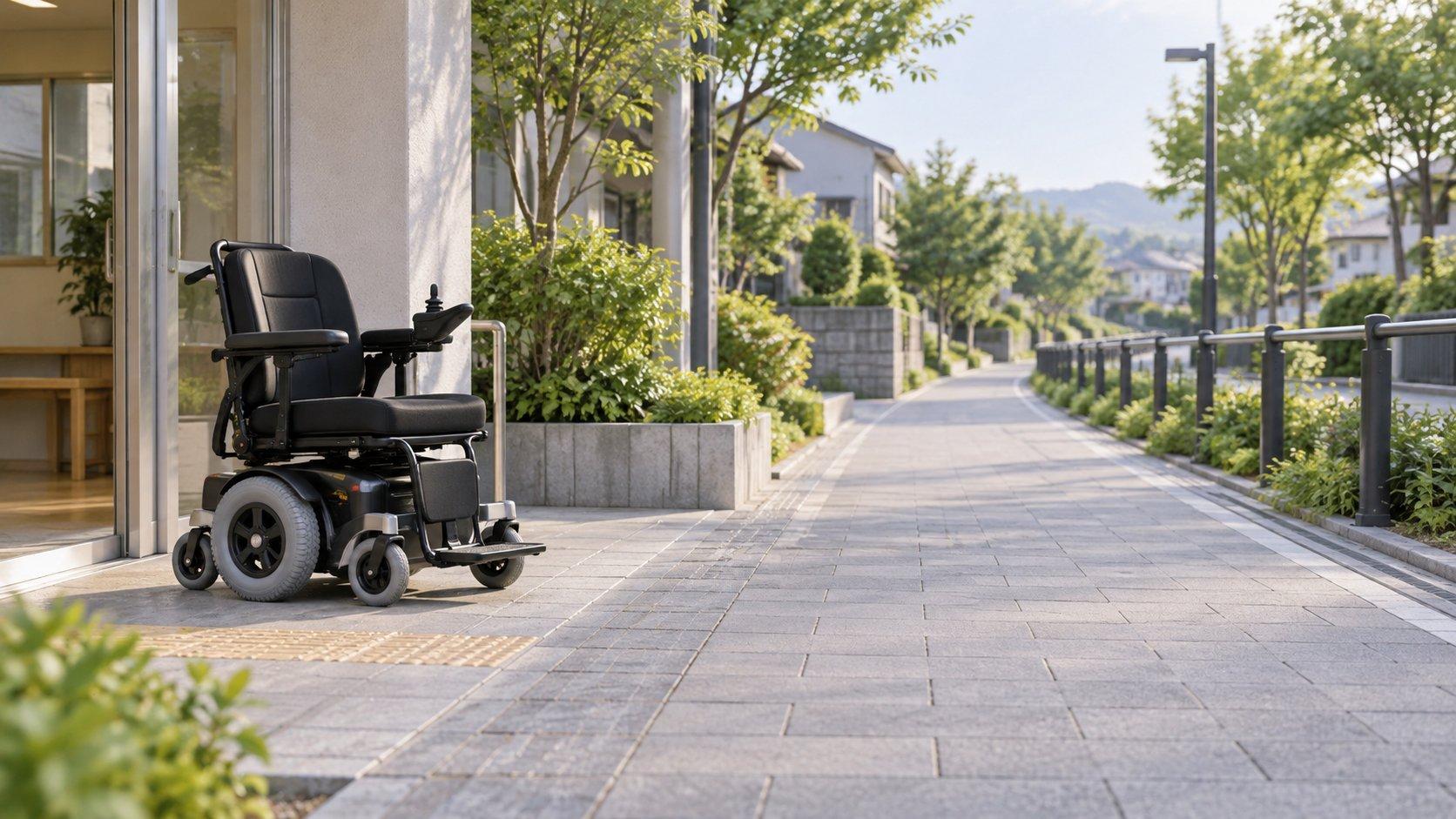
The thumbnail is an AI-generated illustration, not a photograph of an actual accident, an identified product or a road verified as compliant with standards.
This article provides general information from public sources, not an individual safety assessment or legal advice. Confirm operating conditions with responsible managers or specialists and legal judgments with a qualified legal professional.
What Is Happening
Keep events, harm and cause denominators separate.
A powered wheelchair is one way for people who find walking difficult to reach shops or medical appointments. Safety requires more than checking operation and maintenance. A chair may work outside the home, yet a ditch, railway crossing or destination entrance can prevent someone from completing an activity and returning. Product checks need to connect with the route the person will use.
Japan's reported 59 powered-wheelchair accidents involving older people in product-accident information notified during 2016–2025. The document defines older people as aged 65 or above and includes serious and nonserious product accidents. It is neither a census of every accident nationwide nor a rate per wheelchair user.
The separates 26 falls into ditches or rivers from 13 collisions with trains at crossings. Adding fatal accidents across the annual figure on the same page gives 34 fatal accidents. That is not the number of fatal falls alone. Events and the severity of harm are separate classifications.
The cause figure uses another denominator. The covers 57 cases, excluding two still under investigation. It distinguishes 43 cases of misuse or inattention, including suspected cases, five attributed to the product and nine with unknown causes. A classification that includes suspicion does not determine a user's legal responsibility or whether a road was defective.
Accident records
- Reported cases
- 59 reports
- Fatal accidents
- 34 all events
- Ditch/river falls
- 26 falls
Cause analysis
- Investigation excluded
- 57 reviewed
- Misuse etc./suspected
- 43 cases
- Unknown cause
- 9 unknown
Author's summary of NITE Figure 2, Table 2 and Figure 3. The 34 fatal accidents are summed from annual values; the 26 falls are not a fatality count. The 57 cause cases also include five attributed to the product. This is not a legal allocation of responsibility.
Comparing annual reports also cannot determine changing risk without information on users or travel exposure. Product and age coverage and the reporting scope need checking before figures from different surveys are placed together. What accident information establishes should remain separate from aspects of actual use requiring another investigation.
The statistics do not justify treating every powered wheelchair as a dangerous device or treating the absence of a product fault as proof of safety. Safety concerns need to be considered alongside why the person goes out and what the route requires. Both accident prevention and continuation of necessary activities belong in an evaluation.
Background & Context
Distinguish classification, product conditions, advice and road standards.
Pedestrian classification and usable routes are different questions
The explains that a person using a vehicle meeting the relevant Road Traffic Act criteria is treated as a pedestrian. Criteria include dimensions, an electric motor, inability to exceed six kilometers per hour, projections and appearance. A product's powered-wheelchair label alone does not establish that every model receives the same treatment.
A permitted mode of pedestrian travel is not the same as a route an individual can use safely. Even where there is width, turning space, entrance steps and the chair's characteristics affect what needs checking. Operation and individual travel decisions require the manual and appropriate specialist advice. A route used with an earlier model should not automatically be treated as suitable for a replacement.
Model checks should distinguish ability to operate the chair from suitability for a particular place. The speed criterion does not establish that every slope or step is negotiable. Manuals and suppliers can clarify operating conditions and uncertainties. Meeting a generic checklist should not substitute for a decision about an individual route.
The agency explicitly notes that its safe-use manual includes advice that is not a legal duty. Keeping traffic rules, manufacturer conditions and safety advice distinct helps identify the basis for a conversation about use. Advice should not be converted wholesale into uniform nationwide prohibitions; complying only with legal obligations cannot be described as preventing every accident either.
Check maintenance together with the route
NITE advises checking the road environment with family or helpers beforehand, avoiding dangerous places, checking the battery and anti-tip features, and obtaining periodic inspection from a dealer or similar specialist. Its examples include unprotected cliffs, uncovered drainage or waterways, railway crossings and steep slopes. The announcement concerns the environment and checking practices as well as the product.
A record of a family route inspection is not a safety certification. Rain, construction or a changed surface can produce different conditions later. People should not be encouraged to enter a doubtful place merely to test it; dangerous locations should be avoided while alternative methods are discussed with a dealer or appropriate contact. Environmental problems that greater individual caution cannot resolve still need to reach the people responsible for the place.
Road standards do not apply identically to every place
The distinguishes mandatory conformity for construction or alteration of designated roads and related facilities from duties to endeavor on other roads. This does not establish an immediate obligation to install an identical barrier at every ditch. The road or facility covered and its actual manager need to be identified.
Its includes wheelchair users, continuity between facilities, and cooperation among relevant bodies and affected people. It would therefore be inaccurate to say that the institutional framework does not envisage wheelchairs or that coordination mechanisms do not exist. The question is how those arrangements reach the checking and improvement of everyday routes.
Identifying a manager requires locating the path, ditch or waterway and asking the appropriate contact whether the same body manages them. A visually continuous place does not establish a single point of responsibility. Identifying a manager is also different from deciding the repair and its timing. Liability for an individual accident cannot be determined from these general considerations alone.
Reading the Structure
Connect a whole journey to manager responses, participation and evaluation.
Examine a complete activity and return journey
Consider a hypothetical shopping trip from home. A step-free shop entrance is not enough if a narrow section, drainage edge or slope on the return route prevents the journey. The whole activity requires discussion of alternative routes and the distance or battery implications of a detour. This is an example for analysis, not a documented local accident or an improvement already delivered.
The ministry's also describes integrated improvement of areas where facilities are concentrated. Having a plan and having a usable individual route require separate checks. Alongside completed facilities, following connecting routes, alternatives during works and places that remain unusable can make the difference between a plan and daily life more concrete.
Connect care and road checks to a record of the response
Equipment advisers discuss the model, the person's circumstances and intended use. Repairs or changes to the travel environment require confirmation with those managing the place. Can a concern identified in a consultation be recorded with the person to contact, the location and the timing of a check? This proposes a way to organize confirmation; it does not impose a universal legal duty on every adviser to carry out road works.
Product and use
- Chair
- Manual/model
- Person
- Use and tasks
- Inspection
- Check/contact
Route and response
- Travel places
- Linked route
- Environment
- Risk/options
- Improvement
- Who/act/check
A consultation and recording framework proposed by the author. Confirm the manager of each place, the model's conditions and the person's circumstances. It is not a uniform national job description or a safety-guaranteeing checklist.
The road guideline contains municipal examples of involving affected people during design and construction and explaining why an opinion cannot be reflected. A historical example does not prove that every municipality currently operates the same process. It can, however, inform a method that returns a response and its reasons rather than ending with a consultation. A person reporting danger needs a record that makes the next action understandable.
Consultation should not extend one person’s successful passage to everyone. Chair characteristics, physical circumstances, vision and hearing produce different difficulties. Wheelchair access also needs consideration alongside conditions for other pedestrians. Recording differing views can make clear whose difficulty informed a decision to improve a place.
A report can record the location, date, difficult condition, contact, answer and next check. It need not distribute addresses or health information widely. Information necessary for an improvement should be separated from private life, and photographs should consider people or homes appearing in them. A mark on a map should not count as a resolved issue; a manager's inspection and subsequent usability remain separate stages.
After assigning a contact, a message to the individual should not be recorded as a resolved issue. Changes, remaining conditions and the next contact need confirmation, with subsequent usability reassessed safely. The person should not be required to test a dangerous place to demonstrate the result; managers and specialists need to agree the scope of their checks.
Include people who could not go out and continuing responsibilities
Fewer reported accidents do not necessarily mean better mobility support if more people abandoned outings. Accidents, continued necessary activities, unusable routes and the person's burden need separate attention. Satisfaction among users cannot represent people who decided against use or could not respond. An evaluation can specify populations, periods and what remained unknown.
Before-and-after comparisons should also consider seasons, works and changes in users or models. An increase in reports needs interpretation: did danger increase, or did reporting become easier? Family accompaniment, professional checks, road maintenance and consultation staff all require time or funding. Responsibility for those costs affects which arrangements can continue.
Information, individual advice and road alterations cover different people and continuing costs. Priorities need more than a response to one conspicuous incident; they can consider the seriousness of danger and access to alternative routes or support. Replacing every response with family accompaniment leaves a difference between people whose families can provide it and those whose families cannot.
Remaining Questions
Ask how choice, handoffs and continuing responsibilities can be addressed.
How can safety concerns be addressed while preserving the purpose of an outing and the person's choices? A warning should not become a blanket prohibition, while a wish to travel does not justify entering a dangerous place. Can the person and supporters discuss necessary activities, model conditions, unusable routes and alternatives concretely? Where family accompaniment is unavailable, checking should not fall entirely on the individual; accessible advice and a method of confirmation are needed.
Who carries a concern from equipment advice to the management of a route? If the manager is unknown, reporting a dangerous place does not settle whom to ask for confirmation or improvement. Can the municipality identify the subject, contact the relevant parties and follow their response? Even when works cannot begin immediately, reasons and an interim consultation option can prevent necessary confirmation from ending halfway through the person's daily activity.
Can improvement be evaluated through both fewer accidents and continued outings? People unable to afford detours or additional costs need attention alongside successful users. Rather than counting reports, checks or completed works alone, can evaluation record the conditions enabling necessary activities? Responsibilities and funding for another check after changes in the model, health or road environment can keep support from ending with a single repair or explanation.
References
敬老の日に願い、届ける、安全なくらし~ほぼ毎年死亡事故が発生!介護ベッド・電動車いすなどの高齢者の事故を防ぐ~ — National Institute of Technology and Evaluation (2026). National Institute of Technology and Evaluation
敬老の日に願い、届ける、安全なくらし~ほぼ毎年死亡事故が発生!介護ベッド・電動車いすなどの高齢者の事故を防ぐ~ — National Institute of Technology and Evaluation (2026). National Institute of Technology and Evaluation
Safe Use of Powered Wheelchairs — National Police Agency (n.d.). National Police Agency
Road Accessibility Standards and Guideline — Ministry of Land, Infrastructure, Transport and Tourism (n.d.). Ministry of Land, Infrastructure, Transport and Tourism
道路の移動等円滑化に関するガイドライン — Ministry of Land, Infrastructure, Transport and Tourism Road Bureau (2022). Ministry of Land, Infrastructure, Transport and Tourism Road Bureau
道路の移動等円滑化に関するガイドライン 概要版 — Ministry of Land, Infrastructure, Transport and Tourism Road Bureau (2024). Ministry of Land, Infrastructure, Transport and Tourism Road Bureau
Accessibility Promotion Policies and Municipal Basic Concepts — Ministry of Land, Infrastructure, Transport and Tourism (n.d.). Ministry of Land, Infrastructure, Transport and Tourism
Further Reading
Ryoji Hoshika’s 障害とは何か : ディスアビリティの社会理論に向けて(外部サイト、新しいタブで開きます) is related reading on difficulties produced by social environments. Only the publisher’s public introduction, contents and bibliography were consulted; the full book has not been read. This 2007 book does not establish particular accident causes, current legal duties or effects of road improvements.

Publisher bibliography and contents(外部サイト、新しいタブで開きます)
For separating activity from outcomes in evaluation, see Introduction to Social Impact Evaluation Design(このサイトの記事).
Amazon links in this article are affiliate advertising links.
Statistics cited in this article
- 1NITE: Safe Everyday Living for Respect for the Aged Day(2016–2025) Open source
- 2NITE September 17, 2026 announcement, Table 2(2016–2025) Open source
- 3NITE September 17, 2026 announcement, Figure 2; annual values summed by the author(2016–2025) Open source
- 4NITE September 17, 2026 announcement, Figure 3(2016–2025) Open source
Questions to Reflect On
- What does each accident count cover?
- Who receives a concern about a route and returns a response?
- Can necessary outings continue after the proposed change?
Related Content
Older drivers in Japan: what do renewal checks tell us, and how can travel continue?
Differences between cognitive screening, driving skills tests and vehicle assistance, and conditions for medical visits, shopping and return trips after voluntary license surrender

Vote-Weight Disparity Passes 2x in 16 Districts — Japan's Last Redistricting Started at 1.999
NHK estimates that 16 House of Representatives districts now have a vote-weight disparity of 2x or more, up from 12 a year earlier. This is not a failure of the system but its design at work. The 2022 redistricting came in at a widest gap of 1.999 times, leaving 0.001 of headroom before the limit, and seats can only be reapportioned on the census held once a decade. This piece reads the round trip between correction and drift.
Regional Revitalization 2.0 and the '10 Million Related Population' Target: Are Means and Ends Reversed?
Japan's "Regional Revitalization 2.0 Basic Plan," approved by Cabinet in June 2025, aims to create 10 million "related population" through a Furusato Resident Registration system over 10 years. Has the structural logic of 1.0's failures truly been addressed? This article examines the policy through definitional ambiguity, target-setting risks, and international comparison.
Does Implementation Under Way Mean a Transport Gap Is Resolved?
Japan’s transport-law amendment scheduled for 16 October, the 15 May district counts, and usable bookings and round trips.
Get new columns by email
1-2 social structure analysis columns per week. Free to subscribe.
Join ISVD's activities?
Sign up to receive the latest research and activity reports. Feel free to reach out about collaboration or project participation.
Support ISVD’s research and activities
Support ISVD’s research and publications with JPY5,000 per year. There is no automatic renewal.