
Can Neighbouring Prefectures Sustain Emergency Care When a Doctor Helicopter Cannot Fly?
The September 2026 interim report on cross-border assistance, staffing, contracts and safety management
Read Japan’s September 30, 2026 interim report and prefectural announcements on doctor helicopters. Two diagrams distinguish deployment from continuing transport, and immediate coverage from personnel, contracting and safety questions.
TL;DR
- Read the September 30 interim report and operational categories
- Distinguish cross-border assistance and daily coverage
- Examine personnel, contracts, safety and continuing care
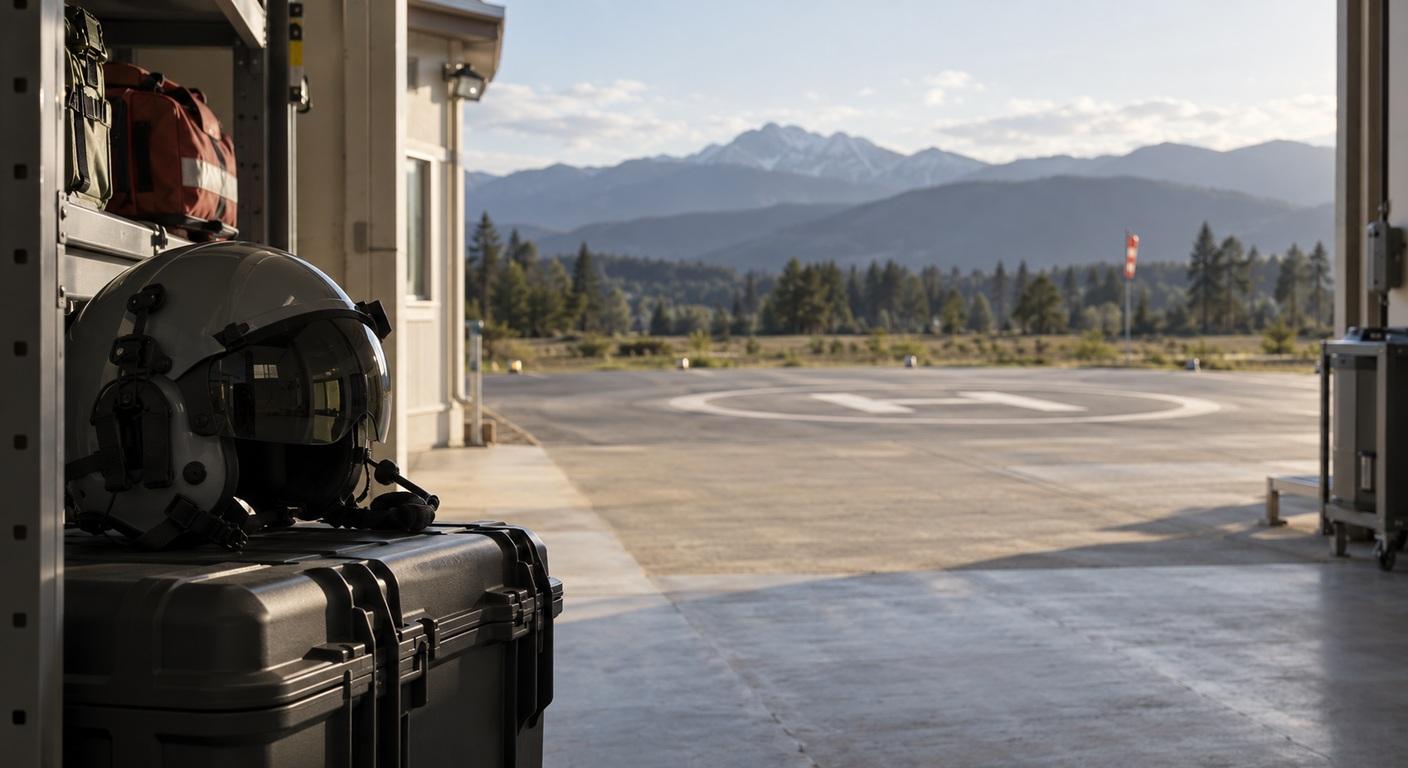
The image is an AI-generated fictional empty helipad, not a documentary photograph of a real location, flight operation or safety procedure.
This general policy account uses public documents checked November 4, 2026. It does not diagnose or treat an individual or certify the safety of a particular flight; consult a qualified physician for individual medical decisions.
What Is Happening
Read the September 30 report and scope of figures
How can a region continue emergency medical care when its doctor helicopter cannot fly? Assistance from a neighbouring prefecture matters, but an aircraft on a map does not establish that care can reach a patient when needed. Dispatch decisions, available personnel and arrangements with receiving institutions connect a fleet to a functioning service. Reading regional cooperation requires attention to those continuing tasks.
The Ministry of Health, Labour and Welfare’s published an interim report on September 30, 2026. It follows the draft discussed on September 17 and distinguishes immediate responses from questions requiring longer-term investigation. Cooperation across prefectural boundaries is one issue in this work. The report does not announce that nationwide deployment and operations have already changed to a single new system.
It records 55 aircraft operating throughout the year under contracts in 43 prefectures as of September 2026. The date and operational category are part of that figure. A deployment history, a year-round contract and availability on a particular day describe different states. Subtracting this number from a historical fleet total would not establish the current number of grounded aircraft.
Background & Context
Examine assistance, care roles and contracting
Cross-border arrangements and daily coverage
Cross-border assistance predates the latest proposal. describes cooperation with Yamanashi and Shizuoka since August 2014. Conditions include overlapping requests, weather and aircraft faults that prevent a prefecture’s own helicopter from responding. The specified area in Shizuoka covers part of that prefecture; this is not unconditional coverage of all three prefectures.
Osaka’s July 29 announcement described partial resumption from August 24 for approximately one year, with about ten operating days each month. It also described possible suspension if the reserve aircraft was needed because of a fault in another aircraft supplied by the operator. Neighbouring doctor helicopters and fire-service helicopters were to cover non-operating days. An announced arrangement does not establish that every request was met with the same response time.
records discussions responding to shortages of maintenance personnel. Operators, base hospitals, fire services and other participants considered operational coordination and backup arrangements. Holding those meetings differs from documenting successful completion of individual transports. The linked meeting materials and minutes were not examined for this article.
Bringing care to a scene and transporting patients
A doctor helicopter is more than a vehicle for moving a patient. Doctors and nurses can travel to a scene and begin treatment early; aircraft also transport patients between institutions. The interim report explains that the relative importance of these roles varies with population, disease patterns and the location of medical institutions. Aircraft distance alone therefore cannot describe a region’s contribution to care.
The report states that 28,405 accepted requests in fiscal 2024 included 6,904 cancellations before completion. Accepted requests, completed patient transports and treatment outcomes are different measures. This count cannot establish that every cancellation was wasteful, nor can every accepted request be represented as a life saved.
The report discusses both early requests that enable earlier medical intervention and limits on information available when requesting assistance. Reducing requests alone could also restrict access for patients who need the service. Requests that cannot be accommodated should be examined by causes such as weather, overlapping requests, aircraft, personnel and operating hours. Interpreting changes in dispatch counts starts with identifying the decisions being counted.
What deployment and agreements describe
- Deployment
- Base hospitals and designated areas
- Contracts
- Year-round contracts and aircraft
- Assistance
- Arrangements for neighbouring assistance
What operations must establish
- Decisions
- Request decisions and priorities
- Resources
- Personnel, aircraft and receiving institutions
- Constraints
- Responses to non-operating days and overlap
Author’s synthesis of the interim report and prefectural announcements. Fleet numbers and agreements do not establish arrival times, survival benefits or availability on a particular day.
Immediate coverage, personnel and contracts
The addresses operator selection, contracts, training and retention alongside neighbouring aircraft and other transport methods. Stable operations depend on doctors, nurses and the base hospital’s emergency-care workforce as well as pilots and maintenance personnel. Asking another region for assistance does not itself add those personnel.
Aircraft procurement and renewal take time, as does training for pilots and maintenance staff. Preparing these resources before knowing whether the next contract will be awarded creates burdens for operators. The report calls for consideration of operational and maintenance continuity, personnel and aircraft plans, information sharing and safety alongside price. It identifies work to consider when contracting; it does not establish that selecting the lowest price caused a particular suspension.
In the September 1 ministerial press conference, the ministry described a ¥13.5 billion request for fiscal 2027. A budget request differs from an enacted budget or payments to individual regions. Reading financial support requires distinguishing requests, decisions and expenditure from the costs each region must secure.
A further question concerns how annual support connects to aircraft and personnel preparation over several years. An increased request alone does not reveal an operator’s prospects for securing a contract or the staffing a base hospital can maintain. Examining what both parties can plan for is an analytical question here, rather than evidence that spending more will necessarily prevent suspensions.
Reading the Structure
Examine complementary methods, safety and explanations
Cooperation includes other transport methods
Distinguish the geographical reach of cooperation from the conditions for continuing transport. The report identifies local-case priorities, request methods, command arrangements, responsibilities and cost sharing as issues. An assisting aircraft may face another request, while staffing and weather impose further constraints. An agreement alone does not guarantee the same response whenever it is requested.
Fire-service helicopters have rescue, firefighting and information-gathering duties. Preparing medical personnel and using landing sites can involve different conditions. Doctor cars bring physicians to a scene by road, subject to roads, communications, physician availability and operating costs. The report treats these methods as complementary under local conditions rather than interchangeable substitutes. The relevant question is how their work combines, not simply which aircraft replaces another.
Temporary operational changes and safety assessment
The report treats a two-pilot arrangement, in which a trained pilot rides in place of a maintenance professional, as a temporary response. Tasks that a pilot can perform must be distinguished from those that maintenance professionals must retain. Inspection arrangements, responses to faults and explanations to medical crews remain necessary. This does not make maintenance roles unnecessary.
Resuming operations differs from completing a safety evaluation. Longer-term treatment of the arrangement remains under discussion, informed by operational experience, safety events and staff views. The material examined here is the national report, not individual flight records or safety-audit results. Urgency about restoring coverage raises questions about preserving the work required to assess safety.
Owning aircraft and sustaining operations
For prefectural ownership of aircraft, the report discusses both possible stability in securing equipment and challenges involving responsibility, maintenance, replacement aircraft and changes of operator. Purchasing an aircraft does not complete the work of securing pilots, maintenance, medical staff or local communication. Combining individual prefectural ownership with regional cooperation also requires further consideration.
describes differences in the quantity or quality of information held by parties to a transaction. The report likewise identifies differences between commissioners and operators in knowledge and information about aviation operations and maintenance. The issue here is how to assess explanations before selection and reports afterwards, rather than an inference that misconduct occurred. Access to information when safety or continuity becomes uncertain is a condition distinct from the purchase price.
Public explanations and regional care
Examine requests, acceptance, transport and outcomes through their respective records. Explaining planned operations to residents also involves why requests could not be accommodated and what other methods covered. Publishing patient information differs from explaining the operation of a system. Distinguishing information shared between institutions from information made public can help readers identify unfinished work while protecting individuals.
Time comparisons would also require consistent starting and ending events. The interval from receiving a request to arriving at a scene includes different work from the interval to arrival at a medical institution. Describing a service as faster would not identify which stage changed. Evaluating a role that brings treatment to a scene solely through hospital arrival time would leave a further question about what is being assessed.
An average restricted to completed transports would exclude requests that were not accepted and those cancelled before completion. Rather than treating these automatically as slow cases, an evaluation could distinguish why they fell outside the timing measure and what response followed. Comparisons across different geographical areas, operating hours or weather would not isolate cooperation’s effects either. These are proposed questions for public explanations, not measured improvements established by the material examined here.
The evaluation proposed here moves from comparing aircraft numbers to examining conditions for reaching care. Mountainous areas, islands and cities differ in roads, weather, receiving institutions and medical personnel as well as distance. The examined material does not establish that regional cooperation has eliminated every disparity or necessarily lengthened response times. Investigating who received care under which conditions is a next step in evaluation.
Questions for immediate coverage
- Preparation
- Assistance and other transport methods
- Communication
- Requests, receiving institutions and fault communication
- Operation
- Temporary operational changes and safety management
Questions for longer-term capacity
- Personnel
- Training and continued employment
- Aircraft/contracts
- Aircraft renewal and information after contracting
- Regional care
- Changing regional care and deployment assessment
Author’s analytical synthesis. This distinguishes immediate and longer-term questions in the interim report; it does not show that a new deployment system is operating or that temporary arrangements have been proven safe.
Related Guide
Designing outcome indicators(このサイトの記事) distinguishes activity counts from subsequent change, a related perspective when examining requests, transport and medical outcomes separately.
Related Reading
Amazon links are advertising links.
Takaaki Kirino’s 医療の選択 (岩波新書)(外部サイト、新しいタブで開きます) (Iwanami Shoten, 2014) offers related reading on choices about sustaining healthcare and sharing its costs. The publisher-registered public contents(外部サイト、新しいタブで開きます) list universal health insurance, an ageing society and support for life after treatment. The full book has not been read; this introduction is limited to its public bibliography and contents. The public primary sources cited in the article support its account of transport arrangements and operating conditions.
This section contains Amazon Associate links.
Remaining Questions
Ask about continuity and evaluation of regional care
How much can residents establish from an assurance that a neighbouring prefecture can help? An agreement, an available aircraft, medical staff reaching a scene and transport to the necessary institution each depend on conditions. When requests overlap or operations are suspended, which institutions decide what and connect the patient to another method? Explaining the scope of coverage and remaining problems while protecting personal information requires a process through which assisting and requesting institutions can examine responsibilities and costs.
While an immediate suspension is avoided, who sustains training, retention, aircraft renewal and information sharing after contracting? Temporary changes leave work to assess safety and feed operational experience into subsequent discussion. Which records establish whether costs were secured, changes explained to crews and contingency arrangements usable? A change in aircraft ownership still leaves a separate question about maintaining the specialised work needed for operation.
As institutional functions and population patterns change, what should a doctor helicopter accomplish? Early treatment at a scene and transport between institutions cannot be assessed solely through one dispatch count. How can national and local bodies understand reasons for unmet requests and the roles of other methods, then inform deployment and workforce support? Regional cooperation should remain a question about continuing the work of necessary care, beyond expanding the area shown on a map.
References
救急医療搬送体制等のあり方に関する検討会 — MHLW (2026). MHLW; Japanese official title; stated reading scope
救急医療搬送体制等のあり方に関する検討会 中間とりまとめ — MHLW (2026). MHLW; Japanese official title; stated reading scope
救急医療搬送体制等のあり方に関する検討会 中間とりまとめの概要 — MHLW (2026). MHLW; Japanese official title; stated reading scope
上野大臣会見概要(令和8年9月1日) — MHLW (2026). MHLW; Japanese official title; stated reading scope
ドクターヘリ推進事業について — Kanagawa Prefecture (2026). Kanagawa Prefecture; Japanese official title; stated reading scope
県内ドクターヘリ — Hyogo Prefecture (2026). Hyogo Prefecture; Japanese official title; stated reading scope
大阪府ドクターヘリの一部運航再開について — Osaka Prefecture (2026). Osaka Prefecture; Japanese official title; stated reading scope

Statistics cited in this article
- 1MHLW September 30 interim report, page 2(2026) Open source
- 2Osaka July 29 announcement of partial resumption(2026) Open source
- 3MHLW interim report, page 3, fiscal 2024 figures(2026) Open source
- 4MHLW September 1 press conference, doctor-helicopter answer(2026) Open source
Questions to Reflect On
- Are agreements distinguished from conditions for continuing transport?
- Can requests, acceptance, transport and outcomes be examined separately?
- Which institutions sustain personnel, contracts and safety?
Related Content

Stranded by Heavy Rain: What Do Temporary Stay Notices Tell Us?
An examination of Japan’s 2026 guidance and Chiba’s historical heavy-rain records, facility designation, opening, reception, closure and cross-boundary updates.
Powered-wheelchair safety: how should the chair and the whole route be checked?
NITE's 2016 to 2025 accident reports involving users aged 65 or older, product conditions and proposals for route checks and coordination with road managers
Who Decides on Reentry After a Shopping Centre Evacuation?
Aeon Mall Kumamoto’s August and September 2026 notices and preparedness guidance on requests, safety checks, communication and drills
Older drivers in Japan: what do renewal checks tell us, and how can travel continue?
Differences between cognitive screening, driving skills tests and vehicle assistance, and conditions for medical visits, shopping and return trips after voluntary license surrender
Get new columns by email
1-2 social structure analysis columns per week. Free to subscribe.
Join our activities
Sign up to receive the latest research and activity reports. Feel free to reach out about collaboration or project participation.
Support our research and activities
Support our research and publications with JPY5,000 per year. There is no automatic renewal.