The Opinion Is There, the Reason Is Not — 28.4% Correct on Japan's National English Item, With 43.6% Giving the View and No Reason
Analysis of Japan's 2026 national survey of academic achievement was published on 3 August. The education ministry describes a weakness in thinking and expression. Read the wrong answers, though, and they are not blanks. On a lower secondary English item asking for a view and the reason behind it, 28.4% were correct while 43.6% gave the view and no reason. Japanese and English items break in the same place. This piece reads a structure in which the opinion arrives and nothing follows it.
TL;DR
- On a lower secondary English item asking for a view and its reason, 28.4% were correct and 43.6% gave the view without the reason
- Across four items in primary Japanese, lower secondary Japanese and lower secondary English, the same shape of wrong answer sits near the top
- About 80% of pupils say they worked on problems of their own accord
Wrote the view but did not meet the quotation conditions
Wrote the view but grounded it insufficiently in the text
Wrote the view but gave no reason
Said what to do but gave no reason
The survey ran from 20 April to 29 May 2026, covering sixth-year primary and third-year lower secondary pupils. Grey covers all remaining answers, including blanks.
What Is Happening
Behind the phrase weakness in thinking and expression sit answers that stopped halfway, not blank pages
On 3 August, analysis of the 2026 national survey of academic achievement was published, drawing on data from across Japan. It comes from the education ministry and the National Institute for Educational Policy Research.
NHK reported it as a weakness in thinking and expression. The ministry's line is that thinking matters precisely because this is the age of generative AI.
The survey ran from 20 April to 29 May 2026, covering sixth-year primary and third-year lower secondary pupils.
The average correct-answer rate
The averages read as follows. 61.1% in primary Japanese, 56.6% in primary maths, 64.2% in lower secondary Japanese and 57.4% in lower secondary maths. Lower secondary English moved this year to computer-based testing across all four skills, reported as an IRT score of 499 under item response theory.
The breakdown of wrong answers is the interesting part
The breakdown of wrong answers repays more attention than the averages.
On the items flagged as weak, pupils did not hand in blank pages. They wrote. They wrote part of it, and stopped.
Background & Context
In all four items pupils met the first condition and fell at the second
Take question 10(2) in lower secondary English. Pupils read an English passage about internet use and write their own view on it, together with the reason.
Two conditions define a correct answer. State a view on the writer's opinion. Give the reason for it.
28.4% were correct. The breakdown of wrong answers records that 43.6% met the first condition but not the second.
They wrote the view. They did not write the reason. That answer outnumbers the correct one.
The same shape in other questions
The same shape recurs.
Primary Japanese question 2-4 was answered correctly by 33.6%, with 29.1% meeting only part of the conditions. The task was to quote from a book and write one's own view; those pupils wrote the view without meeting the quotation conditions.
Lower secondary Japanese question 4-4 was answered correctly by 39.3%, with 35.1% meeting the first condition but not the second. The task was to explain the effect of a mimetic word using words from the passage; the effect was written, the grounding in the passage was thin.
Lower secondary English question 16 was answered correctly by 53.5%, with 16.8% showing the same pattern. Pupils name one thing they would like to do with an exchange student and say why. They named the thing. They did not say why.
In all four, the first condition is met and the second is where they fall.
How the ministry summarised it
The ministry's summary points at the same place. For Japanese, it asks that pupils be made conscious of distinguishing a view from its grounds. For English, that they be made conscious of showing reasons so that a reader or listener can follow.
How teachers rate their own classes
Meanwhile, the classroom's own assessment is not low. 77.6% of primary and 78.8% of lower secondary pupils said they worked on problems of their own accord. Other items on proactive, interactive and deep learning ran the same way.
Digital tools rate well too. 89.9% of primary and 87.0% of lower secondary pupils said ICT lets them enjoy their learning.
One figure often pressed into service as a culprit is worth a look. Longer time on social media and video goes with lower correct rates, with correlations of -0.240 in primary Japanese and -0.257 in lower secondary English. The negative relationship is there. At that strength, it does not explain a cause.
Reading the Structure
Failing to write grounds and writing plausible grounds that are not there live in the same place
Being unable to write a reason is not the same as not thinking.
A wrong answer from junior-high Japanese
The sample wrong answer in lower secondary Japanese shows this well. Pupils compared two example sentences and wrote what the mimetic word kippari, meaning firmly or decisively, conveys and what effect it has. One pupil wrote that using kippari creates the effect of making the student seem to have practised a great deal and to be confident about the presentation.
It reads well. The meaning comes across. Nothing in the passage, however, says the student had practised a great deal. It is a reason written plausibly, without being grounded in what was read.
The primary Japanese sample has the same shape. White is the colour of snow and feels cool; white and blue clothing gives a sense of coolness not only to the wearer but to those around them. Plausible. And not a quotation from the material supplied.
These answers fail in exactly the way generative AI fails.
A plausible sentence appears. Go to the source, and it is not there. When a person checks an AI output, this is the single thing being checked. Is the claim held up by its grounds?
Read that way, the ministry's phrase about thinking mattering in the age of generative AI points in the right direction. What needs protecting, though, sits slightly to one side of where the phrase lands.
Reasons are now the cheapest thing to get
The ability to produce a reason is now the cheapest thing on the table. Hand over an opinion and reasons arrive without limit. Plausible ones, instantly.
What becomes scarce is the checking: holding the reason against the passage to see whether it is there. That is precisely what the lower secondary Japanese item measured. Condition two, "using words from the passage," is that check. 35.1% fell at it.
The wording on the teaching side is worth a second look as well. In both Japanese and English, the summary ends at making pupils conscious of something.
Framed as a matter of consciousness, the remedy becomes a reminder to write the reason too. Yet 43.6% of those pupils had already written a view. The willingness was there. They stopped at choosing which part of the passage could serve as grounds.
Choosing is a procedure, not a state of mind. Which sentence to pull. How to set that sentence beside your own view. Whether the step between them holds. Those three can be broken apart and practised in a classroom. The phrase about distinguishing a view from its grounds only moves once it is brought that far down.
The measuring side is moving too
The measurement side is moving too. From the 2027 school year every subject moves to computer-based testing. The ministry also lists drafting and revising guidelines on generative AI, and spreading practice from pilot schools.
Marking and return will get faster. What returns faster, though, is the correct rate, not the quality of grounds. The most useful thing in this year's analysis was not an average but a single line: "met the first condition but not the second, 43.6%." How far that grain of detail travels into classrooms is the open question.
Reading from the distribution and the breakdown of wrong answers rather than the average is the same move as the approach to official statistics set out in an introduction to statistical literacy(このサイトの記事).
Taking AI output without doubting it runs through "I asked an AI"(このサイトの記事), and what happens once thinking is offloaded runs through cognitive debt(このサイトの記事). This year's 43.6% is that argument turning up on the answer sheets of fifteen-year-olds.
The opinion is there. Nothing follows it.
Further Reading
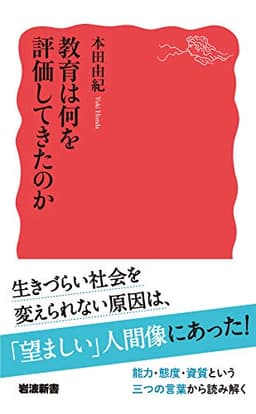
- 教育は何を評価してきたのか (岩波新書 新赤版 1829) (What Has Education Been Evaluating?)(外部サイト、新しいタブで開きます) by Yuki Honda, Iwanami Shinsho, March 2020. A sociologist of education traces what Japanese schooling has tried to measure under the headings of ability, qualities and attitude. Useful for following this article's point — that what gets measured shapes what happens in classrooms — back to its origins.
References
Key Points from the Results of the 2026 National Survey of Academic Achievement and Learning Status — MEXT and National Institute for Educational Policy Research (2026). National Institute for Educational Policy Research
2026 National Survey of Academic Achievement and Learning Status: Reports and Result Materials — NIER Curriculum Research Center (2026). National Institute for Educational Policy Research
National Survey of Academic Achievement and Learning Status — National Institute for Educational Policy Research (2026). National Institute for Educational Policy Research
National academic survey shows weakness in thinking and expression; ministry calls for stronger teaching — NHK NEWS WEB (2026). Japan Broadcasting Corporation
Statistics cited in this article
- 1MEXT and NIER, Key Points from the Results of the 2026 National Survey of Academic Achievement and Learning Status(August 2026) Open source