
The Linear-Shizuoka Agreement Now Carries a Clause to Halt the Work — How a Century-Old Memory of Water Loss Became Procedure
On July 18, 2026, Shizuoka Prefecture and JR Central signed a nature-conservation agreement for the Linear Chuo Shinkansen, and the only unbuilt section, in Shizuoka, moves toward construction. What matters is the content: a clause to halt the work if something unforeseen arises. This is not the finale of a conflict drama but the result of a century-old memory — the Tanna Tunnel's water loss — transcribed, through a national expert panel, into numbers and procedure like the 30-day rule and the monitoring of 33 streams.
TL;DR
- The July 18, 2026 agreement between Shizuoka and JR Central spells out a clause to halt the work if something unforeseen arises
- This is not the finale of a "state versus locality" drama but the result of a century-old memory — the Tanna Tunnel's water loss — transcribed into numbers and procedure
- A locality's power to halt a national project comes not from abstract political muscle but from the craft of turning a memory of harm into numbers and procedure
On July 18, 2026, Shizuoka Prefecture and JR Central signed a nature-conservation agreement for the Linear Chuo Shinkansen. The agreement spells out a halt clause: if something unforeseen arises, the work is to be stopped for a time. This reads less as the finale of a "state versus local pride" drama than as the result of a century-old memory of harm within the same prefecture—the Tanna Tunnel's water loss—being transcribed, through the national expert panel, into concrete numbers and procedure such as the Tashiro Dam 30-day rule and the monitoring of 33 streams.
What Is Happening
The 2026 Shizuoka–JR Central agreement adds a written clause to halt the work — a locality's brake on a national project
A Clause to Halt the Work, Written Into the Agreement
On July 18, 2026, Shizuoka Prefecture and signed a nature-conservation agreement for the Linear Chuo Shinkansen. The Shizuoka section — the only unbuilt stretch between Shinagawa and Nagoya — moves toward construction. Yet when the main tunnel drilling will begin is still undecided.
What to look at is the content of the agreement. At a full session of the prefectural assembly on July 7, Governor Suzuki Yasutomo announced that the prefecture would sign this agreement under its Nature Conservation Ordinance, and said that, written into the agreement, under a monitoring framework, if something unforeseen arises the work is to be stopped for a time to check the cause and consider a response. A nationwide developer has, in writing, acknowledged in an agreement with a local government the possibility of halting the work. It is a concrete institutional answer to the question, "can a locality halt a national project?"
The Governor's Own Words: "Halt the Work Without Hesitation"
The governor's prepared statement puts it in stronger terms still. After work begins, whether the detailed standards on water quality written into the agreement are being met will be managed through regular monitoring, and, he said, it was also agreed that "if an abnormal event occurs, the work will be halted without hesitation and a response grounded in expert knowledge will be taken." Who watches is settled too: a new subcommittee under the prefecture's environmental impact assessment council, with the prefecture, the state, the locality and JR Central working together to monitor how the conservation measures are carried out.
No Station Will Be Built in Shizuoka
The weight of this agreement is easiest to see from where Shizuoka stands. Under the plan the state approved, no station is to be built in the prefecture. The line runs directly beneath the Southern Alps, and the impact on the Oi River's water is the worry. The benefit leaves the prefecture; only the burden stays. The governor himself called this asymmetry a circumstance particular to Shizuoka, and recalled that JR Central's early response fell short, so that the gap in awareness between the developer and the prefecture, the municipalities and the water users became decisive.
Background & Context
Oi River groundwater could escape to Yamanashi; behind the caution is the century-old Tanna Tunnel water loss; talks split into 47 items
How the Water of the Oi River Is Used
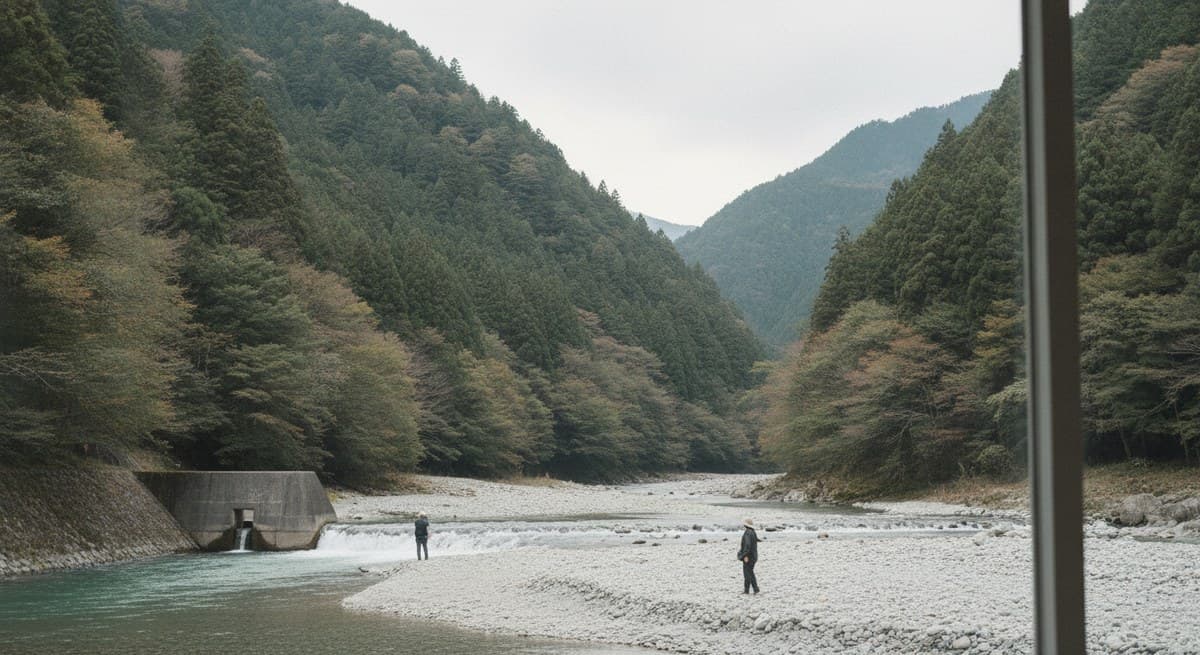
Why was a clause to halt the work needed? The water of the Oi River. Its source is Mt. Ainodake at 3,190m, and its basin covers 1,280 km²; across eight cities and two towns it serves water supply, farming, industry, and power. Its farm water irrigates about 12,000 hectares, including the Makinohara plateau that yields about half the prefecture's tea; in industry, some 400 firms draw groundwater from about 900 wells. Dig the tunnel, and groundwater upstream seeps in and escapes toward Yamanashi. It is not simply that intake falls; water flows out of the prefecture, and the Oi River's flow and water table drop.
A Century Ago, Water Dried Up in the Same Prefecture
But the real reference point of this water problem lies a century ago. In the same Shizuoka, the Tanna Tunnel of the Tokaido Main Line (1918 to 1934) produced huge inflows, and water said to equal three Lake Ashi, 600 million cubic meters, was lost, and the water table fell 130m, down to the level of the tunnel. Along the fault line, springs dried up even far from the tunnel. Wasabi, paddies, and drinking water dried up; 5,000 chobu of paddy are said to have been damaged and 6,000 farmers affected. In the prefecture's own account of it, the heaviest line is the last. Compensation came years after the harm, and the lost water never came back. This memory of water loss a century ago, within the same prefecture, underlies the prefecture's caution.
The State Did Not Judge; It Made Them Close 47 Items One by One
How did the state handle the conflict? In 2020, the , alarmed by the pace of the dialogue between the prefecture and JR Central, set up an expert panel — not an arbitration that judges the dispute. It took up the 47 items of discussion that Shizuoka had built up, under five principles the prefecture required — transparency and neutral members and chair, and, in a form where the state instructs JR Central, closed them one by one. On water resources it took the first thirteen meetings, about a year and eight months, to reach an interim report; on environmental conservation the work ran from the fourteenth meeting to a report in December 2023. The monitoring role then passed to a Monitoring Council and continues today.
Even after the interim report, the prefecture did not step back. Taking up the report's line that returning tunnel water only after construction would not amount to returning all of it, the prefecture submitted its view in January 2022 and had direct dialogue with JR Central resumed. The demand was not that the books balance once the tunnel is finished, but that the water be returned while the digging goes on.
44 Meetings of the Prefecture's Panels, Over 300 Working-Level Talks
The sheer volume of dialogue is what backs this agreement. The prefecture's two expert subcommittees, which the state also joined, met 44 times before dialogue closed in March 2026. Since December 2023, working-level talks with JR Central have passed 300. Residents' briefings were held 22 times between May 26 and June 22, 2026, drawing 1,137 people. The governor said he weighed two things — how far the explanation to residents had gone, and how far the procedures under the River Act and the Fill Regulation Act had progressed — before judging that the stage for signing had arrived.
Reading the Structure
Institutional design, not a drama; a memory of harm becomes the 30-day rule and 33-stream monitoring, letting a locality match the project
The Conflict Was Converted Into Closeable Items
Linear-Shizuoka has been told as a drama of "the state versus local pride." But read the primary sources and the reality is institutional design. By having the state examine, in a neutral panel, the items the prefecture had built up, the conflict between asymmetric parties was converted, rather than left as raw emotion, into a set of closeable items.
The Memory Was Transcribed Into 30 Days and 33 Streams
And the memory of the Tanna Tunnel was transcribed into concrete numbers and procedure: the 30-day rule — if, even with restricted intake at the Tashiro Dam, the same volume as the out-of-prefecture outflow cannot be secured for 30 days, a halt to drilling is considered — and the monitoring of 33 streams. Those 30 days are three operating cycles. The Southern Alps is a rare ecosystem designated a , where the DNA of the Akaishi salamander, listed as critically endangered, has been detected. Eight streams where flow is projected to fall are surveyed upstream first, 11 were selected once control streams are counted, and capture surveys run in two streams in fiscal 2026. Not an abstract pledge to protect nature, but which stream, when, and how it will be examined.
The Burden of Proof Is Not Placed on Residents
The transcription into numbers and procedure goes beyond monitoring. On January 24, 2026, the prefecture and JR Central exchanged a written confirmation on what happens if water use is affected. The transport ministry's administrative vice-minister signed as a witness. Its four clauses read as an answer to what happened at the Tanna Tunnel.
If water use is affected, JR Central is to take measures to restore function, and where that alone will not do, to bear the cost as compensation. That much is close to the usual frame. The other two go further. No deadline or ceiling is set in advance on when claims may be made or what period they cover. And proving the causal link between the work and the harm is not asked of the people of the basin, or of the prefecture. JR Central is to set up a route to expert opinion and investigate promptly.
That victims go unhelped unless they can prove causation is a pattern Japan's history of industrial pollution has repeated. At Tanna, compensation came years later and the lost water never returned. A century on, the document reverses that order.
Conditions for the agreement under the prefectural ordinance
The prefecture’s decision was subject to conditions in its ordinance. Under the Nature Conservation Ordinance that the agreement rests on, where permits are required under related laws, those permits must be "reliably expected." The prefecture has read that as meaning prior consultation is finished and applications have been filed. Here the River Act and the Fill Regulation Act applied, and it was the filing of those applications, dated July 3, 2026, that let the prefecture judge the procedures complete. Put the other way: until those applications were filed, the agreement was not signed. The national project also required procedures under the prefectural ordinance.
So a locality's power to halt a national project is not abstract political muscle. It is won by the craft of turning a century's memory of harm into numbers and procedure. The former governor's words, "not a single drop," paid the cost of the conflict, and his successor, Governor Suzuki, settled its fruit as an institution. Conflict and cooperation worked, dividing the roles between them.
This institutional craft is not the Linear's alone. Turning a conflict into closeable items and procedure is akin to designing a participatory policy-making process(このサイトの記事). Conflicts between asymmetric parties — restarting nuclear plants, military bases, siting renewable energy — can be turned, rather than left as raw political emotion, into closeable items, numbers, and procedure. The halt clause is one example. A locality can stand on equal terms with a nationwide project when it has turned the memory of harm into a procedure the next generation can use.
Further Reading
- リニアは南アルプスをくぐり抜けることができるのか リニア中央新幹線ダークツーリズムガイド (Can the Linear Pass Through the Southern Alps? A Dark-Tourism Guide to the Linear Chuo Shinkansen)(外部サイト、新しいタブで開きます) (Mitsuru Munakata, Yama-Kei Publishers, November 2025) — an author who moved to Ohshika Village in Nagano, at the mouth of the Southern Alps tunnel, walks the site as a mountaineer and villager and records the light and shadow of the Linear in photographs. (In Japanese.)
References
Response to Environmental Impacts of Linear Chuo Shinkansen Construction — Shizuoka Prefecture (2026). Shizuoka Prefecture, Department of Living Environment
A Case of Water Depletion in Another Tunnel Project (the Tanna Tunnel) — Shizuoka Prefecture (2023). Shizuoka Prefecture, Department of Living Environment
Confirmed Items on the Response Should Water Use Be Affected by the Southern Alps Tunnel Works of the Chuo Shinkansen — Shizuoka Prefecture, JR Central and MLIT (2026). Shizuoka Prefecture, Department of Living Environment
Governor's Statement to the Full Session of the Prefectural Assembly, July 7, 2026 — Shizuoka Prefecture (2026). Shizuoka Prefecture
On the Expert Panel Concerning the Shizuoka Section of the Linear Chuo Shinkansen — Ministry of Land, Infrastructure, Transport and Tourism (2024). MLIT, Railway Bureau
Chuo Shinkansen: Environmental Conservation — Central Japan Railway Company (JR Central) (2026). Central Japan Railway Company
Statistics cited in this article
- 1Shizuoka Prefecture, Response to Environmental Impacts of Linear Chuo Shinkansen Construction(July 18, 2026) Open source
- 2Shizuoka Prefecture, Record of Dialogue on Water Resources(2026) Open source
- 3Shizuoka Prefecture, A Case of Water Depletion in Another Tunnel Project(1918-1934) Open source
- 4Shizuoka Prefecture, Summary of the National Expert Panel and Monitoring Council(2020) Open source
- 5Shizuoka Prefecture, Record of Dialogue on Water Resources(2025) Open source
- 6Shizuoka Prefecture, Record of Dialogue on Biodiversity(2025-2026) Open source
Questions to Reflect On
- In a large project in your area, is a mechanism to halt the work when something unforeseen arises secured in writing and procedure
- What does it take to turn an asymmetric state-local conflict, rather than leave it as raw political emotion, into closeable items
- Who, and how, carries a century-old memory of harm into numbers and procedure the next generation can use
Key Terms in This Article
- UNESCO Eco Park (Biosphere Reserve)
- The Japanese name for a UNESCO-designated Biosphere Reserve, an area that seeks to reconcile ecosystem conservation with sustainable local development. The Southern Alps is one such reserve, structured in three zones: core, buffer, and transition.
Related Content
After an AI bear alert, who handles checks and safety measures?
AI-camera trials and the decisions, responsibility and costs of emergency shooting in Japan
Bear Injuries Hit a Record 216 in Japan — Depopulation Has Emptied the Hands That Tended the Boundary
By Japan's Environment Ministry, bear-inflicted injuries hit a record 216, with 13 deaths, in FY2025, and sightings reached 50,801, 2.1 times FY2023. But a poor nut crop is only the trigger. Depopulation has drained the hands that tended the satoyama; abandoned farmland is turning, in quality, back into forest; and the buffer between people and the wild is dissolving from within. This reads not culling versus coexistence, but the vacancy of who manages the boundary.
Kumamoto's Car Society Cannot Be Solved by Roads — Transit's Downward Spiral and Planning Backward from Where People Live
Congestion is worsening in the Kumamoto urban area, where semiconductor industry is concentrating. The Kumamoto Urban Area Person Trip Survey shows the car's mode share rising from 59.3% in 1997 to 67.3% in 2023, while the transit share fell to 5.2%. Yet total travel has fallen to 0.85 times its 2012 level, so congestion cannot be explained by the volume of traffic across the urban area. Adding roads does not clear congestion; in an expressway toll-free trial, traffic rose about 79%. This reads the downward spiral in which driver shortage leads to cuts, fewer riders, unprofitability, and withdrawal, and points to reconnecting where people live with transit by working backward, rather than widening roads.
Does Implementation Under Way Mean a Transport Gap Is Resolved?
Japan’s transport-law amendment scheduled for 16 October, the 15 May district counts, and usable bookings and round trips.
Previous
While a Work-Injury Claim Waits, Nothing Bridges the Bereaved — Six-Month-Plus Backlog Doubled to 2,329 in Five Years
Next
Ten Riot Police, Twenty Minutes, a House That Had Not Collapsed — False Rescue Requests Went from 1 in 573 to 104 in 1,091
Get new columns by email
1-2 social structure analysis columns per week. Free to subscribe.
Join ISVD's activities?
Sign up to receive the latest research and activity reports. Feel free to reach out about collaboration or project participation.
Support ISVD’s research and activities
Support ISVD’s research and publications with JPY5,000 per year. There is no automatic renewal.