
What Does Japan's 74.4% School Reuse Rate Count?
MEXT's May 2024 survey, school counts, multiple-answer use entries and the costs and conditions for using individual facilities.
What does Japan’s 74.4% closed-school reuse rate count? Separate school totals, multiple-answer use entries and listing dates, then examine local costs, conditions of use and community outcomes.
TL;DR
- The 74.4% rate describes schools with facilities remaining on May 1, 2024.
- School counts and multiple-answer use entries cannot establish a private-business market.
- Move from national statistics to current listings, local use conditions and life outcomes.
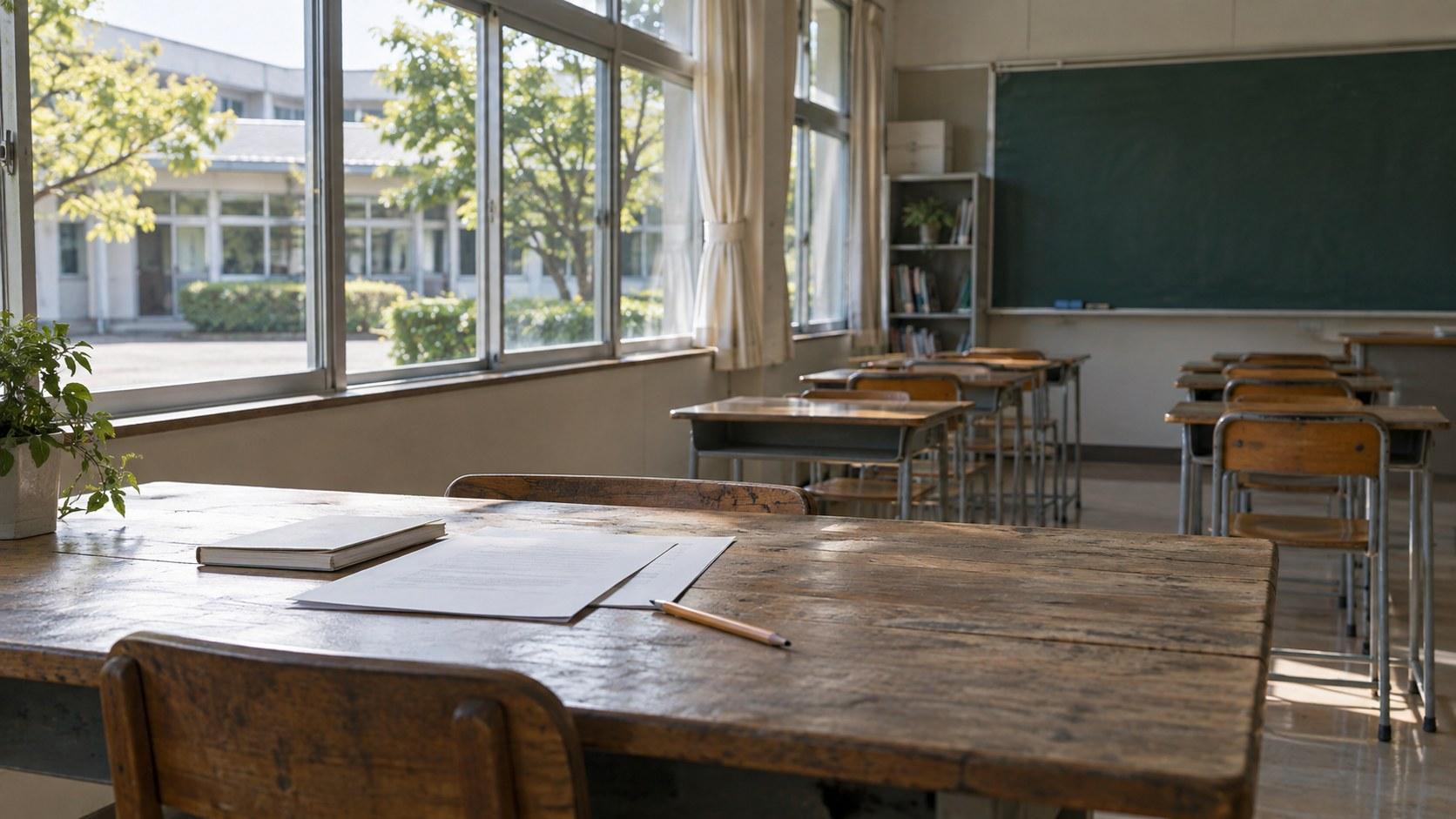
The cover is an AI-generated conceptual image. It is not a photograph of a surveyed closed school or an actual reuse project.
This article explains public statistics and does not provide individual legal or property-investment advice. Consult a qualified legal professional about a particular legal judgment.
What Is Happening
The 74.4% rate describes schools with facilities remaining on May 1, 2024.
Reading the rate through its definition
A figure of 74.4% for the reuse of closed schools provides a starting point for considering buildings left in a community. Without knowing what is counted, however, readers may treat use of a building as evidence that a business is profitable or residents' lives have improved.
Japan's Ministry of Education, Culture, Sports, Science and Technology (MEXT) published its survey on March 31, 2025. Its reference date was May 1, 2024; the figures do not measure conditions in 2026. It covered public elementary, junior high, compulsory education, senior high, secondary education and special needs schools across Japan.
There were 8,850 school closures during fiscal years 2004 to 2023, with facilities still present at 7,612 schools. Of those 7,612 schools, 5,661, or 74.4%, were in use. The rate is calculated using the number of schools whose facilities remained, rather than the cumulative number of closures.
The 1,951 schools not in use also had different statuses. A use had been decided for 235, no use had been decided for 1,503, and demolition was planned for 213. They cannot all be described as buildings without a purpose or properties waiting for an operator.
The reported 19.7% for undecided use likewise means 1,503 out of the 7,612 schools with facilities remaining. It does not mean 19.7% of the 1,951 unused schools. Omitting the base can leave readers imagining different school totals from the same percentage. Reporting a rate should retain the counts it compares.
Deciding a use and starting to use a building are different stages. Even where a facility is in use, the school count does not reveal which buildings are used, how much space is occupied or who pays the costs. The national rate describes facility status; it does not evaluate a community's business plan.
Surveys and listings have different dates
MEXT's lists both closed-school and surplus-classroom materials. Recent publication does not mean their subjects and reference dates match. The date of reading, date of publication and date of measurement should be kept separate.
The list of closed-school facilities seeking proposed uses, by contrast, is dated November 1, 2026. It provides later listing information than the national survey. That does not mean all 1,951 unused schools are listed, and the current conditions of a listed facility still require direct confirmation with its municipality.
Background & Context
School counts and multiple-answer use entries cannot establish a private-business market.
School counts and use counts differ
The survey lists major uses such as schools, sports facilities and corporate facilities. Its use table, however, does not count the same thing as the school totals. It records school buildings and indoor sports facilities separately and allows multiple answers on uses.
For example, the 4,191 entries for schools excluding universities combine 2,110 school-building entries and 2,081 indoor-sports-facility entries. The 1,207 entries for corporate and startup-support facilities similarly combine 789 school-building entries and 418 indoor-sports-facility entries. Counts of schools and counts of uses cannot be compared as lengths of the same bar.
Schools with facilities remaining
- Unit counted
- Schools
- Facilities still present
- 7,612 schools
- Facilities in use
- 5,661 schools
Entries by type of use
- Unit counted
- Multi-answer
- Schools excluding universities
- 4,191 entries
- Corporate and startup support
- 1,207 entries
Prepared by the author using the status and use tables published by MEXT on March 31, 2025. The right panel combines multiple-answer entries for school buildings and indoor sports facilities. Subtracting these from school counts cannot establish privately operated school totals or market size.
Consider a hypothetical closed school whose main building is used for learning and whose indoor sports facility is used for exercise. Multiple uses do not mean multiple schools. This is an illustration of counting, not an observed case. Without school-level combinations in the table, use totals alone also cannot reconstruct how many schools have a particular single use.
Calculating a private-business market by subtracting the school-use share from the use table overlooks this difference. A use label also does not identify whether the owner or operator is public or private. Understanding who carries out an activity requires the individual contract and actual scope of operation.
It is possible to envisage a partial use that supplies a function the community lacked. Conversely, extensive use of floor space may still leave some people unable to participate because of opening hours or prices. The extent of use should be examined alongside the role expected of the place.
Reasons for non-use can overlap
The survey asks separately about school buildings and indoor sports facilities where a use has not been decided. For school buildings, 41.5% of responses indicated no requests from the local community or others, and 41.4% indicated aging buildings. Similar percentages do not describe two separate groups of schools.
The uses 2,177 school buildings as its base and allows multiple answers. The same building may be associated with both a lack of requests and aging. Adding the percentages cannot establish a share of all schools, nor show that repairs would generate requests.
Rankings of aging and financial reasons should not alone determine the order of measures. One possible process is to estimate needed repairs and investigate whether people still wish to use the building under those conditions. If the desired activity is known first, repairs could instead be considered for the parts it needs. National responses do not establish which sequence suits a particular facility.
A response reporting no requests is not equivalent to having established that every resident lacks a desired use. How views were sought and whether feasible conditions were explained need to be investigated individually. The national table alone also cannot establish insufficient dialogue as a cause of non-use.
Similar percentages can come from different surveys
Comparisons with earlier rates require care. The previous survey in 2021 covered schools closed during fiscal years 2002 to 2020, so its coverage period differs from the current survey. A change in the rate cannot be presented as tracking the same schools or as the effect of a particular policy.
Regional comparisons should also examine differences in time since closure and the range of buildings remaining. Inferring stronger operating capability solely from a higher rate would omit site conditions. Examining how individual schools move from undecided use to a decision and then opening requires separate records that track the same subjects.
The surplus-classroom survey with a May 1, 2025 reference date found that 72,902 of 74,138 rooms, approximately 98.3%, were in use. Its subjects were classrooms in public elementary, junior high and compulsory education schools. Ignoring the differences in units and dates cannot establish whether closed-school reuse or surplus-classroom use performs better.
Surplus-classroom use includes learning and pupils' daily activities within the same school. Opening a building for a community business is not the only meaning of use. Comparisons between surveys need to return to the specific activities included in their definitions.
Reading the Structure
Move from national statistics to current listings, local use conditions and life outcomes.
Moving from national tables to site conditions
National statistics describe conditions and response patterns across the survey population. When considering a particular school, the next questions are whether it is still seeking proposals and which areas can be used for how long. Conditions seen in a listing may differ from those available when a contract is signed.
MEXT's warns that details may change and recruitment may already have ended. The rate and listings can help identify facilities. Subsequent decisions need to move to the site and current documentation.
Subjects of the national survey
- Date and coverage
- Survey scope
- Schools or facility responses
- Count units
- Uses and reasons for non-use
- Responses
Subjects to check at a particular facility
- Buildings and hours available
- Use terms
- Maintenance, repairs and closure
- Costs & roles
- Changes for people using it
- Life outcomes
The author uses MEXT's survey and listing page to organize checks for decision-making. The right panel proposes evaluation subjects; it does not describe outcomes measured by the national survey or achieved by individual projects.
For a proposal to use one classroom, for example, the cost of opening that room should be considered separately from maintaining the whole building. Confirming refurbishment costs alone leaves questions about who handles repairs during use and clearing up when it ends. The national rate cannot allocate those responsibilities to users or the municipality.
Applicable procedures concerning buildings or disposal of public property should not be decided from the use label alone. Current original documents and confirmation with the responsible authority are needed to establish conditions. Even when both projects start from a school, different intended uses and included facilities change what must be checked.
Connecting requests with conditions for participation
One approach to seeking views is to ask about intended activities and usable conditions, as well as desired facility names. For people wishing to attend after work or household tasks, opening hours matter. For those needing transport, the method and burden of travel also need consideration.
These are questions proposed for individual investigation, rather than resident difficulties established by the national survey. A request for a gathering place, for example, can involve different expectations about frequency and costs. Understanding those differences before providing a building can inform the choice of use.
There is no need to promise that one school building can meet every request. Supporting an activity in an existing place can be compared with maintaining a new site. It is useful to consider how the person receiving requests can explain what was examined and which conditions made an option difficult.
Keeping responsibility for review after opening
Evaluation after use begins can ask whether the intended activity can continue, alongside visitor totals. Repeat visits by the same people could be distinguished from new participants. An increase in attendance alone, however, does not establish reduced isolation or improved employment.
Activities and evaluation periods could be specified in advance. Selecting only activities whose attendance later increased risks losing sight of the people originally intended to benefit or activities that did not continue. Unconfirmed conditions should remain unconfirmed, rather than be assigned to success or failure. If the purpose changes, recording why can inform the next decision.
Cost review could also examine whether repairs are being postponed or burdens are increasing for the people supporting activities. Opportunities to reconsider use can be provided when users' circumstances change. The proposal is to identify who will review conditions after opening and when decisions will be updated.
Reference Books
廃校再生ストーリーズ(外部サイト、新しいタブで開きます), descriptively rendered here as Stories of School Reuse, is a Japanese book published in 2018. The publisher distinguishes the credits for planning, composition and design from the editing credit. The 20 cases described in the publisher's introduction(外部サイト、新しいタブで開きます) offer a reading starting point for considering uses. The book's main text has not been read for this article, and it is not cited as verification of the facilities' current operation or effects. The book link is an Amazon Associates advertising link.
Related Guides
Remaining Questions
Ask about needed functions, non-use decisions and review of local costs and participation.
The national rate is a starting point for considering closed-school reuse. The next local questions concern which part is used, by whom and for what purpose. Is retaining the whole school building the same as retaining a needed function? Before setting a floor-area target, intended activities and practical hours and travel conditions should be examined. Can those differences be shared from the listing and discussion stages onward? Where preferred activities conflict with travel or available hours, can the staff gathering views also respond with options for support elsewhere? Agreement with preserving a building should not be recast as a statement that the respondent can use that location.
A decision not to use a building still leaves a need for explanation and subsequent work. Comparing support for activities elsewhere with a choice not to maintain the building requires clarity about the options and costs included. Does a project begun to raise the reuse rate obscure future repairs or closure burdens? Who will check those responsibilities and reconsider the conditions under which use can continue? Rather than reducing non-use to a single reason, can the comparison show who would pay and the conditions of people wishing to continue the activity? Responsibility for updating that comparison when conditions change also deserves consideration after an explanation has been given.
How will changes in people's lives be examined after opening? Attendance and participation by those who needed the activity can be considered separately. Reasons for stopping use and conditions that discourage participation also deserve attention. Recording locally the voices and costs absent from national tables, and returning to those observations, is a further task in connecting building use with community life. Could the findings be returned to users and people unable to participate, showing what could actually be changed? Keeping unanswered questions visible and choosing the next scope of inquiry would also form part of that work.
References
FY2024 Survey on the Use of Closed Public School Facilities — MEXT (2025). MEXT
Survey Index: Closed-School Facilities and Surplus Classrooms — MEXT (Accessed November 4, 2026). MEXT
FY2025 Report on the Use of Surplus Classrooms in Public Schools — MEXT (2026). MEXT
List of Closed-School Facilities Currently Seeking Proposed Uses — MEXT (As of November 1, 2026). MEXT

Statistics cited in this article
- 1MEXT FY2024 Survey of Closed-School Facility Use(As of May 1, 2024) Open source
- 2MEXT FY2024 Survey of Closed-School Facility Use, use table(As of May 1, 2024) Open source
- 3MEXT FY2024 Survey of Closed-School Facility Use, reasons table(As of May 1, 2024) Open source
- 4MEXT FY2025 Report on the Use of Surplus Classrooms in Public Schools(As of May 1, 2025) Open source
Questions to Reflect On
- Are school totals being combined with multiple-answer use entries?
- Who will review costs and conditions for participation after opening?
- Have the listing date and the municipality's current conditions been checked?
Related Content
Zentsuji's electronic voting: how can voters who cannot read the screen check a choice?
About braille and assisted voting, completion audio, candidate confirmation and trial evidence, using the August 30, 2026 election and materials checked through October 6
Does Implementation Under Way Mean a Transport Gap Is Resolved?
Japan’s transport-law amendment scheduled for 16 October, the 15 May district counts, and usable bookings and round trips.

Japan Lost 215 Primary Schools in a Year, and the Average School Still Got Smaller — From 315.7 Pupils to 312.4
Final figures from Japan's FY2025 School Basic Survey put primary schools at 18,607, down 215 on the year, with 5,812,375 pupils, a fall of 129,358 and the lowest on record. Closing 215 schools still left the average school smaller, down from 315.7 pupils to 312.4. The four-kilometre commuting standard used to judge mergers sits in a 1958 ordinance; a 2015 ministry guide laid a one-hour travel-time benchmark on top of it.
Japan's Scheme for Handing Inherited Land to the State Transferred 3,008 Plots in Three Years and Three Months — More Were Withdrawn (1,102) Than Refused (181)
Statistics published by Japan's Ministry of Justice show that of 5,863 applications to hand inherited land to the state up to 31 July 2026, 3,008 were accepted. Against 85 rejections and 96 refusals, 1,102 applications were withdrawn, and 392 of those were pulled after the applicant learned the land would not qualify. This piece reads which column a refusal shows up in.
Get new columns by email
1-2 social structure analysis columns per week. Free to subscribe.
Join ISVD's activities?
Sign up to receive the latest research and activity reports. Feel free to reach out about collaboration or project participation.
Support ISVD’s research and activities
Support ISVD’s research and publications with JPY5,000 per year. There is no automatic renewal.