
Who verifies the population counted in Japan's census?
Separate publication dates, evidence of usual residence, response-method rates and post-enumeration verification in Japan's 2025 Population Census.

TL;DR
- The publication date differs from the date on which population is measured.
- Response-method rates do not measure how completely people were counted.
- Post-enumeration surveys and reviews of processing records verify different things.
This AI-generated conceptual image depicts a fictional workspace, not an actual census operation, university, person or private record.
This article provides general information from public documents, not individual legal or privacy advice. Check specific decisions with the responsible authority or a qualified professional.
What Is Happening
Separate reference dates, published counts and scheduled verification findings.
On September 29, 2026, Japan’s Statistics Bureau released the basic tabulation on population and households from the 2025 Population Census. The reference time was midnight at the start of October 1, 2025. These are not counts of residents on the publication date. Preliminary population results had been released on May 29, 2026, providing an earlier account of the same reference date. The Bureau’s and survey outline(外部サイト、新しいタブで開きます) distinguish when the population was measured from when the results became available.
A separate post-enumeration survey examined how the census had identified its target population. According to its , its reference date was November 20, 2025, and it covered approximately 800 statistically selected enumeration districts. The survey announcement(外部サイト、新しいタブで開きます) records its completion on December 26, 2025. The outline schedules publication of the results by the end of December 2027. Completion of survey operations and publication of findings are separate stages; that schedule does not establish how far analysis has progressed today.
A census also determines where a person belongs in the count and what evidence supports including them there. Publication of a population table does not, by itself, establish that every local identification process worked adequately. Population results, response methods and verification of population coverage need to be read separately.
- Reference dateMain census reference date (00:00)
- Reference datePost-enumeration reference date: approximately 800 selected districts
- Operations endedEnd of post-enumeration operations recorded in the announcement
- Results releasedRelease of preliminary population results
- Results releasedRelease of the basic population and household tabulation
- Scheduled; delivery unverifiedScheduled publication of post-enumeration results
Rows show sequence, not elapsed time. A publication schedule does not establish the current completion of analysis. Approximately 800 refers to districts, not people or households.
Sources, checked Nov 4, 2026: Publication notices / Main census / Post-enumeration outline / Completion announcement
Background & Context
Distinguish usual residence, response routes and coverage.
Census population is not simply a count of people at their registered addresses. The Bureau’s guidance on where people are counted(外部サイト、新しいタブで開きます) uses usual residence on October 1, irrespective of the address on a resident registration. The general rule concerns a place where someone has lived, or expects to live, for at least three months. Students living in dormitories or boarding accommodation are counted there even if they visit their family home on census day. Physical presence on that particular night and usual residence need not coincide.
A difference between census population and the Basic Resident Register therefore does not, on its own, measure error or misconduct. If a person’s registered address differs from their usual residence, the two sources can place that person in different areas. A discrepancy can identify something worth examining, but establishing the appropriate count requires checking definitions, reference dates and evidence about residence. Matching an existing register and investigating living arrangements are different tasks.
Enumerators carry out the local identification work. The Bureau’s description of their duties(外部サイト、新しいタブで開きます) includes checking residence, distributing documents and checking submission status after the deadline. Households can respond online, by post or through an enumerator. Its guidance on response methods(外部サイト、新しいタブで開きます) explains that online and postal responses go directly to the Ministry of Internal Affairs and Communications. The organisation checking who lives locally is not identical to the route by which questionnaire answers arrive.
The survey outline(外部サイト、新しいタブで開きます) also describes questioning people other than household members when absence or similar circumstances prevented the usual response methods. This provides a way to identify residents without obtaining answers directly from them. It also makes the basis for the count important: who supplied information, and what did that information establish? Receiving no response and establishing that nobody usually lives at an address are different findings. Distributing a questionnaire does not itself prove that a usual resident lives there.
Response-method rates also require careful interpretation. The prefectural response table(外部サイト、新しいタブで開きます), posted on September 29, reports nationwide online responses at 47.4% and postal responses at 33.0%. The denominator is the 57,324,619 households in the basic tabulation; the respective response counts are 27,149,428 and 18,905,587 households. These are not percentages of people, and the table does not cover every response method. Without accounting for submissions through enumerators and other processes, the portion outside these two categories cannot be labelled people missing from the census.
The Bureau’s notes on using the results(外部サイト、新しいタブで開きます) introduce another distinction: unless stated otherwise, percentages in statistical tables exclude unknown values from their denominators. An attribute distribution calculated after excluding unknown values and a response-method rate based on the basic household count concern different statistical populations. Checking units and denominators helps prevent a calculation convention from being mistaken for a difference in residents’ behaviour or administrative performance.
Denominator: 57,324,619 households in the 2025 basic tabulation. Rates use the source’s one-decimal values.
Each full bar represents 100%; the two rates are shown separately.
Online: 47.4% — 27,149,428 households
Postal: 33.0% — 18,905,587 households
These rates concern households, not people. The source table covers online and postal responses, not all routes such as submissions through enumerators. The bars are not added to calculate population coverage, and the remainder is not labelled uncounted population.
Source: national row of the prefectural response table, checked Nov 4, 2026
Reading the Structure
Separate consistency checks, sampling and reviews of residence decisions.
Before tabulation, the National Statistics Center checks questionnaire contents. The survey outline(外部サイト、新しいタブで開きます) describes the National Statistics Center entering and coding data, checking missing values and inconsistent entries, and making necessary supplementary corrections before tabulation. This is important work on the consistency of recorded answers. Consistent entries alone, however, cannot establish the evidence for deciding who actually lived at a particular address. Checking questionnaire contents and identifying the target population support different parts of the census.
The post-enumeration survey examines identification through a different operational route: the Statistics Bureau, a contracted survey operator and households, rather than the main census’s chain involving prefectures and municipalities. Its Q&A(外部サイト、新しいタブで開きます) describes gathering information about who answered, response methods, absence and differences between registered addresses and usual residence. Conducting it soon after the census helps preserve respondents’ recollections and limit complications from subsequent moves. A different operational route does not, by itself, establish that the verification body is independent of government.
The approximately 800 units are enumeration districts, not people or households. This is a survey of selected areas, not a second inspection of every address in Japan. Assessing population coverage across the country and tracing a particular decision in a particular locality are distinct inquiries. Sample size alone does not establish equal precision for every municipality or demonstrate an ability to detect every individual instance of improper processing.
Public administrative guidance also addresses how statistical processes can be examined. The guidelines for maintaining and improving official statistical quality(外部サイト、新しいタブで開きます), adopted in 2020 and revised on July 28, 2023, list information useful to users: response rates and their calculation methods, differences between preliminary and final results, differences in definitions across statistics, and corrections to published figures. This is an existing framework, not a policy newly announced in response to the present news cycle. The conditions behind a figure, and the ability to identify its corrections, are part of assessing statistical quality.
The following is a proposal for considering improvements. When an assessment of residence or household size changes, records could make it possible to trace the previous assessment, the revision, additional evidence, the decision-maker and the reviewer. The purpose would be to distinguish justified corrections from unsupported changes, rather than simply minimise revisions. Avoiding supplementary corrections that resolve missing values or inconsistencies could leave people who are difficult to identify out of the count. Treating a high number of revisions as evidence of poor practice could also disadvantage places that perform more follow-up checks.
Whether all such records should be public is a separate question. The Bureau’s confidentiality guidance(外部サイト、新しいタブで開きます) explains that questionnaire information is protected and is not used for purposes such as tax collection. A design could separate published verification findings from individual records accessible to authorised reviewers. Reporting categories of reasons, processing counts and the scope that could not be verified might permit useful explanations without broadly exposing addresses or household circumstances. Its effectiveness, and the risk of identifying individuals indirectly, would still need testing against actual records and local conditions.
Census figures also support other surveys. The Bureau’s explanation of census uses(外部サイト、新しいタブで開きます) describes small-area statistics informing the design of the Labour Force Survey and Family Income and Expenditure Survey. Verifying population quality is therefore more than checking one municipality’s total. Social design must also consider how verification findings reach the people who use those figures in later statistics and decisions.
Related Reading
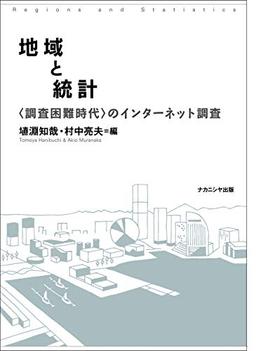
地域と統計 = Regions and Statistics : 〈調査困難時代〉のインターネット調査(外部サイト、新しいタブで開きます), edited by 埴淵知哉 and 村中亮夫 (Nakanishiya Publishing, 2018), is related reading on how surveys capture a population. The publisher’s public introduction and contents(外部サイト、新しいタブで開きます) address survey response, unspecified census information and the representativeness of internet surveys. The full book has not been read; this description is limited to public bibliography, introduction and contents. It does not substantiate the 2025 census figures or individual residence decisions, which require the official records discussed in the article.
This section contains Amazon Associate links.
Guide to reading statistics and public data(このサイトの記事)
Remaining Questions
Compare visits, record checks and registers while protecting confidentiality.
The public documents examined here do not establish the detailed arrangements for reviewing a changed residence assessment: who checks its evidence at national, prefectural or municipal level, and which records are retained. Counts by reason for revision, and the share of decisions whose evidence could not be verified, also remain unconfirmed. A publication schedule for the post-enumeration results does not establish the current extent of completed verification.
Additional visits require household time, staffing and funding. Reviewing existing processing records could reduce repeat visits, but cannot reconstruct a decision if its original evidence was not adequately recorded. Comparing the Basic Resident Register could help select cases for examination, provided differences between registered and usual residence are not automatically treated as errors. Combining these approaches requires specifying which kind of uncertainty each is intended to resolve.
If an improvement were piloted, the Bureau and municipal statistical staff could sample changed residence assessments and test whether the previous and revised decisions, evidence and reviewers can be traced. Researchers could examine published sampling methods and usage notes, separating findings about inspected records from conclusions supportable at national level. The aim would be to identify where decisions remain unexplained and use those findings to revise record formats, training and review responsibilities, alongside assessing publication speed.
References
The following public primary sources from the Statistics Bureau were checked on November 4, 2026. Publication dates, survey reference dates, the guideline revision date and scheduled releases are distinguished in the text.
- 2025 Population Census: publication notices(外部サイト、新しいタブで開きます)
- Main census outline(外部サイト、新しいタブで開きます)
- Q&A: population and place of enumeration(外部サイト、新しいタブで開きます)
- Enumerator duties(外部サイト、新しいタブで開きます)
- Q&A: response methods(外部サイト、新しいタブで開きます)
- Response-method table: national row(外部サイト、新しいタブで開きます)
- Notes on using the results(外部サイト、新しいタブで開きます)
- Post-enumeration survey announcement(外部サイト、新しいタブで開きます)
- Post-enumeration survey outline(外部サイト、新しいタブで開きます)
- Post-enumeration survey Q&A(外部サイト、新しいタブで開きます)
- Statistical quality guidelines, revised in 2023(外部サイト、新しいタブで開きます)
- Confidentiality guidance(外部サイト、新しいタブで開きます)
- Census framework and uses(外部サイト、新しいタブで開きます)
2025 Population Census: publication notices — Statistics Bureau of Japan (2026). Statistics Bureau of Japan
2025 Population Census response methods: online and post — Statistics Bureau of Japan (2026). Statistics Bureau of Japan
Guidelines for maintaining and improving official statistical quality through PDCA — Statistical Administration Promotion Council (2023). Statistical Administration Promotion Council
Questions to Reflect On
- Are response methods distinguished from coverage?
- Who verifies changes in residence assessments?
- How are private records separated from public findings?
Related Content

After Fill Removal, How Can the Public Verify Cost Recovery?
Historical records from Atami distinguish soil removal from recovery of its cost. Earlier action under a prefectural ordinance must be distinguished from the national law introduced later. The article proposes linking work, order and accounting records for matching cases and reporting dates.
What Should a Garbage Bag Charge Pay For? Lessons from Nanae
Public documents from Nanae illuminate the difference between bag prices and treatment charges, and the relationship between waste reduction, funding and service continuity.

Digital Society Vision Council, 12th Meeting (May 22, 2026) — Briefing on the Next Priority Plan and ISVD's Reading
A briefing on the 12th meeting of Japan's Digital Society Vision Council (Digital Agency, held May 22, 2026), with materials submitted by two local government heads (Miyakonojo City, Yamaguchi Prefecture) and one industry leader (Rakuten). ISVD reads the agenda against its own scope of social vision design.

Reading the 85.6% estimate for digital high-school admissions
The November 4 update to Shizuoka's admissions pilot reports modeled workload savings, not measured overtime reductions. Separate actual participant counts, assumed task times, paper exceptions and coordination work before evaluating the result.
Get new columns by email
1-2 social structure analysis columns per week. Free to subscribe.
Join ISVD's activities?
Sign up to receive the latest research and activity reports. Feel free to reach out about collaboration or project participation.
Support ISVD’s research and activities
Support ISVD’s research and publications with JPY5,000 per year. There is no automatic renewal.