
Do Selected Recycled-Plastic Studies Mean Hubs Are Already Operating?
Japan’s 2026 feasibility studies and FY2027 budget requests, alongside quality, inventory and purchase conditions for regional supply.
Examine recycled-plastic hubs through feasibility studies, budget requests and actual supply. Connect regional recovery networks with application quality, inventory, purchasing and responsibility.
TL;DR
- Separate study selection, requests and actual operation
- Examine aggregation built on regional treatment networks
- Connect quality, stock and purchasing with design and evaluation boundaries
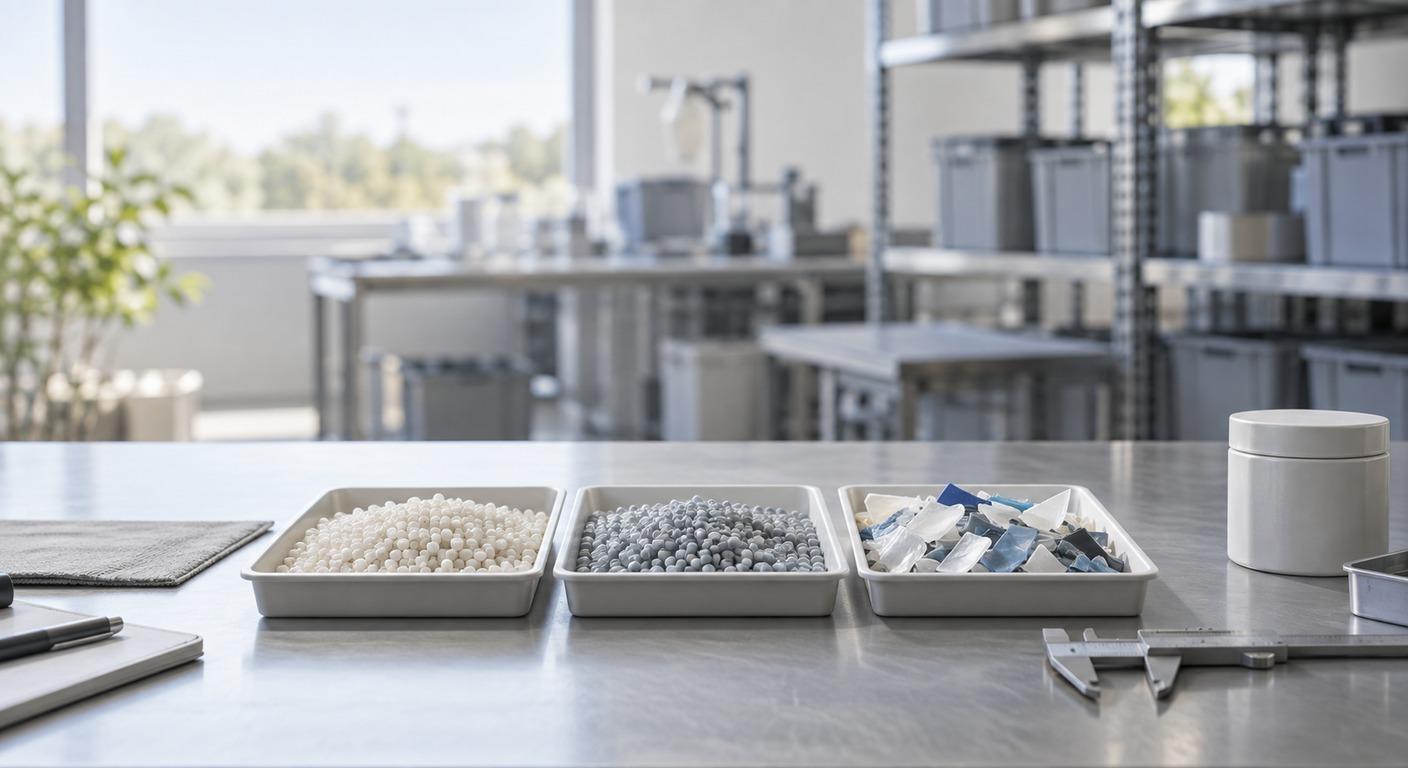
The header is an AI-generated conceptual image of a fictional materials-inspection workspace. It is not a photograph of a real factory or a selected project facility.
What Is Happening
Connect hub proposals with material flows and responsibilities
Communities collect used plastic, and manufacturers use recovered material in new products. Between those activities lie sorting, processing, testing, storage, transport and purchasing agreements. A recycling hub therefore raises questions about the work that makes material usable and available, alongside the location and size of a facility.
At the Ministry of the Environment’s , the minister described fragmented production and difficulties maintaining consistent quality and volume. He also referred to the importance of recycled plastic as an alternative to imported naphtha amid Middle Eastern conditions. Naphtha is a petroleum fraction used as a feedstock in petrochemical production. The explanation concerned connecting recovery and recycling with manufacturing and seeking a stable domestic supply over time.
The exchange concerned a budget request for the following fiscal year. It did not announce that hubs were already operating. Drawing on primary materials checked by November 4, this article follows the conditions connecting regional recovery networks and manufacturing. It complements the article on packaging targets and procurement boundaries(このサイトの記事), with a focus on material flows and responsibilities.
Background & Context
Distinguish preparation, operation and regional networks
Separate feasibility studies from operating capacity
The ministry’s selected 10 projects to investigate stable supply for automobiles and other applications. Feasibility studies examine whether proposed arrangements can work, including preparatory surveys, stakeholder coordination, effects assessment and an implementation roadmap. The count describes selected studies, not completed recycling plants.
Selection establishes a stage of preparation. Location, capacity, funding responsibilities, purchasing commitments and the start of supply remain separate facts to verify. Treating study selection as a delivery date would conceal the uncertainty that the studies are intended to examine.
The ministry’s FY2027 energy-policy budget request index(外部サイト、新しいタブで開きます) includes advanced resource-circulation investment support. The corresponding request document(外部サイト、新しいタブで開きます) concerns an existing support framework for advanced sorting and recycling equipment. Its appearance in the request package does not establish that it is the same scheme as the naphtha-substitution hub proposal discussed at the conference.
A request, an enacted budget and a grant to a particular project are distinct stages.
Build on existing regional treatment networks
The ministry’s links an action plan published in March. A consortium brings industrial, government and research participants together to work on a shared problem. Planning these supply arrangements preceded the September conference.
The envisages using existing networks for appropriate treatment and aggregating recycled plastic produced by recyclers. This is a proposal to connect regional processing with manufacturing requirements. It is not a diagram directing every type of household plastic into a single mixed-waste facility.
More consistent volume and quality, and lower inspection or transport costs, appear as intended improvements. The document also identifies inspection, inventory, quality assurance, transport costs and investment uncertainty arising from demand. These aims do not establish measured savings or universal suitability for every product.
Studies and requests
Developing a workable proposal
- Study
- Examine feasibility and stakeholder conditions
- Budget
- Request the proposed support
- Aim
- Seek consistent quality and supply volume
Supply evidence
Verify for each project
- Plant
- Capacity, start date and actual operation
- Material
- Application specifications and delivery record
- Contract
- Purchasing, inspection and inventory duties
Reading the Structure
Examine quality, collection, demand, design and evaluation
Investigate the gap between collected and usable material
Collected weight does not establish the same weight of material suitable for manufacturers. The summary illustrates a progression from quality improvement to supply capacity and cost considerations. Its stages are explanatory images, rather than graphs of achieved performance or standards shared by every application.
The quality survey also explicitly lacks statistical representativeness. Findings about particular samples under automotive requirements cannot be generalized into the proportion of all Japanese recycled plastic that is usable. The application, sampled materials and test conditions determine what the result can support.
Quality assurance extends beyond visual similarity. It requires a defined use, relevant performance tests and decisions about material that does not meet the requirements. Conditions investigated for automotive parts do not automatically establish suitability or safety for food packaging or other products. The documents discussed here do not authorize every product application.
Compare receipts, shipments and stock over the same period
An illustrative recording approach could connect the date material arrived, the date it left and its inspection status. Shipments during a reporting period may include stock held before that period. Comparing those shipments with current receipts would therefore not establish the share of newly collected material that became usable. Beginning and ending stock, material awaiting inspection, material meeting an application requirement and material needing another destination could be recorded separately.
For example, material received near the end of a month might be shipped the following month. A small shipment total alone would not establish that all receipts failed inspection. Conversely, a month with substantial shipments from older stock would not demonstrate the success of a new collection method. Consistent weight units and reporting periods would help explain which receipts correspond to which shipments. If shipments for different uses are combined, state the requirements each quantity met. This is a proposal for comparing evidence, rather than measured results from selected projects or a compulsory national reporting format. Where the connection cannot be established, retain the quantity as unverified instead of presenting an estimated rate as an observed result.
Connect collection guidance with local receiving conditions
The ministry’s describes routes through a designated organization or certified municipal recycling plans. Certified plans can consider separation requirements in relation to the receiving processor’s capacity. The guidance also requires exclusion of inappropriate materials, including batteries presenting a fire risk and materials posing infection risks.
A national proposal does not itself change household sorting instructions everywhere. Residents need guidance connected to their municipality’s actual collection arrangements. Asking for more collected plastic without explaining receiving conditions can increase the work needed to sort unsuitable items and manage safety.
The ministry’s describes differing local investigations. Examples include analysis of resin in bulky waste and collection conditions in Sendai, processing trials and cost assessment for marine and agricultural plastic in Iki, and transport combined with parcel logistics. These are examples of examining particular conditions. The public summary does not show that installing the same equipment everywhere would produce identical results.
Connect purchasing commitments with responsibility for rejected material
Suppliers need a prospect of continued purchases. Manufacturers need confidence that the required quality and quantity will arrive. The action plan’s concerns about inventory, quality assurance and uncertain demand belong to this relationship. Plans for collection and procurement still need coordination between them.
Consider a hypothetical batch that fails an application requirement. Who arranges another test, stores it or looks for a different suitable use? This is an example for discussion, not a report of a failure in a selected project. Contracts can clarify how the parties discuss inspection costs, transport and inventory burdens when conditions change. Separating quality responsibility from those decisions can make interruptions harder to understand.
Conditions for aggregation
From regional recovery and recycling
- Scope
- Match material with receiving capacity
- Quality
- State application specifications and tests
- Record
- Connect provenance and inspection records
Conditions for continued use
Manufacturing demand and supply
- Demand
- Discuss volume, duration and changes
- Stock
- Assign inspection, storage and assurance
- Rejection
- Decide on retesting and destinations
Return to product design and evaluation boundaries
The summary addresses disassembly, material markings, sorting equipment, dismantling information and greater use of single materials, alongside product safety and required performance. Design for recycling considers recovering usable materials after a product's life, beginning with decisions made during design.
The share designed to use recycled material differs from the share actually collected and used in subsequent products.
Cost and environmental assessments also require a comparator and a boundary covering the relevant collection, sorting, transport and processing activities. The reviewed materials do not establish that every recycled material is cheaper or reduces emissions across every process. Domestic collection still leaves energy and logistics conditions to investigate.
Connect equipment ownership with material records
The action-plan summary says ownership of dismantling, crushing, washing, sorting and recycled-material production processes should respond flexibly to regional conditions and the participating businesses. It does not prescribe one organization owning every stage as a uniform national model. Shared equipment and processes retained locally therefore need concrete discussion.
Suppose participants share testing capacity. They would need records connecting the tested material, the timing and method of testing, and the intended application requirements. This is an operational question proposed here, not a claim that a new compulsory recording format applies to every project.
Equipment performance and the ability to use results in purchasing decisions are related but separate concerns.
The summary’s design section also calls for care with confidential manufacturer information. Communicating necessary requirements does not mean publishing every formulation or design. Participants can examine which information enables repeatable tests and which enables a purchasing decision, then establish the appropriate recipients and scope of sharing.
Finally, a meeting shown on a proposed schedule is not evidence that it occurred or adopted a policy. Published outcomes can show how unresolved quality and demand conditions became concrete. Regional roles need verification through actual responsibilities and their changes, alongside the proposed diagrams.
Related Guides
Related Reading
For related reading on resource-circulation technology and institutions, see 廃プラスチックの現在と未来:持続可能な社会におけるプラスチック資源循環 (editorial translation: Present and Future of Waste Plastics)(外部サイト、新しいタブで開きます), edited by the Japan Institute of Energy (Corona Publishing, 2023). The publisher’s introduction and contents(外部サイト、新しいタブで開きます) cover material flows, sorting technology and recycling assessment. Public bibliography, introduction and contents were checked; the full book is unread. It is not evidence for current hubs, supply quality or project effects and figures. The Amazon link is an advertising link.
Remaining Questions
Ask about regional work, changing contracts and comparisons
When material is aggregated, which jobs and decisions remain in the region? A proposal to preserve existing networks needs concrete transport and contract arrangements. Who funds participation by smaller recyclers in testing or shared storage? Residents' sorting effort also needs an explanation that connects it to manufacturing requirements. If construction alone defines success, changes in the work needed to sustain regional recovery may become difficult to see.
Can continuing purchase commitments support supply when demand changes? Someone must take responsibility for inventory awaiting inspection and material that misses a requirement. Asking collectors for volume and manufacturers for quality leaves sorting, testing and logistics decisions between them. Who can revisit the initial conditions in light of actual supply? A hub may need to support that continuing negotiation alongside the movement of materials.
What comparison establishes the value of usable recycled material? Delivered volume needs to be accompanied by application quality, sustainable costs and a clear environmental-assessment boundary. When findings move to another region, which conditions carry over and which require new investigation? Following a proposal from budget request to operation, while distinguishing targets from results, can help residents and businesses participate in the decisions that follow.
References
石原大臣閣議後記者会見録(9月11日) — 環境省 (2026). Primary source; accessed November 4, 2026
自動車等向け再生プラスチック安定供給体制の構築のためのFS事業の採択結果(5月15日) — 環境省 (2026). Primary source; accessed November 4, 2026
自動車向け再生プラスチック市場構築のための産官学コンソーシアム — 環境省 (2026). Primary source; accessed November 4, 2026
自動車向け再生プラスチック市場構築のための行動計画・概要版(3月) — 環境省 (2026). Primary source; accessed November 4, 2026
市区町村によるプラスチック使用製品廃棄物の分別収集・再商品化と認定申請 — 環境省 (n.d.). Primary source; accessed November 4, 2026
令和7年度プラスチック資源循環に関する先進的社会実装モデル形成支援事業の結果(4月14日) — 環境省 (2026). Primary source; accessed November 4, 2026
令和9年度エネルギー対策特別会計予算概算要求事業一覧 — 環境省 (2026). Primary source; accessed November 4, 2026
先進的な資源循環投資促進事業・令和9年度予算要求資料 — 環境省 (2026). Primary source; accessed November 4, 2026

廃プラスチックの現在と未来:持続可能な社会におけるプラスチック資源循環(公開書誌・紹介) — コロナ社 (2023). コロナ社
Statistics cited in this article
- 1Ministry of the Environment: feasibility-study selection for stable recycled-plastic supply(May 15, 2026) Open source
Questions to Reflect On
- Does a study selection establish operating capacity?
- Who handles testing, storage and destinations for rejected material?
- What needs investigation when findings move to another region?
Related Content
Does Less Redelivery Mean Less Work for Logistics Staff?
Japan’s 2026 redelivery and general-freight releases, survey scopes, receipt choices and work transferred through delivery changes.
Bear Spray: What Does a Test Result of at Least 10m Tell Us?
Japan's August 2026 joint tests and recommendations: 12 bear products, the measurement limit, sustained range and duration, and ingredient labels.

Do Additional Charges for Long-listed Medicines Depend Only on Patient Preference?
Charges for eligible originator medicines with generic counterparts, medical necessity, supply and patient explanations under the 2026 notices.
After an AI bear alert, who handles checks and safety measures?
AI-camera trials and the decisions, responsibility and costs of emergency shooting in Japan
Get new columns by email
1-2 social structure analysis columns per week. Free to subscribe.
Join ISVD's activities?
Sign up to receive the latest research and activity reports. Feel free to reach out about collaboration or project participation.
Support ISVD’s research and activities
Support ISVD’s research and publications with JPY5,000 per year. There is no automatic renewal.