
The Four Layers of "Stealth Tax Increases" — How the End of Flat-Rate Cuts, Rising Social Insurance, the Invoice System, and Defense Surtax Erode Take-Home Pay
The end of Japan's ¥40,000 flat-rate tax cut, rising social insurance premiums, the invoice system, and a new defense surtax — four mechanisms that avoid the word "tax increase" while steadily eroding disposable income. An analysis of the four-layer structure behind Japan's 46.2% national burden rate.
TL;DR
- The expiration of the ¥40,000 flat-rate tax cut (FY2024 only) effectively reduces take-home pay by ¥40,000 from 2025 onward
- Social insurance premiums have risen over the long run between 2003 and 2024, forming the largest layer of "stealth taxation"
- The invoice system effectively subjects ~4.24 million tax-exempt businesses to taxation, and a 1% defense surtax begins in January 2027
What Is Happening
Four "unnamed tax increases" concentrated in the 2024–2027 period
Compare your 2025 payslip with 2024, and your take-home pay has unmistakably decreased. Yet no news headline announced a "tax increase."
In June 2024, the Japanese government implemented a flat-rate tax cut against rising prices: ¥30,000 in income tax and ¥10,000 in resident tax for the taxpayer, with the same amounts again for each dependent spouse or relative. However, this was a one-year-only temporary measure. In 2025, this cut vanishes — technically "the end of a tax cut," but from a household perspective, a ¥40,000 increase in burden.
This is merely the first of four layers. The continued rise in social insurance premiums (Layer 2), effective taxation through the Invoice System (Layer 3), and the defense surtax beginning in 2027 (Layer 4) are all eroding take-home pay without using the word "tax increase."
The national burden rate published by the Ministry of Finance in March 2025 stands at 46.2%. This article unpacks the four structures behind that number.
¥40,000
Layer 1: Burden increase from flat-rate tax cut expiration
Effective ¥40,000 annual take-home pay reduction from 2025
18.3%
Layer 2: Employees' Pension rate, employer and employee combined
Raised 0.354% a year from the 2004 reform, fixed in 2017
~4.24M
Layer 3: Businesses affected by the Invoice System
Tax-exempt businesses effectively subjected to new taxation
1%
Layer 4: Defense Special Income Tax rate
Begins January 2027, no expiration date
Background & Context
Detailed analysis of each layer: flat-rate cut expiration, social insurance, invoice system, and defense surtax
Layer 1: End of the Flat-Rate Tax Cut — "Ending a Cut" as a Tax Increase
The FY2024 flat-rate tax cut was implemented by the Kishida administration (at the time) as "a temporary measure to overcome deflation." A total of ¥40,000 — ¥30,000 in income tax and ¥10,000 in resident tax — was applied uniformly to wage earners and pensioners.
The crucial point is that this was not a permanent structural change but a single-year temporary measure. Daiwa Institute of Research analyst Shungo Koreda noted in his December 2025 analysis of the tax reform outline that the expiration of the flat-rate cut functions as an effective burden increase for FY2025.
"Ending a tax cut" and "raising taxes" produce identical accounting results. Yet in political communication, the former is treated as "merely returning to normal," avoiding the political cost associated with the latter. This constitutes the first layer of "stealth tax increases."
Layer 2: Social Insurance Premiums — A Quiet Rise Over Twenty Years
The rise in social insurance premiums forms the core of "stealth taxation."
The employees' pension premium rate was legally mandated to increase by 0.354% annually under the 2004 pension reform, reaching a fixed rate of 18.3% (employer and employee combined) in 2017. However, health insurance and nursing care premiums continue to rise. From FY2026, a new child-rearing support levy will be added on top.
Social insurance premiums for salaried workers have risen over the long run. The specific claim that a worker on ¥5 million paid about ¥200,000 more a year between 2003 and 2024 has been dropped: the Toyo Keizai article cited is an interview with an opposition party official and is paywalled beyond its opening, so the passage could not be checked. Compared to the intense political debate when consumption tax was raised from 5% to 10%, this cumulative burden increase proceeded with virtually no political attention.
Four Layers of "Stealth Tax Increases"
* These layers compound, not independent — together they compress disposable income
Social insurance premiums have three distinctive characteristics. First, payroll deduction means the "sense of paying" is diluted. Second, rate increases are gradual and technical, making them difficult to perceive as a single "increase event." Third, the employer-employee split means the worker's perceived burden is half the actual rate.
Layer 3: The Invoice System — Effective Taxation of 4.24 Million Businesses
The Invoice System (Qualified Invoice System), introduced in October 2023, tightened the requirements for input tax credits on consumption tax.
Before the system's introduction, tax-exempt businesses with annual sales of ¥10 million or less had no obligation to pay consumption tax. However, with the invoice system, trading partners began requiring "qualified invoices," creating a structure that effectively compels registration as a taxable business.
As highlighted in the Q&A published by Zenshoren (National Federation of Traders and Producers), approximately 4.24 million tax-exempt businesses are affected. The National Tax Agency estimates additional revenue from the invoice system at approximately ¥248 billion.
Why 248 billion yen is not called a tax rise
This ¥248 billion represents consumption tax newly collected from freelancers, sole proprietors, and small-scale contractors. Yet it is not called a "tax increase." Officially, it is positioned as "realizing proper taxation" — correcting the consumption tax that tax-exempt businesses had been "unjustly" retaining.
In practice, many small business operators are forced to choose between price cuts or increased administrative burden. A freelance illustrator told by a client, "If you're not invoice-registered, we'd like you to discount the consumption tax portion" — this structure, while "normalization" in tax law terms, is effectively a burden transfer to small-scale businesses.
Layer 4: The Defense Surtax — "Relabeling" the Reconstruction Tax
In the December 2025 tax reform outline, a "Defense Special Income Tax" of 1% added to income tax was confirmed to begin in January 2027, as a funding source for increased defense spending.
Notably, this defense surtax will be implemented in combination with a reduction of the existing Reconstruction Special Income Tax (currently 2.1%). The reconstruction surtax rate will be lowered from 2.1% to 1.1%, with the 1% difference redirected to the "Defense Special Income Tax." On the surface, the combined surcharge on income tax remains 2.1%.
Critically, the reconstruction surtax collection period has been extended by ten years — from 2037 to 2047 — as part of the same reform. Meanwhile, the defense surtax has no expiration date. Under the appearance of "no rate change," the reform both extends the reconstruction tax collection period and establishes a new indefinite defense surcharge. After 2037, when the reconstruction justification fades, the defense burden persists and compounds — a structural entrenchment of taxation beyond its original stated purpose.
According to the Nikkei, additional revenue from the defense surtax is estimated at approximately ¥700–800 billion per year.
Reading the Structure
The asymmetric communication structure in announcing burden increases
Tax Increases That Are Not Called Tax Increases — Asymmetric Communication
Viewed together, the four layers reveal a common structure. Each avoids the word "tax increase" while effectively reducing citizens' disposable income.
| Layer | Government Framing | Household Reality |
|---|---|---|
| End of flat-rate cut | "Temporary measure expired" | ¥40,000 less take-home pay/year |
| Social insurance hikes | "Ensuring system sustainability" | A cumulative increase over twenty years |
| Invoice system | "Realizing proper taxation" | Burden transfer to small businesses |
| Defense surtax | "Rate unchanged" | Reconstruction surtax period extended by ten years, to 31 December 2047, plus an indefinite 1% defense surcharge |
Staged increases to the Employees' Pension rate legislated
The 2004 pension reform legislated annual increases of 0.354%, and the Employees' Pension rate was fixed at 18.3% (employer and employee combined) in 2017.
Employees' pension premium rate increases begin
2004 pension reform legally mandates annual increases of 0.354%.
Employees' pension premium rate fixed at 18.3%
Employer-employee combined rate reaches 18.3% and is fixed. Health and nursing care premiums continue rising.
Invoice System (Qualified Invoice System) introduced
Approximately 4.24 million tax-exempt businesses are effectively subjected to new taxation.
Flat-rate tax cut implemented (FY2024 only)
¥30,000 income tax + ¥10,000 resident tax = ¥40,000 total, applied as a one-year temporary measure.
Flat-rate tax cut expires — effective ¥40,000 burden increase
Framed as "end of a temporary measure," but functions as a ¥40,000 annual take-home reduction.
Child-rearing support levy added to social insurance
A new layer of social insurance burden takes effect.
Defense Special Income Tax (1%) begins
Reconstruction surtax reduced from 2.1% to 1.1%; 1% redirected to defense surtax with no expiration.
Reconstruction surtax collection period extended by 10 years
Originally set to end in 2037, the reconstruction surtax period is extended through 2047.
The asymmetry in how it is announced
What this table reveals is the information asymmetry between government and citizens in the "announcement" of burden increases. Without a clear message like "the rate rises from X% to Y%" — as happens with consumption tax increases — individual burden increases are unlikely to become political issues, and as a result, they proceed without adequate democratic deliberation.
Japan's tax system changes tend to favor "multiple small changes" over "one large change." Each individual change appears minor, yet they compound into a significant burden increase. This is rational as fiscal management technique, but from the citizens' perspective, it cultivates a sense of distrust — "my take-home pay somehow keeps shrinking."
The Meaning of the 46.2% National Burden Rate
The national burden rate of 46.2% (FY2025 projection) is a number that encapsulates the consequences of this four-layer structure. As discussed in a separate article, "Is 'Half Your Income Goes to Taxes' True?(このサイトの記事)," this figure is a macro indicator — it does not mean 46% is deducted from each individual's paycheck.
However, in the 2025–2027 period when four "stealth tax increases" are compounding, the "shrinking take-home pay" that workers experience feels heavier than the statistics suggest. ¥40,000 from the end of the flat-rate cut, ¥10,000–20,000 from annual social insurance increases, and for sole proprietors who registered for the invoice system, a 10% consumption tax burden on sales — when these stack up, the feeling of "life has become harder without knowing why" is a reality grounded in structure.
The essential issue is not the burden increases themselves, but how they are communicated to citizens and whether consensus is built — or not. The term "stealth tax increases" refers not to the technical aspects of the tax system, but to this asymmetry in communication.
Remaining Questions
How to make burdens visible and build democratic consensus
What the four layers demonstrate is the structural consequence of Japan's fiscal approach of "accumulating small changes." Each individual change possesses its own policy rationale. The flat-rate tax cut cannot be made permanent from a fiscal discipline perspective; social insurance premium increases are essential for sustaining an aging society; the invoice system improves fairness in consumption tax administration; and increased defense spending responds to a changing security environment.
However, when these burden increases proceed without being presented to citizens as clear "tax increases" and without sufficient democratic deliberation, they risk undermining trust in fiscal governance. The sustainability of taxation and social security ultimately rests on citizens' trust and consent.
When you open your next payslip, look not only at the income tax line but compare the social insurance premium line with your previous year's take-home pay. In that difference, the four-layer structure is condensed.
Related Columns
- Is "Half Your Income Goes to Taxes" True? — The Reality Behind Japan's 46% National Burden Rate(このサイトの記事)
- 30 Years of Social Insurance Premiums — How Much Has Take-Home Pay Shrunk for a ¥300,000 Monthly Salary?(このサイトの記事)
- The Structure of Gasoline Double Taxation — The "Tax on Tax" Problem That Remains After the Temporary Rate's Abolition(このサイトの記事)
- 30 Years of Wage Stagnation — The Mechanism Behind "Salaries That Don't Rise"(このサイトの記事)
References
Publication of FY2025 National Burden Rate — Ministry of Finance (2025). Ministry of Finance, Japan
FY2026 Tax Reform Outline Analysis — Shungo Koreda (2025). Daiwa Institute of Research
Stealth Tax Increases Raise National Burden — Toyo Keizai Online (2025). Toyo Keizai Online
Invoice System Q&A — National Federation of Traders and Producers (2024). Zenshoren
Defense Tax Increase Timing Confirmed — Nikkei (2025). Nikkei
Recommended Reading
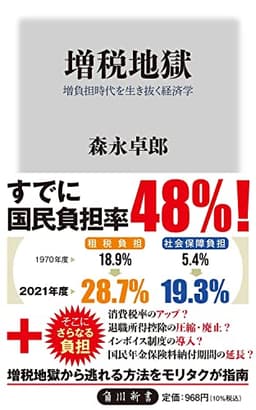
Statistics cited in this article
- 1National Tax Agency, on the FY2024 flat-rate income tax cut(2024) Open source
- 2Ministry of Finance, FY2025 National Burden Rate(March 2025) Open source
- 3Zenshoren, Invoice System Q&A (citing a National Tax Agency estimate)(2023) Open source
- 4Zenshoren, Invoice System Q&A (citing a Ministry of Finance estimate)(2023) Open source
- 5Nikkei, 'Defense Tax Increase Timing Confirmed'(December 2025) Open source
- 6National Tax Agency, Outline of withholding for the defense special income tax and the reconstruction special income tax (withholding from January 2027)(2026) Open source