
Medical critical infrastructure: connecting procurement oversight with continuity of care
Japan's proposed paths for national medical-DX systems and individual hospitals, and what remains undecided
Japan's November 11, 2026 medical council materials distinguish national medical-DX systems from individual hospital designation. We examine proposed timelines and the conditions for connecting equipment and maintenance oversight with continuity of care.
TL;DR
- The law adding the medical field has been promulgated, but specific hospital and equipment designations remain under consideration.
- National medical-DX infrastructure and individual hospitals follow different proposed paths to designation and notification.
- Procurement and maintenance oversight need to connect with equipment renewal and continuity during disruptions.
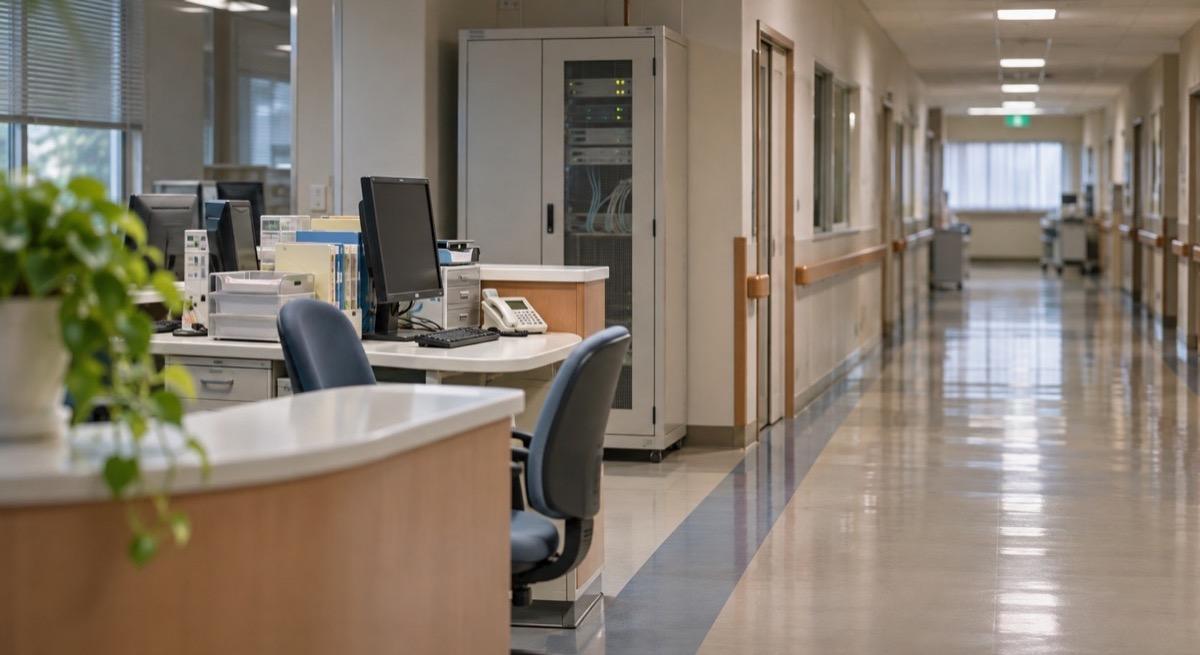
The image is AI-generated and does not depict an actual hospital or its equipment.
This article provides general information from public materials. It does not determine an institution's safety or legal compliance. Consult current ministry guidance and appropriate professionals about specific notification or contractual obligations.
What Is Happening
Separate the enacted law from proposed scope and timelines.
Japan is preparing to add the medical field to the critical-infrastructure framework under the Economic Security Promotion Act. This does not mean that every hospital immediately faces a new notification requirement.
Materials for the present separate proposed scopes and timelines for national medical-DX operations and medical services provided by individual hospitals. The amending law was promulgated on June 17. The new material concerns implementation: which operators and equipment would be covered, and when. The House of Councillors' legislative record(外部サイト、新しいタブで開きます) confirms enactment and promulgation.
The framework requires designated operators to submit plans for introducing specified important equipment or outsourcing its important maintenance and related work for advance review. It examines the risk that equipment or maintenance arrangements could be used to disrupt stable service provision. It is not a process for administrative review of each patient's treatment. The Cabinet Office's explanation(外部サイト、新しいタブで開きます) describes the narrowing of covered operators and equipment.
The timelines below are assumptions in the November 11 materials. They are not evidence of completed individual designations or coverage of every item of equipment. Reading the distributed materials also does not establish final agreement at the meeting or promulgation of the implementing orders.
Background & Context
Distinguish national medical-DX infrastructure from hospital designation.
National medical-DX infrastructure and individual hospitals follow different paths
Pages 7–8 of Material 2(外部サイト、新しいタブで開きます) propose coverage of the systems for sharing electronic medical-record information, managing electronic prescriptions and online eligibility verification operated by the reorganized national payment and medical-information body. The timeline envisages commencement in April 2027, followed by designation and a transitional period before notification requirements apply.
Individual hospitals would be designated gradually, considering both scale and their regional role and substitutability, with advanced-treatment hospitals in view. The proposed sequence on page 12(外部サイト、新しいタブで開きます) starts with initial designations by December 2027 and application in summer 2028, then expands coverage with attention to regional distribution. It would be inaccurate to describe this as applying to all hospitals on the same date as national medical-DX infrastructure.
National medical-DX systems
- Proposed scope
- National sharing and verification systems
- Proposed sequence
- Designation after April 2027 commencement
- Notification
- After a transitional period
Individual hospitals
- Selection approach
- Scale and regional substitutability
- Initial designation target
- By December 2027
- Initial application target
- Summer 2028
Source: Material 2, 131st Medical Care Committee, pages 8, 12 and 16
Selecting equipment is separate from designating hospitals
Designating a hospital does not necessarily make every device within it subject to notification. Pages 13–16(外部サイト、新しいタブで開きます) identify electronic medical-record, surgical-department and intensive-care equipment as candidate areas. Hospital and vendor research would inform further consideration. Proposals for particular hospitals and equipment are envisaged for discussion around spring 2027.
This distinction matters for procurement. Whether a hospital is designated, whether a planned replacement is covered, and whether outsourced work is covered involve different records and responsible people. A headline alone should not prompt a hospital to stop every renewal, nor should the absence of a designation be read as eliminating preparation. Concrete duties require checking the eventual orders, designations and ministry guidance.
Reading the Structure
Examine substitutability, maintenance responsibility, renewal burdens and non-designated hospitals.
Bed numbers do not fully describe the care a region could lose
The following is the author's analysis of the proposed approach. Bed numbers help describe scale. Whether another hospital can take over the same functions after an interruption is a different question. Distance, transport, specialist capabilities and available capacity all deserve examination.
A rise in the number of designated hospitals is also different from an improvement in regional continuity. Evaluation could examine arrangements for receiving patients during interruptions and transferring the information needed for care, alongside designation counts. These are proposed evaluation perspectives, not a list of new duties established by the November materials.
Connect maintenance responsibilities in contracts and practice
Equipment review does not by itself establish who makes decisions or receives calls during an incident. A hospital, equipment supplier and maintenance company hold different information. Subcontracting can add further boundaries around the work being performed.
One proposal is to connect equipment and contract records with clinical functions, responsible staff and contacts. For example, technical restoration of an unavailable medical-record system and the decision to switch to alternative clinical procedures require distinct responsibilities. Assigning someone to keep those connections current may help identify inconsistencies between review documentation and operational procedures. This is an organizational proposal to adapt to each institution, not a method whose effects have been measured here.
Oversight must connect with renewal planning
The purpose of review is stable medical provision. Information gathering and coordination therefore need to connect with planned equipment renewal. If responsibility rests solely with administrative staff, procedural work can become disconnected from clinical departments' needs.
This article has not verified evidence that the new framework has already delayed equipment renewal. Delay should be treated as a risk to examine during preparation, rather than an established outcome. Clear scope, consultation arrangements, preparation time and maintenance-contract renewal dates are ways to connect the institution's purpose with practical delivery.
Continuity remains a concern outside the designated group
Phased designation does not require every institution to assume identical duties at once. But not being designated cannot be read as making safety measures unnecessary. Regional care depends on institutions beyond the large hospitals potentially covered by this framework.
From ISVD's perspective, an enduring question is how support for designated hospitals connects with assistance available to surrounding providers. Can smaller organizations use common documentation and consultation support? Can staffing and costs for compliance coexist with maintaining care? These questions remain relevant after individual hospital names are announced.
When following implementation, distinguish the law, proposed orders, designation, transitional periods and actual application. Evaluating whether care can continue, separately from whether a framework exists, also connects with our Introduction to EBPM(このサイトの記事).
Related Reading
The following includes an Amazon Associate advertising link.
Takaaki Kirino's Japanese-language book Iryo no Sentaku(外部サイト、新しいタブで開きます) (Iwanami Shoten, 2014) offers background reading on the institutions supporting medical care. This recommendation is limited to the publisher-registered bibliographic record and public contents(外部サイト、新しいタブで開きます); the full book has not been read. The sources for the 2026 proposals and timelines in this article are the official materials above, not this book.
References
Materials for the 131st Medical Care Committee of the Social Security Council — Ministry of Health, Labour and Welfare (2026). November 11 meeting materials
Status of consideration of adding the medical field to the critical-infrastructure framework — Ministry of Health, Labour and Welfare (2026). Material 2, particularly pages 1–4, 7–8 and 12–16; proposed timelines
Legislative record: amendment of the Economic Security Promotion Act and Japan Bank for International Cooperation Act — House of Councillors (2026). Enactment, promulgation and Act No. 38
Framework for ensuring stable provision of critical-infrastructure services — Cabinet Office. Framework, notifications and consultation arrangements
Questions to Reflect On
- How does hospital size differ from the difficulty of replacing its local role?
- How can equipment oversight connect with renewal and incident-response work?
- Who supports continuity at hospitals outside the designated group?
Related Content
After Fill Removal, How Can the Public Verify Cost Recovery?
Historical records from Atami distinguish soil removal from recovery of its cost. Earlier action under a prefectural ordinance must be distinguished from the national law introduced later. The article proposes linking work, order and accounting records for matching cases and reporting dates.

Must Tenants Leave Immediately After a Condominium Rebuilding Vote?
Japan’s 2025 amendment and main provisions commencing in 2026: voting requirements, lease-termination periods, compensation and housing continuity.

Do Additional Charges for Long-listed Medicines Depend Only on Patient Preference?
Charges for eligible originator medicines with generic counterparts, medical necessity, supply and patient explanations under the 2026 notices.
3,772 Medical Incidents Reported in Ten and a Half Years, About 356 a Year — the Design Estimate Was 1,300 to 2,000, and the Clause Requiring a Review Within Two Years Has Sat Expired for a Decade
Kyoto University Hospital announced that surgeons removed part of a patient's healthy brain during an operation for a brain tumour. Japan's medical incident investigation system began in October 2015. Reports to it total 3,772 as of the end of April 2026, about 356 a year. The estimate made while the system was being designed was 1,300 to 2,000 a year. A supplementary clause requiring a review of the relationship between Article 21 of the Medical Practitioners Act and reporting under the system, within two years, expired in June 2016 and has not been acted on.
Previous
When University Systems Stop, How Do Procedures Continue?
Next
Older drivers in Japan: what do renewal checks tell us, and how can travel continue?
Get new columns by email
1-2 social structure analysis columns per week. Free to subscribe.
Join ISVD's activities?
Sign up to receive the latest research and activity reports. Feel free to reach out about collaboration or project participation.
Support ISVD’s research and activities
Support ISVD’s research and publications with JPY5,000 per year. There is no automatic renewal.