
What Is Happening
On January 4, 1954, a full-page advertisement appeared in major American newspapers. Titled "A Frank Statement to Cigarette Smokers," it was jointly issued by the leading companies of the tobacco industry. In response to research demonstrating a causal relationship between smoking and health damage, the statement declared: "There is still scientific controversy on this matter. We are committed to discovering the truth."
This was the beginning of the twentieth century's largest campaign of "doubt manufacturing."
The tobacco industry's strategy was not to prove that smoking was safe. There was no need to prove it. Only one thing needed to be done — to maintain the impression that "it is not yet settled." Tobacco kills more than 8 million people worldwide each year, according to the WHO. An internal memo from Brown & Williamson in 1969 summarized this strategy in a single sentence:
Doubt is our product since it is the best means of competing with the "body of fact" that exists in the mind of the general public.
This strategy achieved remarkable success. Although scientific evidence demonstrating the causal relationship between smoking and lung cancer had already accumulated by the 1950s, more than forty years elapsed before effective regulation was implemented in the United States. During that interval, millions died of lung cancer.
And the very same strategy — often deployed by the very same scientists — was transferred to climate change denial.
Background and Context
The Tobacco Industry as the Starting Point of Agnotology
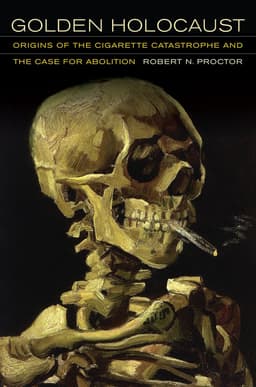
When Robert N. Proctor proposed "agnotology" (無知学) in 2008, his central case was the tobacco industry. In Golden Holocaust(外部サイト、新しいタブで開きます) (2011), Proctor documented in detail the process by which the tobacco industry "manufactured" scientific ignorance, drawing on hundreds of thousands of pages of internal documents (released under the 1998 Master Settlement Agreement).
Proctor's critical insight was that this "manufacturing of ignorance" was not an accidental byproduct but a highly organized industrial activity. The tobacco industry established its own research institutions, hired scientists, had papers published in academic journals, and maintained in the media the impression that "scientific controversy exists."
The Merchants of Doubt
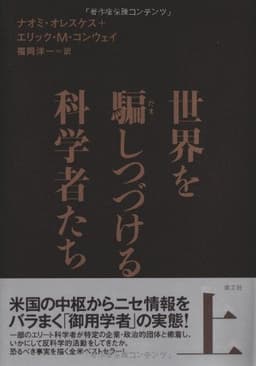
Naomi Oreskes & Erik M. Conway (2010) revealed an astonishing fact in 世界を騙しつづける科学者たち 上(外部サイト、新しいタブで開きます) (Japanese translation of Merchants of Doubt, Vol. 1). Some of the scientists involved in the tobacco industry's doubt manufacturing subsequently participated in manufacturing doubt against scientific consensus on acid rain, ozone depletion, and climate change.
Physicists such as Fred Seitz and S. Fred Singer had been involved in nuclear weapons development during the Cold War before transitioning to become "doubt scientists" for industry. Their motives were not solely financial. An ideological conviction that environmental regulation constituted "government intervention in the free market" aligned with industry interests.
This fact carries important implications. Doubt manufacturing cannot be explained by simple "corporate malice" alone. It is a structural phenomenon in which ideology, scientists' self-perception, industrial interests, and political agendas are complexly intertwined.
David Michaels and "Doubt as Product"
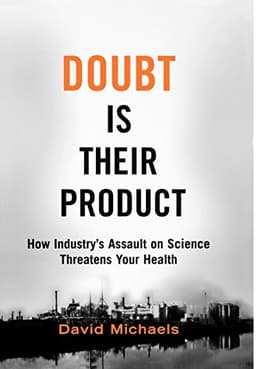
David Michaels (2008) demonstrated in Doubt is Their Product(外部サイト、新しいタブで開きます) that the methods established by the tobacco industry had been widely transferred to the chemical, pharmaceutical, and food industries. Michaels later served as OSHA (Occupational Safety and Health Administration) administrator under the Obama administration, observing industry's regulatory evasion strategies from the inside.
What Michaels particularly emphasized was the exploitation of "scientific uncertainty." Every scientific finding contains some degree of uncertainty. Industry strategically exaggerated this uncertainty to create the impression that "no conclusion has been reached," thereby delaying regulation.
Reading the Structure
The Five Steps of Doubt Manufacturing
Analyzing the history from the tobacco industry to climate change denial reveals five common steps in "doubt manufacturing."
Step 1: Strategic Exaggeration of Scientific Uncertainty
Every scientific study contains uncertainty. Doubt manufacturers reinterpret this uncertainty as "no scientific consensus exists." The 1954 Frank Statement is the archetype; ExxonMobil's climate change communications in the 2000s followed the identical pattern.
Step 2: Funding of Proprietary Research
Industry establishes its own research institutions and produces "an alternative scientific view." The tobacco industry's Council for Tobacco Research (CTR) and the fossil fuel industry's Global Climate Coalition (GCC) are representative examples. These institutions strategically funded research to "counter" existing scientific consensus.
Step 3: Exploitation of Media "Both-Sidesism"
The journalistic principle of "balance" is turned on its head. Even when 97% of scientists agree, equal treatment of the "opposing view" is demanded. Media, in the name of "fairness," present the overwhelming scientific majority and a small minority at a 50:50 ratio. The reader perceives "opinions are still divided."
Step 4: Delay of Policy Decisions
"Since there is no scientific consensus, hasty regulation should be avoided" — this logic is constructed. At this stage, the "doubt" manufactured in Steps 1–3 functions as material justifying the judgment of policymakers. With each delay in regulation, industry continues to secure its profits.
Step 5: Individualization of Responsibility
Finally, responsibility for the problem is shifted to the individual. "Smoking is a free individual choice." "Environmental impact is a matter of consumer lifestyle." Structural and industrial problems are reframed as matters of individual choice and responsibility.
Transfer of the Same Pattern
These five steps have been replicated with remarkable fidelity:
| Target | Period | Key Actors | Core Strategy |
|---|---|---|---|
| Tobacco and health | 1954–1998 | Tobacco industry (CTR) | "Causal relationship is unproven" |
| Acid rain | 1980s | Coal industry | "It may be natural causes" |
| Ozone depletion | 1980s–1990s | Chemical industry | "Scientific uncertainty exists" |
| Climate change | 1989–present | Fossil fuel industry (GCC) | "No consensus exists" |
| Vaccine safety | 1998–present | Anti-vaccine groups | "More research is needed" |
Notably, in the lineage from tobacco → acid rain → ozone → climate change, literally the same individuals — Frederick Seitz, S. Fred Singer, and others — were active as "doubt scientists." It was not merely that the strategy was transferred; the human network itself was inherited.
Agnotological Analysis — Why Is "Doubt" So Powerful?
Within Proctor's (2008) three types of ignorance, doubt manufacturing falls clearly within the third type — "strategically produced ignorance." Understanding the source of its efficacy, however, requires a cognitive science perspective.
First, human cognition seeks "certainty." An intermediate state of "not yet known" is psychologically more acceptable than complete ignorance. Doubt manufacturers exploit this cognitive tendency.
Second, the scientific process itself inherently contains uncertainty. Scientists possess the integrity to state explicitly what "is not yet known." Doubt manufacturers exploit this scientific integrity.
Third, "both-sidesism" intuitively appears fair. Without knowing the ratio of 97% to 3%, a media posture presenting both sides equally appears rational. This also connects to pluralistic ignorance (多元的無知) — when a majority of individuals come to believe "the debate is still ongoing," the entire society becomes fixed in the perception that "it is not yet known."
Contemporary Scope
The structure of doubt manufacturing has become even more complex in the twenty-first century.
The spread of digital media has dramatically lowered the cost of disseminating "an alternative scientific view." As analyzed in this lab's essay on the Brandolini asymmetry, the proliferation of AI-generated content is further accelerating this structure.
Moreover, doubt manufacturing has shifted from "denial" to "delay." It is no longer feasible to deny the existence of climate change itself, but arguments such as "the cost of countermeasures is too high," "technology innovation will solve it," and "developing countries' emissions are the problem" remain effective in delaying concrete action. Lamb et al. (2020) classified these as "Discourses of Climate Delay," identifying twelve patterns.
Questions for This Lab
The tobacco and climate cases provide the richest material for theorizing doubt manufacturing. The questions this lab pursues are as follows:
- To what extent can the five steps of doubt manufacturing be generalized to other domains (health foods, pesticides, electromagnetic radiation)?
- What specific forms does doubt manufacturing take in Japanese society (the cultural specificity of "both-sidesism," media structure)?
- How are the structural changes in doubt manufacturing playing out in the digital age — how should we conceptualize the individualization and decentralization of the "doubt manufacturing industry"?
- What institutional designs are effective as structural countermeasures against doubt manufacturing?
These questions connect structurally to other case analyses in this lab — particularly the weaponization of complexity in predatory business and the invisibilization through media agenda-setting.
Related Articles
- Research Framework of the Agnotology Lab — An Inductive Coding Framework(このサイトの記事)
- Why Predatory Business Endures — Structural Analysis of Converting Information Asymmetry into Profit(このサイトの記事)
- Why Unreported Issues Are Treated as 'Nonexistent' — Media Agenda-Setting and Invisibilization in Japan(このサイトの記事)
References
Agnotology: The Making and Unmaking of Ignorance — Proctor, R. N. & Schiebinger, L. (2008). Stanford University Press
Big AI's Regulatory Capture: Mapping Industry Interference and Government Complicity — Birhane, A., Angius, R., Agnew, W., Pandit, H. J., Mitra, B., Dobbe, R., & Talat, Z. (2026). arXiv:2605.06806 (to appear in FAccT '26 Proceedings)
Reference Books
Statistics cited in this article
- 1WHO, Global Report on the Tobacco Epidemic(2023) Open source