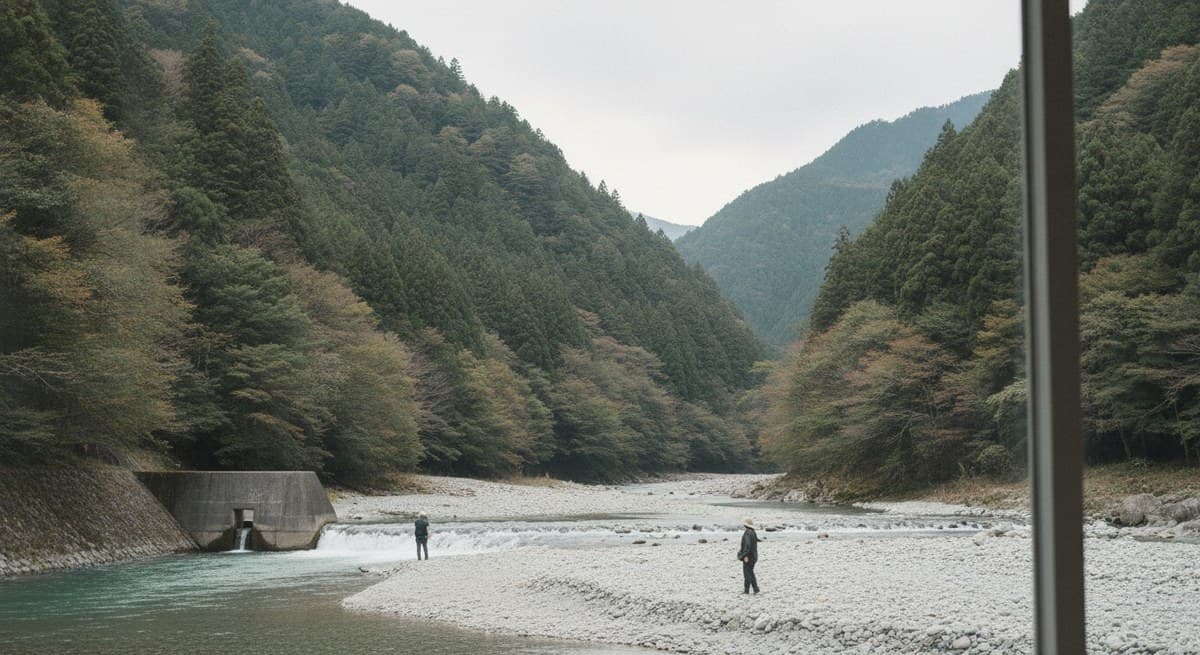
Kamakura Overtourism: Treating Tourist Destinations as Public Goods
Kamakura's friction between concentrated visitors and resident life, reread as a public-goods question — is a tourist destination a commodity or shared infrastructure? An international comparison of four policy levers (price, quantity, time-space distribution, and collaborative governance) and what they can and cannot solve.
TL;DR
- FIRST-HAND Local's portrait of Kamakura describes overtourism not as a large-scale crisis but as a "small inconveniences accumulating" pattern — 10–20 minute taxi waits, school field trips clustered at lunch hours, and local eateries reshaped by Google Maps visibility.
- Inbound visitors hit record highs of 36.87 million in 2024 and 42.68 million in 2025, while the three-metropolitan-area lodging concentration climbed to 69 percent — visitors are not dispersing across Japan but clustering in cities and nearby destinations like Kamakura.
- Kamakura City raised JPY 3.5 million through government crowdfunding to increase security personnel from 2 to 5 (7 on peak days) and launched an AI-camera trial to map crowd flows from December 2025.
- Kyoto's lodging tax (up to JPY 10,000 per night), Venice's daytripper fee, Barcelona's 2028 short-term rental phase-out, and Amsterdam's 20-million overnight cap are partial solutions — each lever covers only a slice of the problem.
- This essay argues for rereading tourist destinations as public goods rather than commodities, and treating the four policy levers as a portfolio rather than a menu.
What Is Happening
How FIRST-HAND Local portrays "leakage into daily life" in Kamakura, and how the 42.68 million inbound visitor era amplifies concentration
FIRST-HAND Local portrayed Kamakura's overtourism not as a large-scale crisis but as a state where "a cup slowly fills with small drops." A resident interviewed in the piece described the problem not through the absolute volume of garbage or noise but through the accumulation of complex frictions: 10–20 minute waits at taxi stands, school field trips clustering around lunch and afternoon hours, and local restaurants flooded by visitors arriving via Google Maps. This essay takes that "ground-level friction" as a starting point and lifts it one level higher: rereading tourist destination management as a public-goods question rather than a commodity-management problem.
The concentration numbers come first. Inbound visitors reached 36,869,900 in 2024 and 42,683,600 in 2025, setting two consecutive all-time records — 2024 was 15.6 percent above 2019, and 2025 grew another 15.8 percent year on year. While Japan as a whole posted record tourism revenue, lodging skewed heavily toward the three metropolitan areas. Foreign overnight concentration in the three metropolitan areas rose from 63 percent in 2019 to 69 percent in 2024. Visitors did not spread out; they clustered more tightly into a handful of cities and nearby destinations.
Kamakura sits squarely inside that pattern. The Japan Tourism Agency includes the Kamakura–Fujisawa area among its pilot model regions. From July 2024 through February 2025, guides were deployed at congested Enoshima Electric Railway stations — Kamakura, Kita-Kamakura, and Hase. The agency's own project documents describe how "even before COVID, inbound numbers were rising, and the impact spread to the quiet residential areas around Kamakurakokomae and Shichirigahama stations." The "leakage" that FIRST-HAND Local captured through resident voices appears in the same structural language inside government planning documents.
In October 2025, Kamakura City launched a government crowdfunding (GCF) campaign targeted at the area around Kamakurakokomae Station. The goal was JPY 3.5 million, raised between October 10, 2025 and January 7, 2026. From October 1, 2025, the city expanded the existing 2-person security team to 5 personnel (7 on peak days). Earlier, between September 13 and 16, 2025, staff conducted a four-day field trial in which visitors were guided toward designated photo spots inside a nearby public park — sidewalks were cleared and dangerous road-edge photography was reduced. The city then started an AI-camera trial from December 19, 2025 to March 31, 2026 to capture visitor counts and crowding hours around the Kamakurakokomae railway crossing.
The three-piece kit — security increases, guided photo spots, and AI cameras — shows that Kamakura is treating overtourism as a layered problem of public safety, behavioral observation, and on-the-ground operations. But FIRST-HAND Local described something below those layers: the gradual erosion of residents' everyday time by visitor flows. Taxis become unreachable. Neighborhood restaurants run out of seats because of "tourist destination" reviews. Lunch hours for school field trips overlap with visitor peaks. These frictions are not solved by adding security personnel. They require rereading tourist destination management at the policy-design layer.
- 13-16 September 2025Staff directed visitors to a photo spot inside a nearby parkconfirmed effective in keeping pavements clear and curbing dangerous photography
- 1 October 2025Guards increased from two to five (seven on peak days)
- 10 October 2025 to 7 January 2026Government crowdfunding, target 3.5m yenfunded by donors rather than resident taxes
- 19 December 2025 to 31 March 2026AI cameras to measure visitor numbers and peak hours
Guards, photo-spot direction and AI cameras handle the problem at the level of policing, movement data and site operations. The friction of residents' daily time being encroached on does not resolve at that level.
Background & Context
The Japan Tourism Agency package, Kamakura's crowdfunding and AI-camera response, and four precedents — Kyoto, Venice, Barcelona, Amsterdam.
The Limits of the Japan Tourism Agency Package
The Japan Tourism Agency's overtourism countermeasure package (decided October 18, 2023) has three pillars: managing crowding and behavioral violations, promoting regional dispersion, and encouraging tourism in collaboration with residents. Pilot model regions started at 20 and expanded to 26 — Kutchan in Hokkaido, Hakone, Kyoto, Taketomi in Okinawa, and the Kamakura–Fujisawa area among them.
The package's underlying logic was to solve two problems at once: ease the burden on crowded metropolitan destinations while reviving depopulating regions through visitor dispersion. The logic is internally coherent. But even as inbound numbers set records for two consecutive years, the three-metropolitan lodging concentration rose rather than fell. Visitors do not redistribute evenly; they are pulled toward places made visible by social media and Google Maps reviews. The concentration around the Kamakurakokomae railway crossing — where one specific photo spot becomes the focal point — is a microcosm of that pull.
Tourism Produces External Costs
In the language of economics, tourism is an externality-producing activity. The benefits flow to visitors, tourism operators, and national tax revenue, while the costs are paid by residents' quality of life and shared infrastructure. The receipt of benefits and the payment of costs are institutionally separated.
From this premise, four broad policy approaches branch out: price mechanisms (internalize the cost), quantitative regulation (cap the volume), time-space distribution (spread demand across hours and locations), and collaborative governance (involve residents in policy design). This essay maps the four international precedents (Kyoto, Venice, Barcelona, Amsterdam) onto these four levers.
Kyoto
Price mechanism (progressive lodging tax)From March 1, 2026: lodging tax raised up to 50×. Five-tier progressive structure from JPY 200 (under 6,000) to JPY 10,000 (over 100,000). Projected revenue JPY 12.6B (2.4× the 2023 figure). Use split between tourism promotion and resident-life harmonization.
Venice
Quantitative regulation (day-tripper entry fee)From April 25, 2024 through mid-July: EUR 5 fee for day-trippers on 29 peak days (8:30–16:00). The city calls it the world's first entry fee. Hotel guests, residents, commuters exempt. Day 1: 113,000 registered, 16,000 actually paid.
Barcelona
Market closure (short-term rental license phase-out)By November 2028: halt all renewals of short-term tourist apartment licenses. Affects 10,000+ legally registered units. Spanish Constitutional Court upheld the plan (March 2025). Five neighboring cities expected to follow.
Amsterdam
Collaborative governance (Stay Away campaign)From 2023: targeted ads against UK men aged 18-35 (deter party tourism), Airbnb regulation, Night Mayor system, resident councils — combined into a comprehensive design. Target: reduce 18M tourists to 15M.
* The four cities each test different policy levers. Kyoto = price internalization, Venice = quantitative regulation (caps and exemptions), Barcelona = market closure (license phase-out), Amsterdam = collaborative governance (targeting + resident councils). Sites like Kamakura with free photo spots cannot be handled by a single lever; combinations are required.
Kyoto — Testing the Ceiling of Price Mechanisms
Kyoto City raised its lodging tax by up to fifty-fold effective March 1, 2026. The five-bracket progressive structure ranges from JPY 200 (per night under JPY 6,000) to JPY 10,000 (per night JPY 100,000 and above), with intermediate brackets at JPY 400, JPY 1,000, and JPY 4,000. Projected annual revenue is roughly JPY 12.6 billion, about 2.4 times the 2023 figure of JPY 5.2 billion. The use of funds is explicitly split between tourism promotion and the harmonization of resident life with tourism.
What stands out about the Kyoto model is two-fold: the progressive design imposes higher burdens on higher-priced lodging, and the use allocation explicitly carves out resident life as a co-equal pillar. Japan's lodging taxes had long defaulted to Tokyo's flat 100–200 yen scheme. Kyoto's progressivity and revenue doubling show how far price mechanisms can move inside the Japanese system — while also exposing their limits: a free photo spot (such as the area in front of Kamakurakokomae Station) cannot be reached by a lodging tax.
Venice — Symbolic Effect and Limits of Entry Fees
Venice introduced the world's first city entry fee on a trial basis, applying a EUR 5 daytripper fee (08:30–16:00) on 29 peak days between April 25 and mid-July 2024. The fee applied only to day-trippers; hotel guests, residents, commuters, and students were exempt. On day one, 113,000 people registered, of whom 16,000 actually paid — the rest fell into exemption categories.
In 2025, operating days expanded to 54, and a two-tier system was implemented — EUR 5 for advance reservations and EUR 10 for last-minute bookings within four days of visit. Venice's "saturation" threshold is generally cited at 30,000–40,000 day-trippers per day. But the fee continues to draw protest from resident activists who view it as turning the city into a theme park. Euronews reported that 2025 revenue reached EUR 5.42 million from 723,497 payments, while also noting that the first year posted a loss — implementation cost of approximately EUR 3.0 million against revenue of EUR 2.4 million from 485,062 payments. Entry fees produce strong symbolic effects, but whether they actually reduce crowding remains contested.
Barcelona — Stepping Into Quantitative Regulation
Barcelona City decided to halt the renewal of all short-term tourist apartment licenses by November 2028. The decision affects more than 10,000 legally registered short-term rental units, and Spain's Constitutional Court upheld the city's phase-out plan in March 2025. The stated goal is clear: curb housing-price inflation and convert units back to long-term residential use. Five neighboring cities are expected to follow, creating a precedent of municipalities closing an Airbnb-type market through urban policy.
Quantitative regulation has the strength of directly excluding property categories that price mechanisms cannot reach. Its political cost is high, however — operators, owners, and short-term rental platforms all push back. Cities can only make this move when resident support is firmly aligned with the policy. Barcelona managed it because housing-price inflation had become the central issue of municipal politics, a rare case where the policy window aligned.
Amsterdam — Hard Caps and the Difficulty of Enforcement
Amsterdam introduced Europe's highest lodging tax at 12.5 percent of room rate and codified a "hotel bed stop" that bans existing hotels from expanding or adding rooms. The city additionally set an annual overnight cap at 20 million stays.
But 2024 actuals reached 22.9 million overnights, exceeding the cap, and in September 2025 residents filed suit against the city. The complaint argued that the municipality failed to enforce its own ceiling — a symbolic case of the enforcement gap. Even when both price and quantity are tightened, demand-side pressure that exceeds policy assumptions reduces caps to numbers on paper.
Reading the Structure
Tourist destinations as public goods, the partiality of each of the four policy levers, and the implications for Kamakura
Rereading Tourist Destinations as Public Goods
Economics defines public goods through two properties: non-rivalry (one person's consumption does not preclude another's) and non-excludability (users cannot be kept out). The "absence of crowding," "scenery," and "daily quiet" of a tourist destination are not pure public goods — they sit closer to quasi-public goods or common-pool resources, with weak rivalry but partially weak excludability.
This produces the classic free-rider problem. Visitors enjoy the benefits (scenery, experience, photographable moments) without paying the costs of crowding, waste, or imposed resident burdens. When a visitor steps into the roadway in front of the Kamakurakokomae railway crossing to take a photo, the photographer gains the "shot" while residents absorb the externality of "dangerous road-edge intrusion." This separation of benefit and burden is the free-rider structure itself.
Multiple theoretical frameworks exist to handle this problem institutionally. A.C. Pigou's Pigovian tax (internalizing externalities), Elinor Ostrom's collaborative governance of common-pool resources, and the classical public-economics design of property rights and exclusion mechanisms. Kamakura's on-the-ground response — security increases, photo-spot guidance, and AI-camera observation — can be read as an implementation of "collaborative governance" plus "weak exclusion devices" among these theoretical levers.
Levers acting on demand
- Price (Kyoto)
- lodging tax raised up to 50-fold; no effect on day visitors or free sites
- Spreading in time and space (Kamakura)
- timed direction, photo-spot concentration, AI cameras; cannot fully offset concentration on places made visible by social media
Levers acting on supply and governance
- Quantitative regulation (Barcelona)
- short-term tourist flats phased out by November 2028; high political cost
- Collaborative governance (Amsterdam)
- residents brought into the design; the city could not hold its own cap and ended up in court
No single lever suffices; they only work in combination. Cities are not picking from a menu of equivalents but combining different levers according to the policy window each has.
The Four Levers and Their Partiality
Mapping international precedents reveals four policy levers for tourist destination management — and reveals that each is only a partial solution.
The first lever, price mechanisms (the Kyoto model), uses lodging taxes, entry fees, and admission fees to impose costs on the demand side. Kyoto's progressive 50-fold scaling pushed deeply, but it cannot reach day-trippers or free spots. The second lever, quantitative regulation (the Barcelona model), constrains supply through short-term rental phase-outs, overnight caps, and bed stops. It works decisively but carries heavy political costs and rarely moves unless another municipal priority (such as housing inflation) aligns with it. The third lever, time-space distribution (the Kamakura model), softens physical friction through timing adjustments, photo-spot consolidation, AI-camera observation, and circulation route design — but it cannot fully suppress concentration around social-media-visible locations. The fourth lever, collaborative governance (which Amsterdam aimed for), embeds residents in policy design and sustains enforcement. But the 2025 lawsuit over Amsterdam's self-imposed cap shows that when demand exceeds the design assumption, the regulation becomes paper.
No single lever suffices. They function only when combined. Kamakura raises crowdfunded security and runs AI cameras, Kyoto pushes lodging tax up to fifty-fold, Barcelona phases out short-term rentals — these are not parallel options but lever combinations chosen according to each city's available policy window.
Implications for Kamakura
Returning to Kamakura, the question becomes how to combine the four levers. Price mechanisms alone cannot reach free photo spots like Kamakurakokomae. Raising Enoshima Electric Railway fares specifically for visitors is conceivable, but managing a two-tier pricing structure alongside resident commuter pass holders carries high operational cost. Quantitative regulation would draw strong opposition from operators and local commerce. Time-space distribution combined with collaborative governance emerges as the realistic combination — though enforcement challenges remain.
Raising JPY 3.5 million through government crowdfunding to add three security personnel (with two more on peak days) is a notable detour: making visitors themselves pay, rather than taxing residents. Donors include past Kamakura visitors and people sympathetic to the destination. The separation of benefit and burden is partially closed through the voluntary route of philanthropy. Compared to a strong price mechanism like Kyoto's lodging tax, the revenue scale is small — but the political cost is low and the design avoids the enforcement debate altogether.
Three Lessons from the International Comparison
The first lesson is the cold fact that none of the four levers is a standalone solution. Kyoto's JPY 10,000 maximum lodging tax is dramatic but does not touch free spots. Barcelona's short-term rental phase-out is strong but does not reach hotel-routed visitors. Amsterdam's overnight cap is explicit but the city failed to enforce it. Combination and parallel operation are baseline requirements.
The second lesson is that resident support is the actual policy window. Barcelona moved into quantitative regulation because housing inflation became the focal political issue and resident support outweighed operator pushback. Kyoto's 50-fold lodging tax increase passed because the design explicitly carved out resident-life uses alongside tourism promotion. Kamakura's crowdfunding worked because the design routed payment through visitors themselves rather than asking residents for direct contributions. Whether a city can move a lever depends on whether resident support is built into the design.
The third lesson is that the binary frame of "visitors versus residents" does not produce workable policy. Visitors mix together day-trippers, overnight guests, repeat visitors, and commuting students. Residents mix together tourism operators, commuters, students, elderly people, and local merchants. Kyoto's progressive design separates burdens by lodging price; Venice institutionally divides day-trippers from overnight guests. Both subdivide the visitor population. Translating "visitors versus residents" into "distribution among residents" and "stratified distribution among visitors" is the actual starting point of policy design.
Transferability — From Kamakura to Kyoto, Kurashiki, Miyajima, and Nara
The structure of the Kamakura model carries implications for transferability to other Japanese destinations. Kyoto already pushed price mechanisms further than Kamakura with its 50-fold lodging tax. But Kyoto's free spots — the bamboo grove in Arashiyama, the senbon torii at Fushimi Inari, the stone-paved Ninen-zaka in Higashiyama — share the photo-spot concentration problem Kamakura faces. Kurashiki, Miyajima, and Nara resemble Kamakura in population scale, visitor-resident ratio, and near-urban location, making them candidates for transferring the GCF-funded security increase plus AI camera observation combination.
Three preconditions matter for transfer. First, the accumulation of narratives that describe ground-level friction in residents' own words (a reporting function like FIRST-HAND Local). Second, a policy design that subdivides visitors and residents into stratified groups (the equivalent of Kyoto's progressive scheme). Third, a statistical infrastructure for ongoing enforcement monitoring (the AI-camera observation function). Transfer requires not duplicating Kamakura's three-piece kit but redesigning it to fit each destination's resident-support structure.
Tourist destinations should not be optimized as commodities. They should be designed as public goods. Whether this rereading takes hold will shape Japanese tourism policy in the 42.68-million-visitor era. The question of how to convert JPY 9.5 trillion in inbound consumption into resident quality of life is addressed in the companion essay Who Are the JPY 9.5 Trillion Tourism Revenues For(このサイトの記事). The public-goods design of destinations and the resident-return design of tourism revenues are two sides of the same problem. Japan's tourism policy has yet to address both as a single integrated agenda.
Recommended Reading
オーバーツーリズム = OVER-TOURISM : 観光に消費されないまちのつくり方 (Overtourism: Revised Edition — Building Towns That Are Not Consumed by Tourism)(外部サイト、新しいタブで開きます) (Akiko Kosaka, Gakugei Shuppansha) — The definitive Japanese-language survey of domestic and international overtourism cases, with added chapters on community-based and regenerative tourism in the revised edition.
オーバーツーリズム解決論 - 日本の現状と改善戦略 (The Overtourism Solutions Argument: Japan's Current Conditions and Strategies for Improvement)(外部サイト、新しいタブで開きます) (Toshinori Tanaka, Wani Books PLUS Shinsho) — A Kyushu University associate professor's field analysis of Kyoto bus congestion, Mt. Fuji queues, and Okinawa coral, framing solution strategies.
観光公害――インバウンド4000万人時代の副作用 (Tourism Pollution: The Side Effects of the 40-Million Inbound Era)(外部サイト、新しいタブで開きます) (Yoshihiro Sataki, Shodensha Shinsho) — Pioneering fieldwork by a Kyoto-based tourism scholar, including comparisons with Venice.
References
Kamakura Overtourism: The Leakage Problem into Daily Life — FIRST-HAND Local (2026)
Sustainable Tourism Promotion Project for Prevention and Suppression of Overtourism — Japan Tourism Agency (2023)
Government Crowdfunding for Overtourism Measures Around Kamakurakokomae Station — Kamakura City (2025)
AI Camera Trial Around Kamakurakokomae Station — Kamakura City (2025)
Visitor Arrivals December 2025 and Annual Totals — Japan National Tourism Organization (JNTO) (2026)
Lodging Tax Revision Effective March 1, 2026 — Kyoto City (2025)
Venice Entry Fee in 2024 — All You Need to Know — Visit Venezia (2024)
Goodbye Airbnb: Barcelona Sets 2028 Deadline to Phase Out Tourist Apartments — idealista (2025)
Amsterdam Tightens the Screw on Tourism — A Further Update — CMS Law (2024)
Amsterdam Tourist Nights Hit 23 Million, Surpassing City Limit — DutchNews.nl (2025)
Overnight Travel Statistics 2024 Preliminary Annual Report — Japan Tourism Agency (2025)
Statistics cited in this article
- 1JNTO Visitor Arrivals Statistics(2026) Open source
- 2Japan Tourism Agency, Overnight Travel Statistics 2024 Preliminary(2025) Open source
- 3Kamakura City press release, October 10, 2025(2025) Open source
- 4Kyoto City — Lodging Tax Revision Effective March 1, 2026(2025) Open source
- 5Visit Venezia official / NPR April 25, 2024(2024) Open source
- 6DutchNews.nl / CMS Law / Amsterdam budget reports(2024) Open source