
Japan's 4,317 Teacher Shortage — Why No One Wants to Teach
Japan's teacher shortage has grown approximately 1.7 times in four years, according to MEXT's latest survey. Three structural factors — declining recruitment competition, exhaustion of substitute teacher pools, and surging demand from special support classes — are eroding the foundation of public education.
TL;DR
- Teacher shortages in public schools grew from 2,558 in FY2021 to 4,317 at the start of FY2025 — approximately 1.7x in four years
- Competition ratios for teacher recruitment exams have fallen to historic lows, signaling a shrinking pipeline of prospective teachers
- The rapid expansion of special support classes has increased staffing requirements, while the pool of temporary substitute teachers has dried up
What Is Happening
Teacher shortages have grown approximately 1.7x in 4 years, with 2,828 schools starting the year without full staffing.
In March 2026, the (MEXT) released its FY2025 Teacher Shortage Survey, reporting the number of unfilled positions and affected schools. At the start of the 2025 school year, 4,317 teaching positions across public elementary, junior high, high schools, and special support schools went unfilled, affecting 2,828 schools nationwide. Some schools respond to shortages by assigning classroom teaching to principals or vice-principals.
Shortage at start of year grew ~1.7x in 4 years (2,558 → 4,317).
The figure as of May 1
As of May 1, the figure improved to 3,827, partly due to mid-year hiring of temporary teachers. As of 1 May the shortage stood at 3,827, a rate of 0.45%, against 2,065 and 0.25% in FY2021.
By school type (as of May 1): elementary schools 1,699; junior high schools 1,031; high schools 508; and special support schools 589. The shortage rate for special support schools stands at 0.71% — the highest among all school types.
Special support schools have the highest shortage rate (0.71%), driven by rapid growth in special support classes.
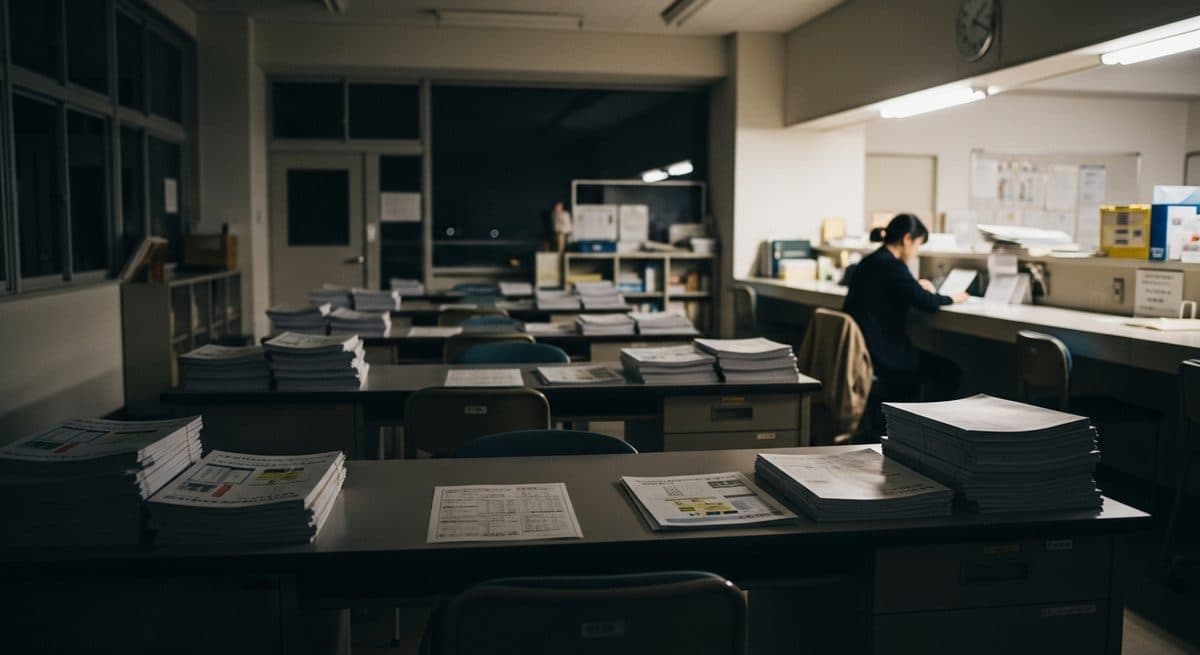
A classroom with no homeroom teacher
Children starting a new school year without a homeroom teacher assigned. This fact alone reveals that the teacher shortage is not an abstract statistical problem, but a crisis directly affecting individual learning.
Background & Context
Declining exam competition, substitute teacher pool exhaustion, and special support class expansion form a triple structural crisis.
Declining Recruitment Competition — A Profession No Longer Chosen
At the root of the teacher shortage lies a shrinking applicant pool. The competition ratio for public school teacher recruitment exams keeps falling. The overall ratio came to 2.9, a record low, down from 3.2 the year before; elementary schools stood at 2.0, junior highs at 3.6, high schools at 3.8 and special support schools at 2.0, each a record low. For elementary schools, some municipalities have seen ratios drop below 2x.
This decline is not simply about "less competition." It carries the risk of being unable to maintain the quality of new hires. As private-sector starting salaries rise and recruiting timelines move earlier, teaching has become associated with "long hours and low pay," dropping in priority among university graduates' career choices.
The has also reported a decline in students aspiring to become teachers. Some teacher training programs at universities are failing to fill their enrollment quotas, indicating that the shortage begins at the training stage.
Depletion of Temporary Teachers — The Buffer Has Broken
Japan's public school staffing model assigns regular (full-time, permanent) teachers to established positions and fills gaps from maternity leave, sick leave, and other absences with "temporarily appointed teachers" (rinji-teki nin'yō kyōin). These temporary teachers have become the direct bottleneck of the shortage.
Historically, candidates who failed the regular teacher recruitment exam often served as temporary teachers while awaiting another opportunity. However, as competition ratios fell, a higher proportion of candidates secured regular positions, shrinking the temporary teacher "pool." Furthermore, the unstable conditions of non-regular employment — annual contracts, no retirement benefits, pay disparities — have pushed potential candidates toward the private sector.
A report by the House of Councillors Research Office (Teacher Shortage and Responses, 2024(外部サイト、新しいタブで開きます)) identifies the difficulty of securing temporary teachers as the primary driver of shortages. Even if regular hiring increases, it simultaneously shrinks the temporary pool — a structural dilemma.
Surging Special Support Classes — A Shift in Demand
A third structural factor is the expansion of . Enrollment in special support classes has roughly doubled over the past decade, requiring corresponding increases in teacher allocations.
Approximately one-quarter of special support class homeroom teachers are temporary appointees. The reliance on non-regular staff in a domain demanding specialized expertise presents serious quality concerns.
Reading the Structure
The shortage is not merely a staffing gap but reflects a fundamental devaluation of the teaching profession.
The teacher shortage operates on three layers.
Shrinking supply, the lost buffer, changing demand
Layer 1: Shrinking Supply. The number of people aspiring to teach is declining. This reflects societal perceptions of compensation and working conditions — problems that short-term recruitment measures alone cannot resolve.
Layer 2: Buffer Failure. The dual-track staffing system of regular and temporary teachers has broken down as the temporary pool has dried up. The system's foundational assumption — "substitute teachers are always available" — no longer holds.
Layer 3: Structural Demand Shift. The diversification of educational needs, symbolized by the growth of special support classes, is pushing up required staffing levels. Advancing inclusive education is socially important, but the human resource base has not kept pace.
What the working-hours survey shows
Teachers' average overtime hours remain extensive, and the "Kyutokuho" (Special Measures Act on Salaries of Educational Personnel) — which provides a flat 4% adjustment in lieu of overtime pay — has been repeatedly criticized for its disconnect from reality. A 2024 policy to raise this to 10% was announced, but many view it as insufficient to close the gap with private-sector compensation.
Teaching is not being chosen
The core of the issue is this: behind the phenomenon of "not enough teachers" lies the structure of "teaching is not chosen." Increasing hiring quotas, improving temporary teacher compensation, reducing workload — all are necessary measures, but implementing them individually will not change the overall structure. What is needed is a fundamental response to the question of how to redefine the social value of teaching and design systems that match that value.
Related Guides
Related Columns
- The Structure of Free High School Tuition(このサイトの記事)
- Cross-Analysis of School Non-Attendance(このサイトの記事)
- The Youth Mental Health Crisis(このサイトの記事)
References
FY2025 Teacher Shortage Survey — Ministry of Education, Culture, Sports, Science and Technology (2026). MEXT
Teacher Shortage Survey (FY2021) — Ministry of Education, Culture, Sports, Science and Technology (2022). MEXT
Teacher Shortage and Responses — Securing Public Education's Workforce — House of Councillors Research Office (2024). Legislation and Research
Implementation Status of Public School Teacher Recruitment Exams — Ministry of Education, Culture, Sports, Science and Technology (2024). MEXT
Recommended Reading
Statistics cited in this article
- 1MEXT 'FY2025 Teacher Shortage Survey'(March 2026) Open source
- 2MEXT, FY2025 Teacher Shortage Survey(March 2026) Open source
- 3MEXT, Implementation Status of Public School Teacher Recruitment Exams for FY2025(December 2025) Open source
- 4MEXT 'Teacher Working Conditions Survey (FY2022)'(2023) Open source
Questions to Reflect On
- How have perceptions of the teaching profession changed since you were in school, and what factors do you think have driven this shift?
- If you were considering teaching as a career, what conditions would need to be in place for that choice to feel viable?
- What role can communities play in addressing the learning opportunity gaps that teacher shortages create?
Related Content
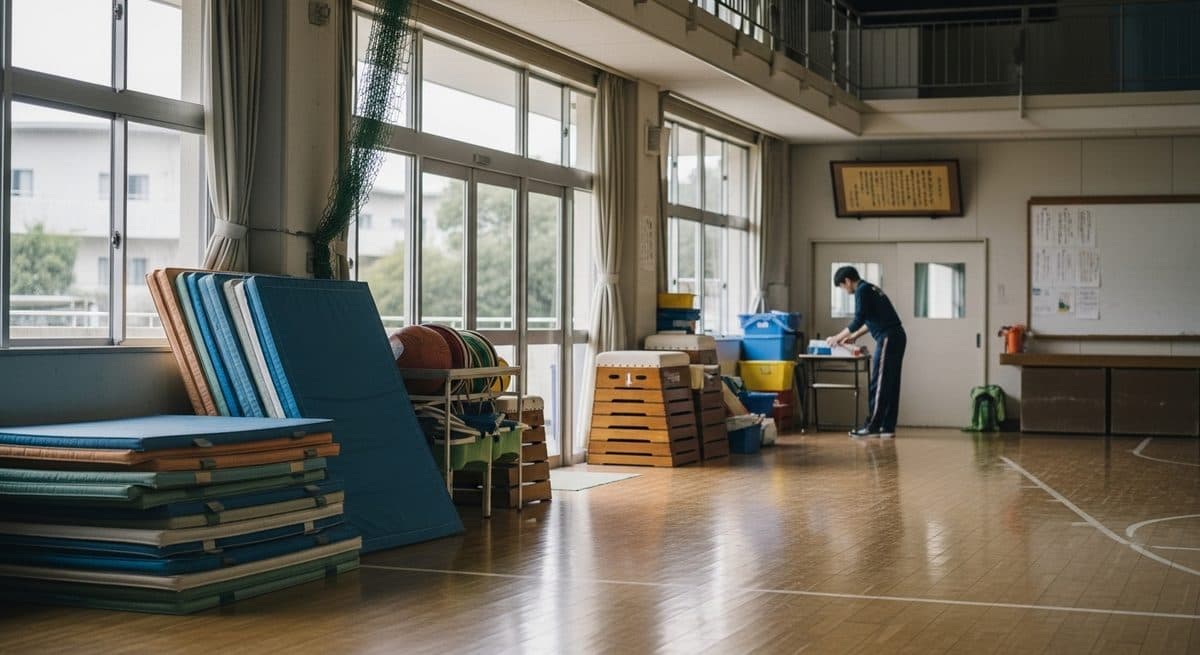
Teacher Attrition from Mental Illness Hits a Record 1,319 — Will the Raise Reach the Root?
Japan's School Teacher Statistics Survey shows 1,319 public school teachers left over mental illness in FY2024, a record, up 369 from the prior survey. The state has amended the Kyutoku Law to raise the teaching allowance from 4% to 10% in stages, yet long hours are cited in only 0.5% of leave cases. Does adding money reach the root of why teachers fall ill? This reads the downward spiral of attrition and vacancy, and the question of symptom versus cause.
What Divides Japan's Teacher Shortage Is the Prefecture: A 4.4x Recruitment Gap and 43 Worsening Local Governments
Japan's MEXT FY2025 Teacher Shortage Survey reports 3,827 unfilled positions nationwide, yet the real story is not the total. Across 68 reporting entities, 43 worsened, 23 improved, and only 8 reported zero shortage. The recruitment ratio for elementary teachers ranges from 4.8x in Kochi to 1.1x in Akita — a 4.4-fold gap. Japan's teacher shortage has entered a phase of locked-in regional disparity.
Japan Post Failed to State Terms to 167 Freelancers. The First Day of the Violation Period Is the Day the Law Took Effect
On 2 September 2026 the Japan Fair Trade Commission issued a recommendation to Japan Post under the Act on Ensuring Proper Transactions Involving Specified Entrusted Businesses. Terms were not stated promptly to 167 people, and payment due dates were neither set nor met for 140. The violation period runs from 1 November 2024 to 30 June 2025, and its first day is the day the law took effect. All ten recommendations in FY2025 involved a failure to state terms. This piece reads why the most basic obligation is the one that goes unmet.

When Private Afterschool Care Costs Exceed Take-Home Pay — The Market Mechanics of Japan's Child Penalty
Japan's public afterschool clubs leave 16,330 children on waitlists nationwide, 3,360 in Tokyo alone. Nikkei reports private fees running as high as ¥100,000 a month per child — exceeding take-home pay for multi-child households. This column reads the institutional silos and market sorting that turn the so-called "child penalty" into a structural phenomenon.
Previous
One Year Since Japan's Loneliness Countermeasures Act — Can We Quantify 'Connection'?
Next
Is Babysitter Pay a 'Business Expense'? — The Structural Fault Line in Childcare Tax Deductions
Get new columns by email
1-2 social structure analysis columns per week. Free to subscribe.
Join ISVD's activities?
Sign up to receive the latest research and activity reports. Feel free to reach out about collaboration or project participation.
Support ISVD’s research and activities
Support ISVD’s research and publications with JPY5,000 per year. There is no automatic renewal.