A Nation That Underinvests in Education — Japan's Public Spending at 56% of the OECD Average and the Inequality It Perpetuates
Japan's public spending on tertiary education stands at just 56% of the OECD average, with households bearing over half the cost. As defense spending reaches roughly twice the education budget, this article examines why reframing education as social investment matters, drawing on OECD data and social investment theory.
TL;DR
- Japan's public funding share for tertiary education is 37.5%, compared to the OECD average of 67.4%, approximately 56% of the benchmark
- In the FY2025 initial budget, defense spending at 8.7 trillion yen is approximately 2.05 times the 4.23 trillion yen allocated to education
- Heckman's research demonstrates a 13% annual ROI on early childhood education, yet Japan's public spending on pre-primary education is just 0.1% of GDP, the lowest in the OECD
What Is Happening
EAG 2025 data reveals Japan's international standing on education spending and the structure of household burden
Source: OECD Education at a Glance 2025 Japan Country Note
The OECD's "Education at a Glance 2025" (EAG 2025), published in September 2025, once again laid bare the international standing of Japan's education investment.
Total spending on educational institutions from primary through tertiary education stands at 3.9% of GDP, well below the OECD average of 4.7%. Yet the more revealing structure lies not in the aggregate but in how the burden is distributed between public and private sources.
For tertiary education specifically, public funding accounts for just 37.5% of total spending, against an OECD average of 67.4%. Japan's public share is approximately 56% of the OECD benchmark. The corollary: about half of tertiary education funding in Japan is provided by households, against an OECD average of 19%. Japanese families shoulder roughly 2.7 times the international norm.
Education's share of total government expenditure is also low. Japan allocates 7.1%, ranking 37th out of 42 OECD members, sixth from the bottom. As a measure of how much a government prioritizes education, this ranking sends an unambiguous signal.
A paradox coexists with these figures. Japan's tertiary attainment rate among young adults (25-34) reaches 66%, far surpassing the OECD average of 48% and placing Japan among the top five countries. High educational attainment despite low public investment is sustained by the excessive burden placed on households. What the state does not provide, families pay out of pocket. The sustainability of this structure is the central question.
Background & Context
Two decades of widening gap with OECD peers and fiscal competition with defense and social security spending
Japan's divergence from the OECD average on education spending is neither recent nor incidental. It is a structural, long-term trend.
Between 2005 and 2010, OECD countries increased their education expenditures by an average of roughly 40%. During the same period, Japan's increase was a mere 5%. Post-Lehman fiscal austerity was a factor, but while other OECD nations maintained or expanded education investment even during economic downturns, Japan moved toward cuts. This period was when the gap with the OECD became definitive.
The Defense-Education Inversion
Budget allocation priorities are starkly visible in FY2025 figures.
Source: FY2025 General Account Budget (Ministry of Finance, Japan)
The Ministry of Defense's initial budget stands at 8.7005 trillion yen. Just three years earlier, in FY2022, the defense budget was 5.4 trillion yen. It has expanded approximately 1.6-fold. The government targets achieving 2% of GDP (NATO standard) by 2027.
Education-related spending, meanwhile, amounts to 4.2339 trillion yen, less than half of defense spending. Defense expenditure is now approximately 2.05 times the education budget. An implicit assumption that education falls outside the scope of "national security" is embedded in these numbers.
Competition with Social Security
Another source of fiscal pressure is social security spending. Pension, healthcare, and long-term care expenditures consume roughly 33% of the general account budget and continue to rise with population aging. The allocation for child-rearing countermeasures (3.6 trillion yen annually for FY2024-2028) creates additional fiscal competition.
The Fiscal System Council (November 2024) emphasized efficiency gains and leveraging private funds for education. This direction focuses on "doing more within constrained budgets" rather than expanding the pie. The discussion of fundamentally increasing public investment remains marginal.
Conditions on the Ground
Underinvestment in education manifests directly in classrooms. Statutory salaries for primary teachers in Japan run from a minimum of USD 34 863 to a maximum of USD 66 530, against OECD averages ranging from USD 44 153 to USD 74 896. Moreover, real wages have declined 6% over eight years, while the OECD average rose 4%.
Class sizes pose further challenges. The average class in primary education contains 27 students against an OECD average of 21; at lower secondary level the gap widens to 32 in Japan versus 23 across the OECD. At upper secondary level, about 30% of teachers' working time is spent teaching, against 43% on average across the 26 countries with data. The rest goes to non-teaching tasks. Teachers are structurally prevented from devoting themselves to their core mission: teaching.
Recent Policy Developments
From April 2025, income limits on high school tuition support were abolished, extending the annual cap of 118,800 yen to all households. In FY2026, the support ceiling for private high schools will rise from 396,000 to 457,200 yen. These measures are estimated to represent a +0.1% of GDP impact.
However, these policies do not fundamentally alter the household burden structure in higher education. The expansion of high school-level support is an important step, but it does not move the needle on the 37.5% public funding rate for tertiary education.
Reading the Structure
Heckman's early investment thesis and Esping-Andersen's social investment state theory illuminate Japan's structural challenges
Two theoretical lenses help make sense of Japan's education spending structure.
The Return on Early Childhood Investment
The first is the early education investment thesis of James Heckman (Nobel Laureate in Economics, University of Chicago).
Heckman's research team, drawing on the longitudinal Carolina Abecedarian Project initiated in the 1970s, demonstrated that investment in quality early childhood programs (ages 0-5) generates an annual ROI of 13%. This figure exceeds long-term stock market average returns. It reflects comprehensive measurement of lifetime outcomes across education, health, labor earnings, and crime reduction.
The core of Heckman's theory is the "complementarity of skill formation." Capabilities acquired during early childhood, when brain plasticity is at its peak, amplify the effectiveness of all subsequent learning. Missed early investment leads to diminishing returns on later remedial spending. The policy implication is clear: earlier investment yields greater efficiency.
Japan's public spending on pre-primary education stands at 0.1% of GDP, against an OECD average of approximately 0.8%. This is the lowest in the OECD. The 2019 introduction of free early childhood education and care (for ages 3-5) was a significant step, but coverage for ages 0-2 remains limited to low-income households. Investment in precisely the period Heckman identifies as yielding the highest returns remains thin.
A panel data analysis covering 107 countries from 1970-2019 also confirmed that public investment in education has a statistically significant positive impact on real GDP per capita in both the short and long term (Education Spending and Economic Growth, IADB(外部サイト、新しいタブで開きます)). Education investment is not mere expenditure; it is the foundation of economic growth.
The Social Investment State
The second lens is the social investment state theory of Esping-Andersen.
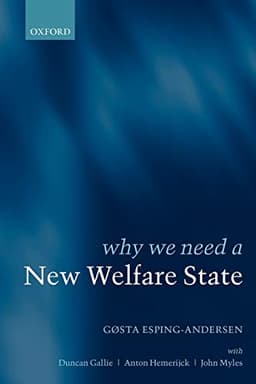
Why We Need a New Welfare State(外部サイト、新しいタブで開きます) (Esping-Andersen et al., 2002) presented a clear central thesis: the future of the welfare state lies in "investing in families" and "investing in children," with early public investment in education and childcare as the key to breaking the intergenerational reproduction of social inequality.
Esping-Andersen's welfare regime typology classifies advanced economies into three models: the social-democratic type (Nordic countries: universal, high-level public education investment), the conservative type (continental Europe: moderate public investment, family-dependent), and the liberal type (Anglo-American: low public investment, market- and family-dependent). Japan is classified closest to the conservative type, but its high household burden in higher education carries strongly liberal-type characteristics.
Through this theoretical framework, Japan's education spending structure can be understood as a "social investment deficit." While Nordic countries have positioned education as "infrastructure to be borne by society as a whole," Japan has treated education as "personal (household) investment." The household share of about half is the logical consequence of this foundational assumption.
The Paradox of "High Attainment, Low Public Investment"
As noted earlier, Japan's tertiary attainment rate of 66% among young adults is among the highest in the OECD. High educational achievement persists despite low public investment. This seemingly "efficient" structure is, however, sustained by cost-shifting to households.
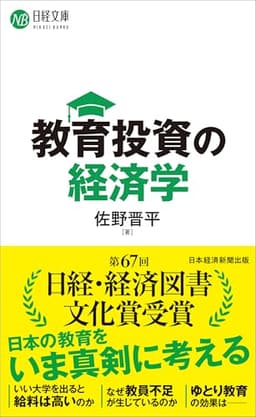
As Ryoji Matsuoka empirically demonstrated in 『教育格差』(Educational Inequality)(外部サイト、新しいタブで開きます) (Chikuma Shinsho, 2019), educational attainment in Japan is strongly determined by parental education level, income, and region. In societies with high household dependence on education costs, children from economically advantaged families have greater access to higher education. Shimpei Sano's 『教育投資の経済学』(The Economics of Education Investment)(外部サイト、新しいタブで開きます) (Nikkei Bunko, 2024) also argues from an economics perspective that insufficient public investment constitutes a bottleneck in human capital formation.
In other words, "high educational attainment" is not the product of national investment but the result of household burden. And that burden does not fall equally on all households. The structure that constrains educational access for low-income families is preserved by inadequate public investment.
The OECD Economic Survey of Japan (January 2024) explicitly recommended raising teacher salaries, expanding public investment in early childhood education, and increasing public funding for tertiary education. The prescriptions from the international community are clear, but their realization requires a paradigm shift: positioning education as social investment.
A budget where defense is more than double education
A budget in which defense spending exceeds education by a factor of two reflects Japan's current priorities. Those priorities will determine the quality of the nation's human capital two decades from now. Public investment in education is infrastructure that supports individual effort; it is an upfront investment in society's future returns. Without this recognition, education spending will remain merely "a budget line item eligible for cuts."
Remaining Questions
That public investment in education is insufficient is a fact the data demonstrates repeatedly. The challenge lies in building consensus on what follows. "Whose education, at which stage, deserves how much public funding?" is an inescapable choice within fiscal constraints. Heckman's research points to high returns from early childhood education, but this does not mean the cost burden on higher education can be left unaddressed. Esping-Andersen's social investment state theory is persuasive as a vision, but implementing it within Japan's fiscal structure is a distinct problem. Between the reality the numbers reveal and the direction society chooses, a considerable distance remains.
Rethinking Education as Social Investment, Starting from Organizations
Education spending may appear to be a matter of national budgets, but it can also be interrogated through organizational design and community structures.
Assess Your Organization's Social Design Score
Visualize your organization's strengths and gaps across 7 social design dimensions, including education investment (free).
Learn EBPM Fundamentals
Understand the Evidence-Based Policy Making framework and develop perspectives for evaluating education policy.
Consult on Social Issues
Free initial consultation on policy advocacy and research design in education and welfare.
Related Columns
- The Depth of Child Poverty — The Reality of Deprivation Beyond Relative Poverty Rates(このサイトの記事)
- The Blind Spots of "Free Tuition" — The True Weight of Education Costs That High School Fee Waivers Conceal(このサイトの記事)
Related Guides
References
Education at a Glance 2025: Japan Country Note — OECD (2025). OECD Publishing
Education at a Glance 2024: Japan Country Note — OECD (2024). OECD Publishing
OECD Economic Surveys: Japan 2024 — OECD (2024). OECD Publishing
Lifecycle Benefits of an Influential Early Childhood Program — 13% ROI — James J. Heckman et al. (2017). The Heckman Equation
Government expenditure on education, total (% of GDP) — Japan — World Bank (2022). World Bank Open Data
Higher Education Public Expenditure — Research Institute for Independent Higher Education (2023). Japan Association of Private Universities and Colleges
Returns to Investment in Education: A Decennial Review of the Global Literature — George Psacharopoulos, Harry Anthony Patrinos (2018). World Bank Policy Research Working Paper 8402
Books

Statistics cited in this article
- 1OECD Education at a Glance 2025(2025) Open source
- 2OECD Education at a Glance 2024, Japan country note(2024) Open source
- 3World Bank Government Expenditure on Education(2022) Open source
- 4Ministry of Defense FY2025 Defense Budget(FY2025) Open source
- 5Ministry of Finance, FY2025 Education and Science Promotion Budget(FY2025) Open source
- 6OECD Education at a Glance 2025, Japan country note(2025) Open source
- 7The Heckman Equation(2017) Open source
- 8OECD Education at a Glance 2024(2024) Open source