
What Is Happening
Imagine a conference room. The department head explains the plan for a new project. Of the ten participants, seven inwardly think "this will not work." Yet no one speaks up. The first person says "I think it's a good plan," and the next two nod. The remaining seven remain silent or offer perfunctory agreement. The meeting ends in fifteen minutes.
This scene occurs daily in Japanese organizations. Even when individuals privately hold dissenting views, they mistakenly perceive that "everyone else seems to agree" and choose silence. Social psychology terms this pluralistic ignorance (多元的無知) — the phenomenon in which members of a group mutually misperceive each other's true attitudes, thereby maintaining a state that no one actually desires.
In 2017, this structure was made visible at the national political level. Amid the Moritomo Gakuen and Kake Gakuen controversies, the term sontaku (忖度, anticipatory compliance) surged into wide circulation — it took the top prize in Sanseido's "New Words of 2017". Without explicit instructions from the prime minister, bureaucrats infer "the intentions of those above" and act accordingly — this phenomenon should be understood not as an individual moral failing but as a structural mechanism.
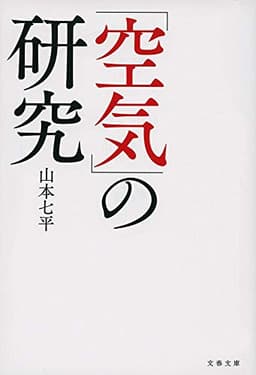
Yamamoto Shichihei (山本七平, 1977) had named this structure kūki (空気, atmosphere) nearly half a century earlier.
Background and Context
Yamamoto Shichihei's Analysis of "Kūki"
(『「空気」の研究』(Yamamoto Shichihei, 1977)(外部サイト、新しいタブで開きます)) argued in 「空気」の研究 (A Study of "Atmosphere")(外部サイト、新しいタブで開きます) that an invisible binding force called kūki underlies decision-making in Japanese society. Using the example of the Battleship Yamato's special attack sortie to Okinawa, he analyzed the process by which, despite every participant recognizing the recklessness of the operation, the decision could not be overturned due to kūki.
Crucial to Yamamoto's analysis is the point that kūki is not mere peer pressure. Kūki functions as what he called rinzaikan-teki haaku (臨在感的把握, apprehension through a sense of numinous presence) — a quasi-religious "domination of the setting." Even when logical counterargument is possible, defying kūki is socially sanctioned as an act of "disrupting the setting." That is, the cost attaches not to the content of dissent but to the act of expressing dissent itself.
Miyadai Shinji's Critique of "Reading the Air"
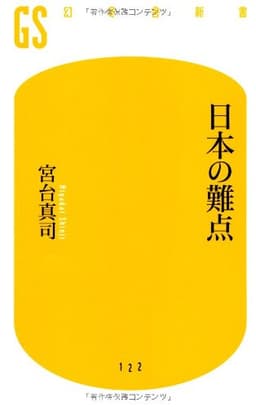
Miyadai Shinji (宮台真司, 2009) diagnosed the culture of "reading the air" (空気を読む) in 『日本の難点』 (Nihon no Nanten)(外部サイト、新しいタブで開きます) (『日本の難点』, Japan's Difficulties) as a symptom of the structural deterioration of Japanese society. According to Miyadai, "reading the air" is the avoidance of communication. By evading explicit, verbal consensus-building and relying on non-verbal "inference," conflicts are kept from surfacing.
This strategy avoids friction in the short term but degrades the decision-making capacity of the group over the long term. For if dissent is never expressed, the group cannot detect errors in its own judgment.
Social Psychology's Theory of Pluralistic Ignorance
The conceptual lineage of pluralistic ignorance, the counterpart to the false consensus effect, traces back to Allport (1924), but the term pluralistic ignorance itself first appears in Katz & Allport (1931)'s Students' Attitudes. Individual students did not, in fact, object to admitting minorities to fraternities, yet each believed that "the other students do object" — this observation is what gave the term its origin. The concept was subsequently refined by Prentice & Miller (1993) in a study of college students' drinking behavior. Students were personally negative toward excessive alcohol consumption yet mistakenly believed that "other students are positive about drinking." This misperception contributed to the maintenance of the drinking culture.
The core of pluralistic ignorance is that the divergence between private attitude and public behavior occurs simultaneously throughout the group. Each individual believes "I alone hold a different opinion," with the result that what is in fact the majority opinion goes unexpressed.
Connection to Proctor's Agnotology
Proctor's (2008) agnotology (無知学) presented three types of ignorance: native ignorance (the unknown), lost knowledge (the forgotten), and strategically produced ignorance (intentional production). Pluralistic ignorance does not fit neatly into any of these three types. The knowledge itself exists — the problem is that its expression is structurally suppressed.
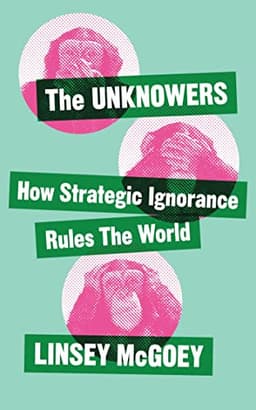
McGoey's (2019) concept of "useful ignorance" from The Unknowers(外部サイト、新しいタブで開きます) becomes relevant here. The state of "knowing but not speaking" is extremely "useful" for power structures. The locus of responsibility becomes obscure, and the legitimacy of decisions is retroactively assured.
Reading the Structure
The Three Stages of Silence-Structuring
Integrating kūki and sontaku within the theoretical framework of pluralistic ignorance reveals a three-stage mechanism that may be called silence-structuring (沈黙の構造化).
Stage 1: Raising the Cost of Dissent
The social cost of expressing dissent is structurally elevated. In Japanese organizational culture, the following costs are operative:
- Relational cost: Dissent is perceived as "disrupting the setting," damaging the speaker's interpersonal relationships.
- Evaluation cost: The label "lacking cooperativeness" (協調性がない) is directly tied to personnel evaluations.
- Membership cost: In extreme cases, dissent is interpreted as "lack of loyalty to the organization" and becomes a trigger for exclusion.
Crucially, these costs are uncodified. No rule states "dissent is forbidden." Indeed, many organizations officially declare that they "welcome open discussion." The costs are shared as tacit knowledge and internalized by individual members who "read the air."
Stage 2: Normalization of Silence
Once the high cost of dissent is perceived, silence becomes established as a rational option. What matters here is that silence has a dual function.
First, silence is self-protection. It is more rational for the individual to remain silent and await another opportunity than to pay the cost of expressing dissent.
Second, silence functions as a signal. Other members interpret silence as "agreement" — or at least "not disagreement." In this way, silence itself reinforces kūki in a self-reinforcing cycle.
At this stage, no intentional suppressor exists. As a result of everyone acting rationally, structural silence emerges. This is the mechanism of emergent ignorance production that Proctor's (2008) three types do not fully capture.
Stage 3: Fixation of Pluralistic Ignorance
As the normalization of silence progresses, the cognitive state within the group becomes as follows:
- Each member perceives: "I hold a dissenting view, but others seem to agree."
- This perception is shared by everyone, yet no one knows this.
- As a consequence, a policy or course of action that everyone opposes is executed as "the consensus of all."
This state is the fixation of pluralistic ignorance. Once fixed, self-correction is extremely difficult without an external shock — a scandal, a whistleblower, an organizational crisis.
The Relationship Between "Kūki" and "Sontaku"
Yamamoto Shichihei's kūki and the sontaku that gained attention from 2017 are different facets of the same structure.
Kūki = the pressure of the setting. An implicit norm pervading the group, non-verbally dictating "what can and cannot be said." Kūki is not intentionally created by any particular individual; it emerges from the group's interactions.
Sontaku = the individual's adaptation strategy. A cognitive and behavioral process in which, having read the kūki, an individual infers "the intentions of those above" without explicit instruction and acts accordingly. Sontaku is both an adaptation to kūki and a feedback loop that further reinforces it.
This relationship can be schematized as follows:
| Concept | Level | Direction | Nature |
|---|---|---|---|
| Kūki | Group | Acts upon the entire setting | Implicit norm / binding force |
| Sontaku | Individual | Bottom-up inference | Adaptation strategy / preemptive obedience |
| Pluralistic Ignorance | Cognitive | Aggregate of individual misperceptions | Cognitive foundation that sustains the structure |
Implications for Agnotology
The implication this analysis brings to agnotology concerns the reconsideration of intentionality.
Proctor's (2008) agnotology centered on ignorance production by actors with clear intent, such as the tobacco industry. Yet the pluralistic ignorance produced by kūki and sontaku is ignorance structurally produced without anyone's intention.
This is why this lab's coding axes design intentionality as a three-valued axis: "strategic" (intentional), "structural," and "emergent." The mechanism of kūki and sontaku is a paradigmatic case of emergent ignorance production — arising from the accumulation of individual rational actions.
Possibilities for Resistance
Pluralistic ignorance possesses a structural vulnerability: if the first person raises their voice, it can collapse in a chain reaction. This is known as the "Emperor's New Clothes" effect.
In practice, however, the cost of being "the first person" to speak is extremely high. Insights from organizational theory suggest the following conditions are effective for resistance:
- Assurance of anonymity: Institutional designs that separate utterance from the speaker — anonymous ballots, anonymous surveys.
- Institutionalization of dissent: Explicit appointment of a devil's advocate.
- Psychological safety: The organizational climate conceptualized by Edmondson (1999), in which failure and the expression of dissent are not punished.
Each of these directly intervenes in Stage 1 of silence-structuring — the raising of the cost of dissent.
Questions for This Lab
This case analysis poses the following questions for the Agnotology Lab:
- Under what conditions does emergent ignorance production occur, and what sustains it?
- Is the kūki of Japanese society structurally equivalent to silence-structuring in other cultures, or does it represent a culture-specific form?
- How does the mechanism of sontaku transform in digital environments (social media, chat tools)?
- Can the "collapse threshold" of pluralistic ignorance — how many people must speak up before the chain begins — be empirically measured?
These questions constitute the core of the cross-cutting theme "Conformity and Silence" and also connect to the analysis of media agenda-setting and invisibilization, for what media "do not report" may itself function as part of society-wide silence-structuring.
References
Agnotology: The Making and Unmaking of Ignorance — Proctor, R. N. & Schiebinger, L. (2008). Stanford University Press
Reference Books
Statistics cited in this article
- 1Sanseido, New Words of the Year 2017(2017) Open source
