
What Is Happening
"We did explain it to you, didn't we?"
The important matters explanation for a real estate contract, the terms and conditions of an insurance policy, a mobile phone rate plan, a prospectus for an investment trust — all are formally "disclosed." The information legally required has been provided. The consumer has received an explanation, signed, and is deemed to have consented.
But how many consumers have substantively understood that "explanation"?
Here lies a structure that agnotology (無知学) must analyze. Information is not concealed. Yet comprehension is impeded. Formal transparency and substantive opacity coexist — this state is precisely the mechanism that should be called "complexity weaponization" (複雑性の武器化).
A common pattern runs through the structure of consumer harm in Japan. Victims were not "deceived"; they "did not understand." And that "not understanding" is not accidental; it is built into the core of the business model.
Background and Context
The Lemon Market and Information Asymmetry
George Akerlof (1970) theorized the mechanism by which information asymmetry causes market failure in his "Market for Lemons" paper. In the used car market, the seller knows the quality of the car, but the buyer does not. This asymmetry drives good cars out of the market, leaving only lemons.
Akerlof's analysis addressed situations in which information asymmetry "naturally" exists. The structure analyzed here is different: information asymmetry is "intentionally maintained and expanded."
When a real estate agent gives a vague explanation knowing about a property's defects, that is classical information asymmetry. But when the structure of the contract itself is designed to make comprehension difficult — that is complexity weaponization.
The Two Faces of Nudge
Richard H. Thaler & Cass R. Sunstein (2008; 2021 revised) presented in 『NUDGE 実践 行動経済学 完全版』 (Nudge: The Final Edition)(外部サイト、新しいタブで開きます) the possibility of choice architecture that leverages human cognitive biases "for good" — modifying default settings and the presentation of information to encourage better choices.
But the design principles of the nudge can be used "for bad" in exactly the same way. What Thaler & Sunstein themselves termed "sludge" — the intentional introduction of friction to maintain choices disadvantageous to consumers — is the behavioral-economic foundation of complexity weaponization.
A mobile phone plan where cancellation is more complex than sign-up. A subscription requiring multiple clicks to opt out. Fees printed in small type. All are paradigmatic "sludge," functioning as mechanisms that convert consumers' "not knowing" into profit.
The Structure of Financial Literacy in Japan
According to the 2022 Financial Literacy Survey by the Central Council for Financial Services Information (金融広報中央委員会), Japan's financial literacy score falls below the OECD average. Japan's overall correct answer rate across 25 questions was 55.7%. On the 6 common questions used for international comparison, Japan scored 47% vs the US 50%, and 59.1% vs the UK 60.0% — all lower than both peer countries. Particularly low scores were recorded in understanding of compound interest, the concept of risk diversification, and the impact of inflation on purchasing power.
But the question to ask is not "why is Japanese financial literacy low?" The question to ask is "for whom is low Japanese financial literacy convenient?"
From the perspective of agnotology, low financial literacy should not be explained solely as "insufficient education." The fact that a state of low financial literacy is structurally advantageous for particular business models must be confronted.
Reading the Structure
Three Methods of Complexity Weaponization
Complexity weaponization in the Japanese consumer market can be classified into three principal methods.
Method 1: Intentional Complexification
Making the structure of products and services intentionally complex beyond the consumer's capacity for understanding.
The mobile phone rate plan is a paradigmatic example. Base fee, data volume, call options, handset discount, family discount, loyalty discount, cashback — combined in layers, these make it effectively impossible to compare final monthly costs. The 2019 amendment to the Telecommunications Business Act mandated the separation of handsets and service plans, but the fundamental complexity of rate plans has not been resolved.
Insurance products follow the same pattern. The rider structure of life insurance can become so complex that even the policyholder cannot grasp the full picture. Layer upon layer of riders is added to the main contract, each with its own conditions and exceptions. The result is cases where coverage is unavailable "when the time comes," processed as a matter that "was already explained."
The important matters explanation in real estate possesses the same structure. Legally mandated disclosure items are comprehensively covered, but the barrage of technical terminology and sheer volume impede understanding. Consumers are asked to sign before they have had time to digest the explanation.
Method 2: Design That Impedes Comparison
Design that intentionally makes comparison between products and services difficult.
The fee structure of financial products is a paradigmatic case. The management fee of an investment trust is expressed as an annual rate, while the sales commission is levied as a lump sum at purchase. The trust asset redemption fee is charged at the time of sale. Integrating these costs to compare "the total cost of holding this product for five years" is beyond the capacity of ordinary consumers.
After energy liberalization, the electricity rate plans of various companies employ different pricing structures (basic-fee-plus-usage, flat rate, time-of-use) — determining the "cheapest plan" requires one's own household's monthly and time-of-day electricity consumption data. Most consumers abandon this comparison and maintain their existing contract — which is precisely the outcome that complexity weaponization targets.
Method 3: Shifting Responsibility to "Self-Responsibility"
Using formal disclosure as a shield to shift responsibility for understanding to the consumer.
"We explained the important matters." "It's written in the terms and conditions." "You applied of your own judgment." These statements are legally legitimate. In substance, however, they function to shift responsibility for not understanding from the side that designed the comprehension-impeding structure to the side that could not understand.
This structure is isomorphic with the tobacco industry's argument that "smoking is a free individual choice." Reducing a structural problem to individual responsibility diverts attention from structural reform itself.
The Structurally Exploited Strata
Complexity weaponization does not affect all consumers equally. Particular strata are placed in structurally vulnerable positions.
The elderly: In addition to declining cognitive function, disparities in digital literacy compound. In-person sales of high-priced products accompanied by "courteous explanations" frequently become problematic.
Foreign residents: The language barrier compounds unfamiliarity with Japanese commercial customs. In real estate contracts, bank account opening, and mobile phone contracts alike, Japanese language proficiency and understanding of commercial customs are simultaneously required.
Financial literacy disparities: Carl T. Bergstrom & Jevin D. West (2020) noted in Calling Bullshit(外部サイト、新しいタブで開きます) that the ability to critically assess "bullshit" employing numbers correlates strongly with educational background and economic circumstances. As a result, those with lower financial literacy purchase higher-fee financial products, while those with higher literacy access low-cost index funds — information disparity reproduces economic disparity.
Connection to McGoey's Strategic Ignorance
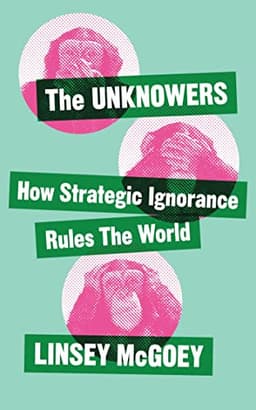
Linsey McGoey (2019) analyzed in The Unknowers(外部サイト、新しいタブで開きます) the role of strategic ignorance in maintaining power structures. "Pretending not to know" is both an individual act and an institutional strategy.
Complexity weaponization in predatory business can be regarded as the market version of McGoey's strategic ignorance. Companies know about consumers' "not knowing." Knowing this, they design to maintain that state. Yet, using the legal legitimacy of "we fulfilled our disclosure obligations" as a shield, they process it as "the consumer's problem that they didn't know."
This is structurally isomorphic with the analysis of strategic ignorance in EBPM in this lab. "Evidence has been presented. Yet the structure that impedes its use is maintained." Formal transparency concealing substantive opacity — this structure lies at the heart of the contemporary challenges that agnotology must analyze.
Perspectives for Resistance
Resisting complexity weaponization is insufficient through "improving consumer education" alone. The structure itself must be changed.
What nudge theory (Thaler & Sunstein) suggests is the possibility of "removing bad sludge" — institutionally constraining complexity itself. The 2019 mandate for separating handsets and service plans in mobile phone pricing may be one such example.
For financial products, mandatory "single annual fee rate" disclosure is one possible direction. The "single annual fee rate" disclosure obligation introduced by the UK's FCA (Financial Conduct Authority) is noteworthy as an attempt to institutionally reduce the difficulty of comparison.
Questions for This Lab
- In which industries, and to what degree intentionally, is complexity weaponization practiced — how can the gradient of intentionality be measured?
- What are the design principles for institutionally closing the gap between "formal disclosure" and "substantive understanding"?
- How effective is Japan's consumer protection legislation against complexity weaponization?
- How does the information exclusion of those in poverty (detailed in the next case analysis) interact with complexity weaponization?
Related Articles
- Poverty and Epistemic Exclusion — The Structure of 'Being Unable Even to Know'(このサイトの記事)
- The Doubt Manufacturing Industry — The Sixty-Year War of Tobacco and Climate(このサイトの記事)
- What Is Agnotology? — How Manufactured Ignorance Corrodes Society(このサイトの記事)
References
Calling Bullshit: The Art of Skepticism in a Data-Driven World — Bergstrom, C. T. & West, J. D. (2020). Allen Lane / Penguin Books
Reference Books


Statistics cited in this article
- 1Central Council for Financial Services Information, Financial Literacy Survey(2022) Open source