
The Structure Behind 9 Million Vacant Houses — Why Japan Can Neither Demolish Nor Utilize Them
Japan's 2023 Housing and Land Survey recorded a record 9 million vacant houses at a 13.8% vacancy rate. Of these, 3.85 million are abandoned properties with no plans for rental or sale. The residential land tax exemption, high demolition costs, and inheritance complexity form a triple deadlock that keeps vacant houses growing unchecked.
TL;DR
- The 2023 count of 9 million vacant houses at a 13.8% vacancy rate are both all-time highs; 3.85 million are abandoned properties accounting for 72% of the total increase
- The residential land tax exemption (reducing property tax by up to one-sixth) blocks demolition, while ¥1–1.5 million demolition costs and inheritance complexity accelerate abandonment
- The 2023 Vacant Houses Act amendment introduced the 'management-deficient vacant house' category, but reversing the structural increase requires controlling total housing volume
What Is Happening
The reality of 9 million vacant houses at a 13.8% vacancy rate and the surge in 3.85 million abandoned properties.
Vacant houses in Japan are no longer a problem confined to certain regions. According to the 2023 Housing and Land Survey published by the Statistics Bureau of Japan, the national count of vacant houses reached 9.0 million, with total housing stock at 65.02 million units and a vacancy rate of 13.8%. Both figures are all-time highs. Vacant houses have exactly doubled since 1993, when the count stood at 4.48 million.
What the 9 million comprises
The crux of the problem lies in the breakdown. Of the 9 million, 4.43 million are for rent, 330,000 are for sale, and 380,000 are secondary residences such as vacation homes. The remaining 3.85 million are classified as "other vacant dwellings" — properties with no plans for rental or sale. These abandoned properties increased by 370,000 from 2018, accounting for 72% of the total increase of 510,000. The primary driver of Japan's growing vacancy problem is the accumulation of properties that can neither be brought to market nor demolished.
Cannot sell, cannot rent, cannot afford to demolish
"My parents' house has been vacant for five years. Can't sell it, can't rent it, can't afford to demolish it. I just keep paying property tax."
Such accounts are far from rare. The vacant house problem arises at the intersection of macroscopic social changes — population decline and aging — and the economic and legal barriers faced by individual property owners.
Vacant houses by type (as of October 1, 2023)
Other (abandoned): 3.85M
~2x in 30 years; 72% of total increase
* 'Other' = no plans to rent/sell, no resident household. Primarily caused by post-inheritance neglect
🏠 Residential land tax exemption
Clearing land can raise property tax up to 6x → no demolition incentive
💰 Demolition costs
¥1M–1.5M for a standard wooden house; subsidies vary by municipality
📋 Inheritance complexity
Unknown owners / multiple co-owners → decision-making paralysis
Background & Context
The triple deadlock created by the residential land tax exemption, demolition costs, and inheritance complexity.
Can't Demolish — The Residential Land Tax Exemption Trap
The single largest structural factor keeping vacant houses standing is the residential land tax exemption. Land with a residential building on it receives a property tax reduction of up to one-sixth. Conversely, demolishing a vacant house and clearing the land removes this exemption, causing a sharp tax increase. The actual magnitude varies between four- and sixfold depending on assessed values and burden adjustments, but for property owners, the incentive is clear: it is cheaper to leave a decaying house standing than to tear it down.
Demolition costs represent another barrier. A standard wooden house costs approximately one to 1.5 million yen to demolish, with reinforced concrete and steel-frame structures costing even more. Municipal demolition subsidies exist, drawing on MLIT's Vacant House Revitalization Promotion Program, but eligibility criteria and subsidy amounts vary widely by municipality. Many owners make the rational calculation that demolition means a net loss while leaving the property as-is at least keeps taxes low.
Can't Utilize — Inheritance and Ownership Complexity
Behind the failure to bring vacant houses to market lies a structural barrier rooted in inheritance. According to the Ministry of Justice, approximately two-thirds of unknown-owner land stems from incomplete inheritance registration. From April 2024, inheritance registration became mandatory, requiring registration within three years of learning of the inheritance. Violations carry fines of up to 100,000 yen.
Yet mandatory registration alone does not solve the problem. For properties that have gone unregistered across multiple generations, the number of heirs can reach dozens. Without unanimous agreement, neither sale nor demolition can proceed, and if even one heir cannot be located, the process stalls. The total area of unknown-owner land has been estimated to rival the size of Kyushu. Beneath the vacant house problem lies a deeper dysfunction of the ownership system itself.
Regional disparity in vacancy rates
Highest vacancy rates
Highest abandoned property rates
* Prefectures with high vacancy rates and those with high abandoned property rates don't always overlap. Western Japan's depopulating areas show disproportionately high abandonment rates
The Reach of the Vacant Houses Special Measures Act
The Vacant Houses Special Measures Act, fully implemented in 2015, enabled municipalities to designate dangerous or unsanitary vacant houses as Specified Vacant Houses and apply graduated measures: advice, guidance, recommendation, order, and administrative subrogation. Properties receiving recommendations lose their residential land tax exemption.
The category added by the 2023 amendment
The December 2023 amendment introduced the new category of Management-Deficient Vacant House — properties at risk of becoming Specified Vacant Houses. This enables earlier intervention, with the residential land tax exemption revocable at the recommendation stage. The amendment also introduced the ability for municipal heads to petition courts for the appointment of building management agents, along with "Vacant House Utilization Promotion Zones."
Can 3.85 million homes be handled one by one
The amendment's aim is early intervention before properties deteriorate to the Specified Vacant House stage. However, individually certifying management-deficient vacant houses among 3.85 million abandoned properties and executing graduated measures demands enormous administrative capacity. The legal framework is being developed, but enforcement capacity has not kept pace.
Reading the Structure
Limits of the 2023 legal amendment and the necessity of total housing volume control.
Three structural dimensions emerge from this problem.
Tax rules, new-build bias, absolute ownership
First, the way tax policy shapes behavior. The residential land tax exemption was originally designed to promote residential occupancy. In a depopulating society, however, it functions perversely as an incentive not to demolish unoccupied homes. A social change unforeseen when the system was designed — declining household numbers alongside excess housing stock — has decoupled the system's purpose from its effect. The 2023 amendment allowing exemption revocation through management-deficient vacant house recommendations is progress, but a framework requiring case-by-case administrative intervention against millions of properties has inherent limits. What is needed is a redesign of the tax system itself — for instance, time-limited restrictions on exemption eligibility for properties without evidence of actual occupancy.
Second, the "new construction bias" in Japanese housing. According to projections by the Japan Research Institute, if current trends continue, vacancy rates exceeding 20% will emerge in multiple prefectures by the 2040s. Despite this, new housing starts remain at approximately 800,000 units per year. Japan's housing market has a remarkably low proportion of existing-home transactions compared to Western countries, perpetuating a cycle of "build new, abandon old." Without mechanisms to control total housing volume — new construction restrictions in high-vacancy areas, tax incentives for existing-home transactions — the upward trend in vacancies will not reverse.
Third, the tension between the "absoluteness of property rights" and public interest. Japan's Civil Code strongly protects property rights, making forcible administrative intervention in abandoned houses a high bar to clear. Administrative subrogation exists as a last resort, but cost recovery is frequently difficult, making it a burden for municipalities as well. Given the reality that vacant houses damage neighboring properties, degrade the landscape, pose security risks, and lower local asset values, how to design social responsibility for "non-use ownership" is a question that challenges the very concept of property rights.
Remaining Questions
The question is whether Japan can shift from a society that keeps building houses to one that can also reduce them.
Nine million vacant houses is not merely a number — it is a demand for structural transformation that a depopulating society is placing on housing policy. The distortion of property taxation, the limits of the inheritance system, and the new-construction bias of the housing market are not separate problems but symptoms of a system designed for a society that keeps building houses failing to adapt to a reality where houses are surplus.
Vacant-house policy needs to consider demolition costs, taxation and new housing supply alongside management of existing vacant properties. Examine changes since the 2023 reform, together with demand for reuse and new construction.
Related Columns
- Population Decline and Tokyo Concentration — The Structure of Regional Disappearance(このサイトの記事)
- Disappearing Municipalities — What the Data Shows About Regional Futures(このサイトの記事)
- Agriculture's Structural Crisis — Rethinking Food Security(このサイトの記事)
References
2023 Housing and Land Survey: Basic Tabulation Results on Housing and Households — Statistics Bureau, Ministry of Internal Affairs and Communications (2024). Statistics Bureau of Japan
Act on Special Measures Concerning Promotion of Measures Against Vacant Houses — Ministry of Land, Infrastructure, Transport and Tourism (2023). e-Gov Laws
Overview of Vacant House Countermeasures — Housing Bureau, MLIT (2025). Ministry of Land, Infrastructure, Transport and Tourism
Overview of Mandatory Inheritance Registration — Civil Affairs Bureau, Ministry of Justice (2024). Ministry of Justice
Projections of Vacant House Counts and Rates by Prefecture Through the 2040s — Japan Research Institute (2025). Japan Research Institute
Recommended Reading
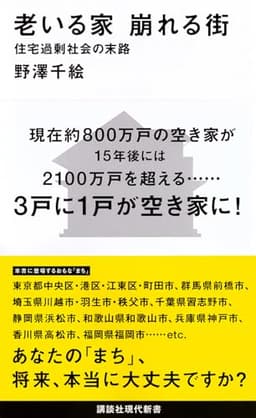

Statistics cited in this article
- 1Statistics Bureau, "2023 Housing and Land Survey — Summary of Results"(October 2023) Open source
- 2Statistics Bureau, Housing and Land Survey(October 2023) Open source
Questions to Reflect On
- Are there properties among your family's holdings or neighborhood that could become abandoned vacant houses in the future?
- Where should the line be drawn between treating housing as purely private property and treating it as social infrastructure subject to public management?
- How can the freedom to build new homes coexist with the responsibility not to abandon existing ones?
Key Terms in This Article
- Management-Deficient Vacant House
- A category established by the 2023 amendment to the Vacant Houses Special Measures Act. Refers to inadequately maintained vacant houses at risk of becoming Specified Vacant Houses. Properties receiving recommendations lose their residential land tax exemption.
- Residential Land Tax Exemption
- A tax provision that reduces property tax on residential land by up to one-sixth. Since demolishing a vacant house removes this exemption, it creates an economic incentive to leave deteriorating houses standing rather than clearing the land.
- Specified Vacant House
- A designation under the Vacant Houses Special Measures Act for properties posing risks of collapse or sanitation hazards. Designated properties face graduated measures: advice, guidance, recommendation, order, and administrative subrogation.
Related Content

Vote-Weight Disparity Passes 2x in 16 Districts — Japan's Last Redistricting Started at 1.999
28 Firms Raided Over Suspected Bid Rigging in Condominium Repairs — Japan Named the Method Nine Years Ago and Published the Going Rates From 944 Projects
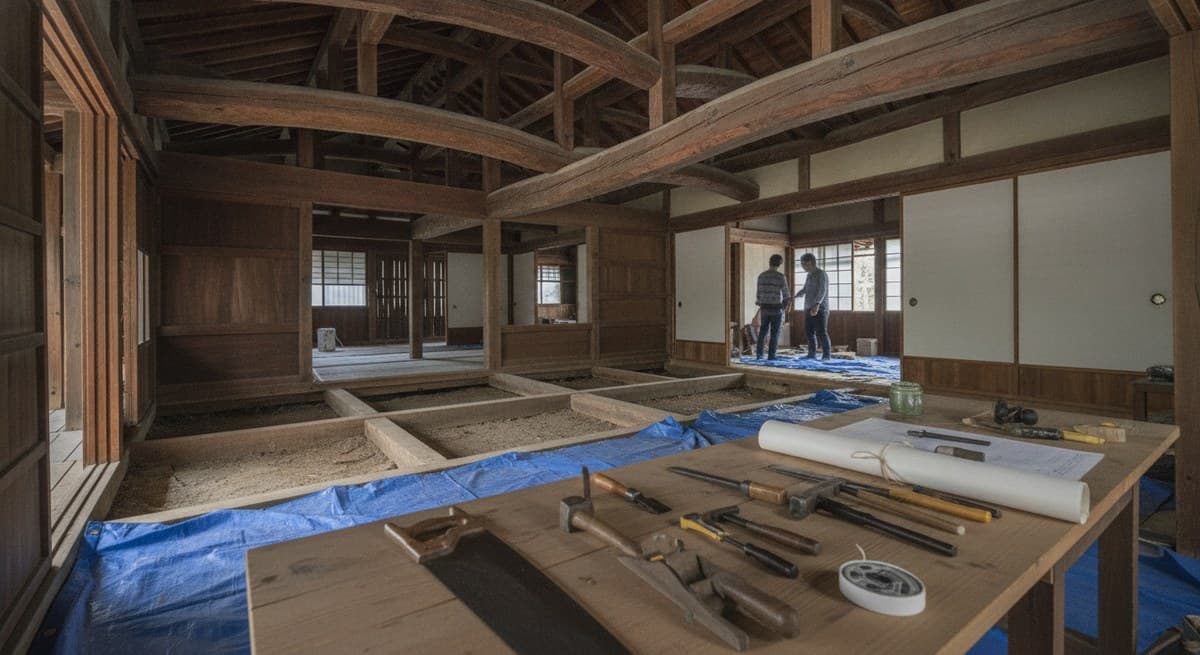
Repairs Keep Surfacing After You Buy a Kominka — The Information Gap Born of Inheritance and Aging
Regional Revitalization 2.0 and the '10 Million Related Population' Target: Are Means and Ends Reversed?
Previous
The 'Invisible Walls' of Disability Pension — Structural Barriers from Application to Receipt
Next
20% of Japan's Water Pipes Are Past Their Service Life — Data on an Invisible Infrastructure Crisis
Get new columns by email
1-2 social structure analysis columns per week. Free to subscribe.
Join ISVD's activities?
Sign up to receive the latest research and activity reports. Feel free to reach out about collaboration or project participation.