
Farm Machinery That Runs Only Days a Year — The Structure That Keeps Individual Ownership Locked In
A newcomer farmer in Takamori, Kumamoto faces machinery worth millions of yen that runs only a few days a year. This is not bad luck. MAFF data—an average of 3.8 hectares per farm, 24.3% use of paid support services, 28.5% for equipment sharing—reveals why joint use fails to spread, and points to reframing farm machinery as a quasi-public good.
TL;DR
- The average cultivated area per farm is 3.8 hectares nationwide (2.7 in prefectures outside Hokkaido), so individually held costly machinery is structurally underused
- Paid agricultural support services are used by only 24.3% of farmers, and equipment-sharing services by just 28.5% of those users
- What blocks joint use is not willingness alone but barriers of information, price, and work timing, and the absence of a governance base such as usage logs and shared responsibility
Respondents are farmers who can use only part of the services they want, plus those who intend to use them (n=3,395, multiple answers). The second reason, "felt no need" (30.6%), reflects thin demand, while the top reason—not having looked into the services—and barriers of price and timing also weigh heavily. Source: MAFF, "Survey on Attitudes toward Agricultural Support Services" (FY2022, published December 2022).
What Is Happening
Machinery worth millions of yen runs only days a year—not bad luck, but tiny farms holding costly equipment individually across the country
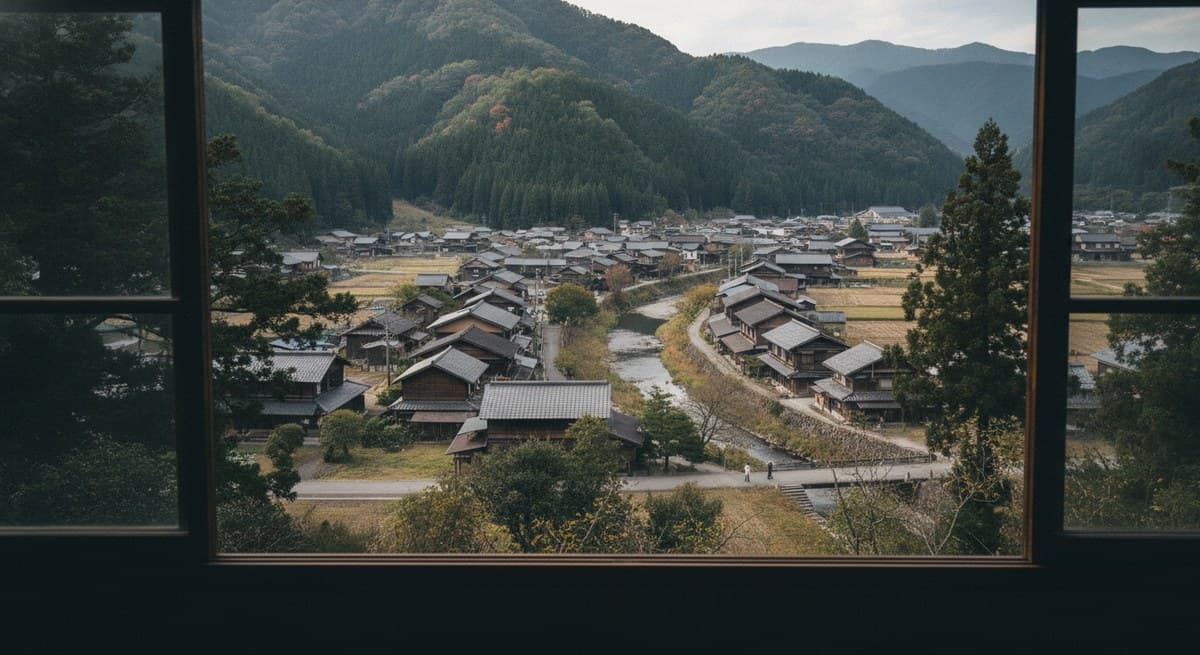
In Takamori, Kumamoto Prefecture, a newcomer to farming grows bell peppers in about 5,000 square meters of greenhouses. As , a combine harvester and other machines each cost more than two million yen, yet run only a few days a year. After the harvest season, cleaning is outsourced to the maker at about fifty thousand yen once a year. Greenhouses need re-covering roughly every seven years, costing one hundred thousand to one hundred fifty thousand yen per house when done by a contractor.
What stands out here is not the price of the machinery. It is that no record exists of who used it, when, or for how long. Management depends on the head of the group's memory, and the newcomer holds back from using the machines, delaying planting to shift the timing. Sometimes the previous user's rice remains inside a machine and varieties get mixed.
Reading this as individual bad luck is premature. According to MAFF's FY2026 Survey on Agricultural Structure Dynamics, the average cultivated area per farm is only 3.8 hectares nationwide, and 2.7 hectares in prefectures outside Hokkaido. Core agricultural workers have fallen to 986,600. Costly machines held individually by each of many tiny farms: this combination itself structurally produces low utilization.
On the supply side, sharing is still thin. In a survey of households that include certified farmers, paid agricultural support services are used by only 24.3% of farmers, and among them, the "equipment-supply type" that corresponds to machinery sharing is used by 28.5%. Even across all users of paid services, 61.5% say they can use only part of what they want.
Background & Context
Short weather-bound work windows make shared use risky when needed; barriers of information, price, and timing meet a shrinking workforce
Why does ownership fall back on the individual? First, the timing of the work is tightly bound to weather and crop growth. The window for transplanting or harvesting is short. Share a machine, and that short window overlaps with others, creating the risk of not being able to use it on the day you need it. Indeed, 15.9% of farmers cited "cannot book at the desired time" as a reason for not using paid services. When bad weather shifts the work, this tug-of-war grows fiercer.
Second, there are barriers of information and price. The most common reason for non-use is "have not looked into the services concretely," at 31.9%, followed by "felt no need to use them" at 30.6% and "fees are too high" at 24.0%. The second—"felt no need"—reflects thin demand itself. But the rest belong to the design of supply and information: what is available is invisible, prices do not line up, and timing does not mesh. Willingness alone cannot explain it; matching design weighs heavily.
Third, the carriers themselves are shrinking. The number of farms keeps contracting, down 4.4% year on year, and though incorporated farms grew 2.4% as consolidation advances, the layer of individual carriers who run joint use day to day thins every year.
Back to the field in Takamori: relying on the group head's memory because no usage records exist shows that the minimum foundation for sustaining joint use as an institution—usage logs, cleaning responsibility, rules for sharing repair costs when a machine breaks—cannot be maintained in a field where carriers have dwindled. That subsidy reports must be typed by hand into Word every six months, consuming enormous time, has the same root. The layer of clerical work and governance that supports operation is thin.
Reading the Structure
Treat machinery as a quasi-public good optimized locally; add usage logs and responsibility rules to existing joint-use subsidies
What comes into view here is room to question the very premise that farm machinery is a private asset each household should own. An asset that runs only a few days a year and would suffice if circulated within the community is close to a . It can be reframed as something to optimize at the community scale.
The institutional template already exists. Germany's spread as a broker that does not own machinery itself but arranges lending among farmers. By the organization's recent figures, it runs 230 regional rings and counts some 178,000 member farms. This idea of institutionally separating ownership from use entered Japan early. The was founded in various areas from 1974, modeled precisely on the Maschinenring.
Nor is there a need to create new subsidies to encourage joint use. The continues as its sixth-term program (FY2025–FY2029) and includes the joint use of machinery and farm work within community-agreement activities. Some municipalities, like , support the introduction of jointly used machinery at a one-third subsidy rate with a cap of one million yen. The pieces are scattered about.
If so, the move is less to create a new budget line than to embed into existing joint-purchase and joint-use schemes, as a public good, the operating rules of usage logs, cleaning responsibility, and settlement when machines break. This small institutional fix turns scattered subsidies into joint use that actually runs. In another community of the same town, the Kusakabe district, to protect farmland that had become hard to cultivate as farmers aged, seven of them founded the in 2015 and made consolidating machinery a strategy. It is a shift from "each household protects its own farmland" to "the community protects the community's farmland." Equipment, too, can be reframed along the same line.
Machines that run only a few days a year, and yet each household keeps buying them. This structure is not an error of farmers' judgment but the consequence of a thin institutional arrangement for separating ownership from use, and of a thin governance layer to support it. The view that redesigns equipment as a community asset connects straight to the practice of a social vision built on the utilization of public assets.
Further Reading
- 日本農業への正しい絶望法 (A Proper Way to Despair over Japanese Agriculture)(外部サイト、新しいタブで開きます) (Yoshihisa Godo, Shincho Shinsho, 2012) — a perspective that refuses to romanticize agriculture and views it coolly as structure. (In Japanese.)
- シェア 〈共有〉からビジネスを生みだす新戦略 (What's Mine Is Yours: The Rise of Collaborative Consumption)(外部サイト、新しいタブで開きます) (Rachel Botsman & Roo Rogers, NHK Publishing, 2010) — an overview of how the center of value shifts from ownership to use. (In Japanese.)
References
Results of the FY2026 Survey on Agricultural Structure Dynamics — Ministry of Agriculture, Forestry and Fisheries, Statistics Department (2026). Ministry of Agriculture, Forestry and Fisheries
Results of the Survey on Attitudes toward Agricultural Support Services (FY2022) — Ministry of Agriculture, Forestry and Fisheries, Statistics Department (2022). Ministry of Agriculture, Forestry and Fisheries
Fostering and Securing Agricultural Support Service Providers — Ministry of Agriculture, Forestry and Fisheries (2024). Ministry of Agriculture, Forestry and Fisheries
Statistics cited in this article
- 1MAFF, FY2026 Survey on Agricultural Structure Dynamics(FY2026 (2026)) Open source
- 2MAFF, FY2026 Survey on Agricultural Structure Dynamics(as of Feb 1, 2026) Open source
- 3MAFF, Survey on Attitudes toward Agricultural Support Services(FY2022) Open source
Questions to Reflect On
- In your area, are usage records and shared-responsibility rules in place for equipment and machinery meant to be used publicly
- Are you writing off weak joint use as a problem of willingness? Which barrier—information, price, or timing—is actually in the way
- Which works first, a new budget or adding a layer of governance to existing arrangements
Key Terms in This Article
- Quasi-public Goods
- Goods with characteristics between pure public goods and pure private goods. Many can benefit from them, yet rivalry arises when use concentrates in particular periods or users, so their provision and allocation require social coordination. Education, roads, and water infrastructure are common examples. Equipment that is sufficient when circulated locally also approaches this character when optimized collectively rather than owned individually.
Related Content

Inherited Forest Land Without Clear Boundaries — Negative Assets and the Making of Owner-Unknown Land
A family in Imari, Saga inherited about 4,300 square meters of forest whose boundary survives only by word of mouth; timber is worth less than surveying, yet disaster liability stays with the owner. Owner-unknown land reached about 4.1 million hectares in 2016 (exceeding Kyushu's main island) and a projected 7.2 million by 2040, while the cadastral survey sits near 53%. This reads how the four faces of one piece of land—ownership, boundary, benefit, and liability—split apart while registration, cadastral survey, forest management, the environment tax, and treasury absorption each pursue them separately, and points to redesigning ownership.
Bear Injuries Hit a Record 216 in Japan — Depopulation Has Emptied the Hands That Tended the Boundary
By Japan's Environment Ministry, bear-inflicted injuries hit a record 216, with 13 deaths, in FY2025, and sightings reached 50,801, 2.1 times FY2023. But a poor nut crop is only the trigger. Depopulation has drained the hands that tended the satoyama; abandoned farmland is turning, in quality, back into forest; and the buffer between people and the wild is dissolving from within. This reads not culling versus coexistence, but the vacancy of who manages the boundary.
Kumamoto's Car Society Cannot Be Solved by Roads — Transit's Downward Spiral and Planning Backward from Where People Live
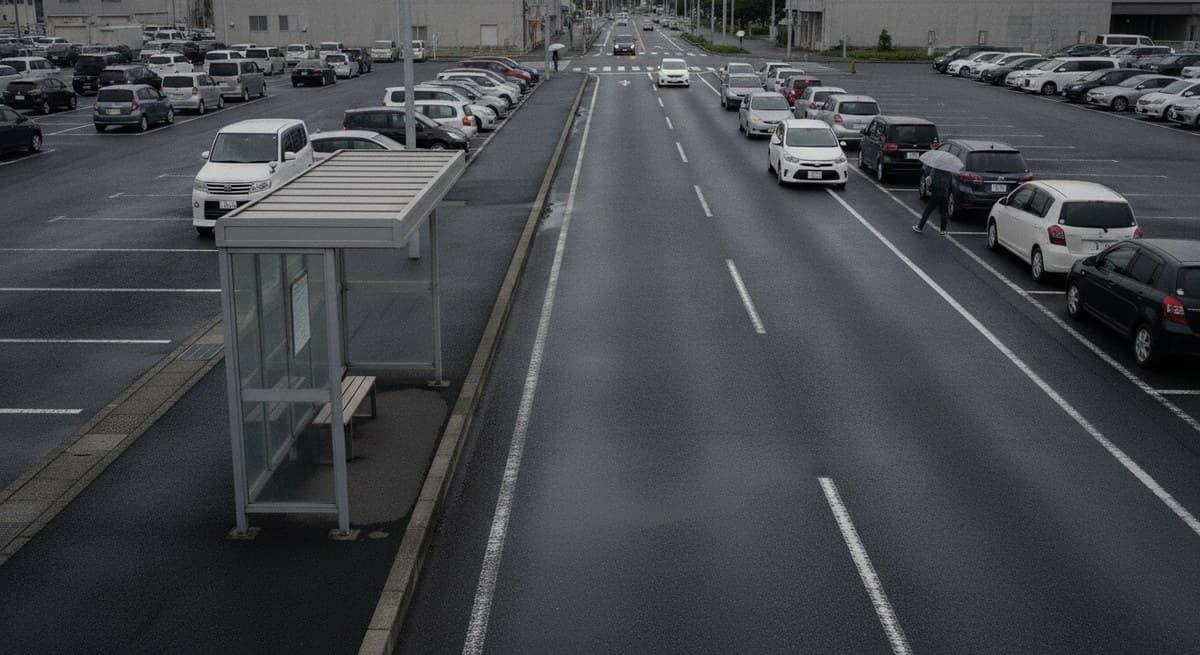
Congestion is worsening in the Kumamoto urban area, where semiconductor industry is concentrating. The Kumamoto Urban Area Person Trip Survey shows the car's mode share rising from 59.3% in 1997 to 67.3% in 2023, while the transit share fell to 5.2%. Yet total travel has fallen to 0.85 times its 2012 level, so congestion cannot be explained by the volume of traffic across the urban area. Adding roads does not clear congestion; in an expressway toll-free trial, traffic rose about 79%. This reads the downward spiral in which driver shortage leads to cuts, fewer riders, unprofitability, and withdrawal, and points to reconnecting where people live with transit by working backward, rather than widening roads.
Repairs Keep Surfacing After You Buy a Kominka — The Information Gap Born of Inheritance and Aging
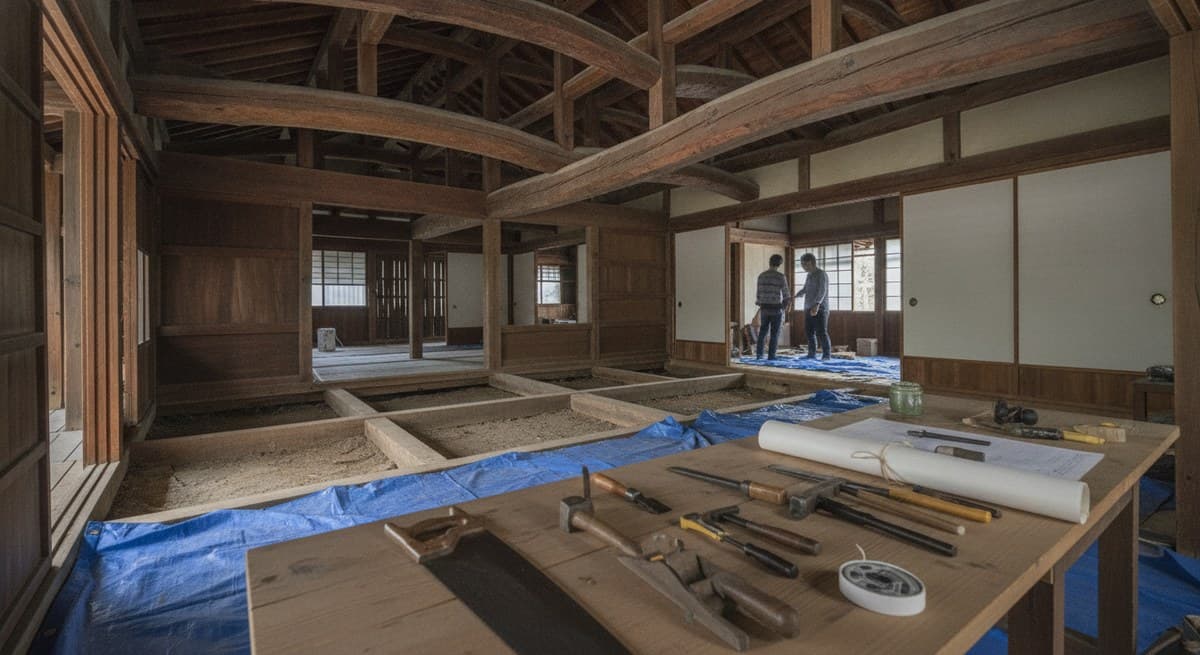
A newcomer who bought an old house in the mountains of Nara found, only after moving in, a well that ran dry for two months, mold, and drainage failures. Japan holds 9.002 million vacant homes at a 13.8% vacancy rate, 80.9% of vacant detached houses are the neglected kind, and more than seven in ten inherited vacant homes already carry decay or damage. Repairs surfacing after purchase are the consequence of a three-layer information gap: disclosure that stops at the state of provision of facilities, sellers who do not know the condition amid inheritance and aging, and vacant-house banks that only 3.3% of households registered with even among those that resolved a vacant home.
Previous
Mental-Disorder Workers' Comp Awards Hit a Record 1,082 (FY2025): How Japan's Occupational Injury Shifted from Overwork Death to Psychological Strain
Next
School Pools Are Disappearing — How Fiscal Gaps Between Municipalities Become Gaps in Learning to Swim
Get new columns by email
1-2 social structure analysis columns per week. Free to subscribe.
Join ISVD's activities?
Sign up to receive the latest research and activity reports. Feel free to reach out about collaboration or project participation.
Support ISVD’s research and activities
Support ISVD’s research and publications with JPY5,000 per year. There is no automatic renewal.