
Mental-Disorder Workers' Comp Awards Hit a Record 1,082 (FY2025): How Japan's Occupational Injury Shifted from Overwork Death to Psychological Strain
In July 2026, approved workers' compensation claims for work-related mental disorders reached a record 1,082 — a seventh consecutive annual increase, with a recognition rate of 28.2%. The leading cause was power harassment, and customer harassment and sexual harassment drew level at 127 cases each. Meanwhile, cardiovascular and cerebrovascular claims from long working hours stood at just 217. The center of gravity of occupational injury has moved from "quantity of time" to "quality of relationships."
TL;DR
- FY2025 approved mental-disorder workers' comp claims reached 1,082, a record high — up 26 from the prior year's 1,056, a seventh straight annual increase, at a recognition rate of 28.2%
- The leading triggering event was power harassment (222). Customer harassment (127) and sexual harassment (127) drew level, both above major workload change
- Long-hours cardiovascular/cerebrovascular claims totaled 217, about one-fifth of the mental-disorder figure. The main front of occupational injury has moved to psychological strain
Note: This article explains statistics and institutional structure as general information; it does not offer guidance on any specific workers' compensation claim. For actual filing and recognition, please consult a licensed labor and social security attorney (sharoshi), a lawyer, or your nearest Labour Standards Inspection Office.
What Is Happening
Approved mental-disorder claims hit a record 1,082; power harassment led, and customer and sexual harassment drew level at 127 each
On July 15, 2026, Japan's Ministry of Health, Labour and Welfare released its FY2025 report on workers' compensation for karoshi and related conditions. Approved claims for work-related mental disorders reached 1,082 cases, a record high. That is up 26 from the prior year's 1,056. The recognition rate was 28.2%.
At the entry point of the system, filed claims numbered 4,958, up sharply from the prior year's 3,780. Of the recognized cases, suicides (including attempts) numbered 76, down from 88 a year earlier.
Breaking the approvals down by triggering event makes the structure clear.
Total approved claims: 1,082, a record high (the rise continues). Customer harassment (127) and sexual harassment (127) drew level. Source: MHLW, FY2025 "Workers' Compensation for Karoshi and Related Conditions" (published July 15, 2026).
The largest category was power harassment from superiors, at 222 cases. The second rank is the striking one. "Suffering egregious nuisance behavior from customers, clients, or facility users" — customer harassment — reached 127 cases, and sexual harassment also reached 127, drawing level. Both stand above major changes in job content or workload (113). The picture in which harassment's three types occupy the top ranks has grown sharper still.
Background & Context
The 2023 criteria revision widened recognition, as occupational injury's center moved from long-hours cases to psychological strain
The "gateway widening" of the recognition criteria
It is too quick to read the rise as "workplaces suddenly got worse." First, we must separate out the effect of a change on the institutional side.
In September 2023, the Ministry revised its . In that revision, "suffering egregious nuisance behavior from customers, clients, or facility users" was added as a specific triggering event: customer harassment. At the same time, concrete examples of the six types of power harassment were spelled out in the assessment table.
In other words, strains that had not previously been articulated as grounds for recognition can now be formally captured as "psychological load caused by work." The rise in cases includes not only worsening reality but also a surfacing produced by a wider net of recognition.
Even so, the fact that filed claims themselves have risen sharply from the prior year cannot be dismissed. If the gateway had merely widened, filings could have stayed flat. That the number of people coming forward keeps climbing shows that psychological load is accumulating as a reality, too. "Surfacing" and "worsening reality" are happening at once.
The "main front" of occupational injury has moved
Once, the symbol of occupational injury was death from overwork. Long hours brought on cerebrovascular and cardiovascular disease and took lives. The benchmark for judgment is the , with 80 hours of monthly overtime serving as one standard.
What has become of that overwork-death category? Approved cardiovascular and cerebrovascular claims stood at 217. That is down from 241 a year earlier, and against the 1,082 mental-disorder cases it is about one-fifth. The center of gravity of workers' compensation has moved from the physical collapse of long hours to the psychological collapse of strain.
This move is also the flip side of working-hour regulation working to a degree. Caps on overtime have advanced, and hours long enough to destroy the body have, in principle, been curbed. But the burden did not vanish; it changed form.
Harassment moved to the front of the labor problem
Harassment — power, customer, and sexual — occupies the top ranks by triggering event. It signals that the center of the burden of work has moved from the volume of tasks to relationships in the workplace and with customers.
That customer harassment has risen to draw level with sexual harassment is especially telling. It first surpassed sexual harassment in FY2024, and in FY2025 the two stood level at 127 each. The standing of "the customer" can become a breeding ground for harm against workers. This asymmetry is now counted as an independent ground for recognition.
27.0% of awards are in health and welfare
The published material carries an industry breakdown. There is a concentration in it that does not appear in the headline.
By industry, health and welfare leads with 292 awards, followed by manufacturing at 158, wholesale and retail at 116, transport and postal at 104, and construction at 98. Health and welfare alone is 27.0% of the 1,082.
The concentration starts at the claim stage. Health and welfare accounts for 1,288 claims, or 26.0% of the 4,958 total.
Drilling into subcategories, it collapses into two. Social insurance, social welfare and care services account for 151 and medical services for 139, together 290. Of the 292 awards in health and welfare, these two account for 290.
- Health and welfare292238 women / 2 suicides
- Manufacturing15821 suicides
- Wholesale and retail11610 suicides
- Transport and postal104
- Other industries102
- Construction9815 suicides
- Accommodation and food64
- Services57
- Information and comms41
- Finance and insurance23
- Education14
- Agriculture, forestry, fishing13
81.5% of health and welfare awards are women
The breakdown by sex is published too. Of the 1,082 awards, 530 — 49.0% — went to women. Overall it is close to even.
Health and welfare is not. Of its 292 awards, 238 went to women, 81.5%. Of all 530 awards to women, 44.9% sit in this one industry.
The subcategories run the same way. Of the 151 in social insurance, social welfare and care services, 117 are women; of the 139 in medical services, 119.
The industry with the most awards is not where the suicides are
The material also gives suicides (including attempts) as a subset within each industry. The shape differs from the award distribution.
Suicides within awards number 21 of manufacturing's 158, 15 of construction's 98, and 10 of wholesale and retail's 116. As shares, 13.3% and 15.3%.
Health and welfare has 2 of 292. 0.7%.
The highest subcategory rate is equipment installation work, at 6 of 30, or 20.0%.
By count, health and welfare leads. The people dying are concentrated in manufacturing and construction. Two phenomena of different character sit inside the single category of occupational mental disorder.
Managers are 5.2% of awards and 25.0% of suicides
By occupation the split becomes sharper still.
Professional and technical workers lead with 296 awards, followed by service workers at 174, clerical workers at 165, production process workers at 116 and sales workers at 109. Managers account for 56, or 5.2% of the total.
The suicide subset reverses it. Of the 56 awards to managers, 19 are suicides. 33.9%. One in three.
Against the 76 suicides overall, the 19 among managers are 25.0%. The other occupations run at 16 of 296 for professional and technical workers (5.4%), 6 of 43 for construction and mining workers (14.0%), 12 of 116 for production process workers (10.3%) and 5 of 165 for clerical workers (3.0%).
One of the smallest occupational groups by award count carries the densest concentration of suicides. Managers are the group most often discussed as the source of harassment. Within the same statistics, they are also the group dying at the highest rate.
Awards by count
1,082 total
- Professional and technical
- 296
- Service
- 174
- Clerical
- 165
- Production process
- 116
- Sales
- 109
- Managers
- 56 (5.2%)
Suicides as a share of awards
76 suicides in total
- Managers
- 19 / 56 = 33.9%
- Construction and mining
- 6 / 43 = 14.0%
- Production process
- 12 / 116 = 10.3%
- Professional and technical
- 16 / 296 = 5.4%
- Service
- 7 / 174 = 4.0%
- Clerical
- 5 / 165 = 3.0%
Managers are 5.2% of awards but 19 of the 76 suicides, or 25.0%.
Claims rose 31.2% in a year
The entrance figures are moving too. Claims rose from 3,780 in FY2024 to 4,958 in FY2025, up 1,178. An increase of 31.2% in one year.
Determinations went from 3,496 to 3,839, up only 343. Subtracting 3,839 determinations from 4,958 claims leaves 1,119 with no conclusion within the year.
The 28.2% recognition rate is against the 3,839 determined. Taking the 4,958 who filed as the denominator gives 21.8%.
Without settling first what a figure measures, the same statistics yield different stories. How indicator design drives the result was covered in designing outcome indicators(このサイトの記事).
Reading the Structure
As work's burden shifts from quantity of time to quality of relationships, prevention lags behind after-the-fact recognition
- Claims4,958up 31.2% from 3,780
- Determined3,839↓ 1,119 had no conclusion within the year
- Awarded1,082recognition rate 28.2%
The 28.2% rate is against the 3,839 determined. Against the 4,958 who filed it is 21.8%.
From "quantity of time" to "quality of relationships"
Death from overwork was, at bottom, a problem of the quantity of time. How many hours one worked set the body's limit. It is easy to count and relatively easy to regulate.
Mental-disorder workers' compensation is a problem of quality. With whom, and in what kind of relationship, did one work? Attacks from a superior, unreasonable demands from a customer, an absence of discretion over one's own work. These cannot be measured as simply as a count of hours. The had analyzed that approvals rose for six consecutive years through FY2024; FY2025 extends the run to seven. The quality of the burden has changed, yet the design philosophy of the workplace has not caught up.
What the institutionalization of customer harassment shows
Customer harassment became an independent ground for recognition and has now reached the top level, level with sexual harassment. This means the burden of emotional labor is starting to be captured squarely by the institution.
Retail, care work, call centers. In jobs that face customers directly, responding to unreasonable demands with a smile has been the expectation. The norm that "the customer is god" conceals an asymmetry of power. That burden has been made visible and has entered the stage of recognition as occupational injury. Put the other way around, it shows just how thick the harm that had gone quietly endured really was.
Recognition is after-the-fact relief; prevention does not keep pace
Here lies a structural problem. Recognition of occupational injury is, in the end, relief after the harm has occurred. The rise in cases reflects both that the relief mechanism has begun to function and that the harm itself has not stopped.
What is truly needed is prevention before the collapse. Workplace anti-harassment measures, mechanisms to protect employees from customer harassment, designs that secure discretion over one's work. Unless these carry real force, recognized cases will keep rising. A state in which the relief figure keeps setting records is also an indicator of the failure of prevention.
Just as working-hour regulation curbed overwork death to a degree, psychological load requires its own preventive institutional design. What the numbers show is that this design has not caught up with the collapse of the working-age generation.
Related columns
- Continuous-Duty Caps and Work-Interval Rules(このサイトの記事) (How far long-hours regulation can curb the burden)
- Why the "Right to Disconnect" Stalls in Japan(このサイトの記事) (Psychological load outside working hours)
Further Reading
Karoshi Jisatsu (Death from Overwork by Suicide), 2nd ed.(外部サイト、新しいタブで開きます) (Hiroshi Kawahito, Iwanami Shinsho, 2014) records the reality of death from overwork and the changing shape of workers' compensation, written by a lawyer who handled many such cases. It offers a way to understand the background of mental-disorder workers' compensation through concrete cases and history. (In Japanese.)
References
Release of the FY2025 Report on Workers' Compensation for Karoshi and Related Conditions — Ministry of Health, Labour and Welfare (2026). Ministry of Health, Labour and Welfare
Revision of the Recognition Criteria for Mental Disorders Caused by Psychological Load — Ministry of Health, Labour and Welfare (2023). Ministry of Health, Labour and Welfare
Approved Mental-Disorder Workers' Comp Claims Rise for a Sixth Straight Year (Business Labor Trend, Aug/Sep 2025) — Japan Institute for Labour Policy and Training (JILPT) (2025). Japan Institute for Labour Policy and Training
Statistics cited in this article
- 1MHLW — FY2025 Workers' Compensation for Karoshi and Related Conditions(July 2026) Open source
- 2MHLW — Revision of Recognition Criteria for Mental Disorders Caused by Psychological Load(September 2023) Open source
- 3MHLW, FY2025 karoshi compensation statistics, appendix (mental disorders by industry and occupation)(FY2025) Open source
- 4MHLW, FY2025 Status of Workers Compensation for Karoshi and Related Conditions(July 2026) Open source
- 5Japan Institute for Labour Policy and Training (JILPT)(2025) Open source
Questions to Reflect On
- If we separate the rise in recognized claims into "worsening reality" and "the surfacing of harm long overlooked," what comes into view?
- What does customer harassment and sexual harassment both reaching the top level reveal about the relationship between customers and workers?
- Why does harassment prevention in the workplace fail to keep pace with after-the-fact recognition through workers' compensation?
Key Terms in This Article
- Karoshi Line
- The level of overtime work used by Japanese labor authorities as a benchmark for adjudicating death from overwork (deaths from cerebrovascular and cardiovascular disease). Sustained overtime of 80 hours per month over two to six months, or single-month overtime of 100 hours or more, is considered to have a strong causal relationship with onset. The annualized figure of 80 hours × 12 months = 960 hours is referenced as 'one year at the karoshi line.'
Related Content
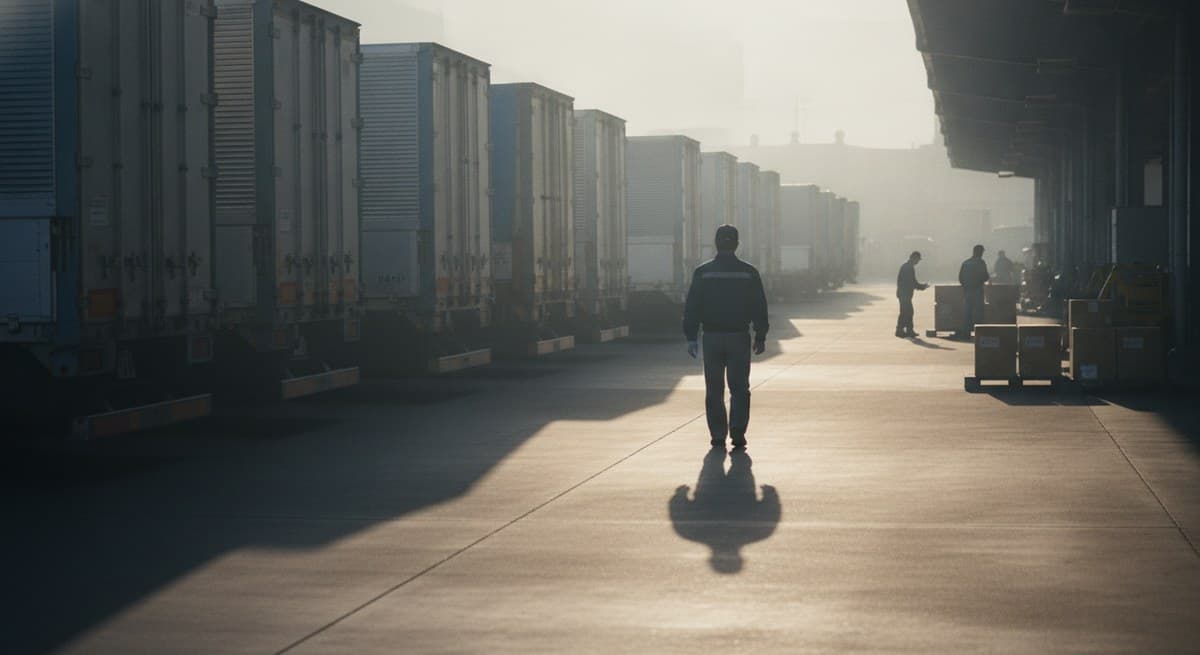
Trucking's "Appropriate Cost" — Can a Legal Floor Stop Rates Thinning Toward the Bottom of Multi-Tier Subcontracting?
On July 17, 2026, Japan's transport ministry opened an expert panel on an "appropriate cost" for trucking. Under two 2025 laws, the advisory standard rate is abolished and replaced by a legally binding floor that must not be undercut, with a duty placed on shippers who order transport. Behind it lie a 2024 reform that cut hours but not pay, and a multi-tier subcontracting structure where over 70% re-subcontract and each tier skims a 5–10% fee. This reads it as a system moving three forces at once: visible shipper responsibility, the culling of small operators, and price pass-through.

Japan Post Failed to State Terms to 167 Freelancers. The First Day of the Violation Period Is the Day the Law Took Effect
On 2 September 2026 the Japan Fair Trade Commission issued a recommendation to Japan Post under the Act on Ensuring Proper Transactions Involving Specified Entrusted Businesses. Terms were not stated promptly to 167 people, and payment due dates were neither set nor met for 140. The violation period runs from 1 November 2024 to 30 June 2025, and its first day is the day the law took effect. All ten recommendations in FY2025 involved a failure to state terms. This piece reads why the most basic obligation is the one that goes unmet.
Japan's National Pension Payment Rate Hits 79.6%, Rising for a 14th Year — Yet Fewer Months Are Actually Being Paid
The premium payment rate for Japan's National Pension reached 79.56% for fiscal 2025, according to figures the Ministry of Health, Labour and Welfare released in July 2026, rising for a fourteenth consecutive year. Yet the months actually paid fell from 71.28 million to 71.08 million. The rate rose because the denominator shrank by 7.18 million months. This piece reads the two channels draining that denominator, and what happens to those months in retirement.
While a Work-Injury Claim Waits, Nothing Bridges the Bereaved — Six-Month-Plus Backlog Doubled to 2,329 in Five Years
A report that a work-injury claim took "seven years" to certify misleads: that was one worst case, and the state's rough guide is about four months for death and bereaved claims. Yet claims undecided past six months number 2,329, nearly double in five years. A living worker who can no longer work can partly bridge the wait with health-insurance sickness allowance, but the family of a worker who has died has no bridge. This reads the asymmetry of livelihood support during the wait for certification.
Previous
Japan's Second-Hand Smoke Law Seven Years In — The Revised Health Promotion Act and Regional Variation in Indoor-Smoking Rules
Next
Farm Machinery That Runs Only Days a Year — The Structure That Keeps Individual Ownership Locked In
Get new columns by email
1-2 social structure analysis columns per week. Free to subscribe.
Join ISVD's activities?
Sign up to receive the latest research and activity reports. Feel free to reach out about collaboration or project participation.
Support ISVD’s research and activities
Support ISVD’s research and publications with JPY5,000 per year. There is no automatic renewal.