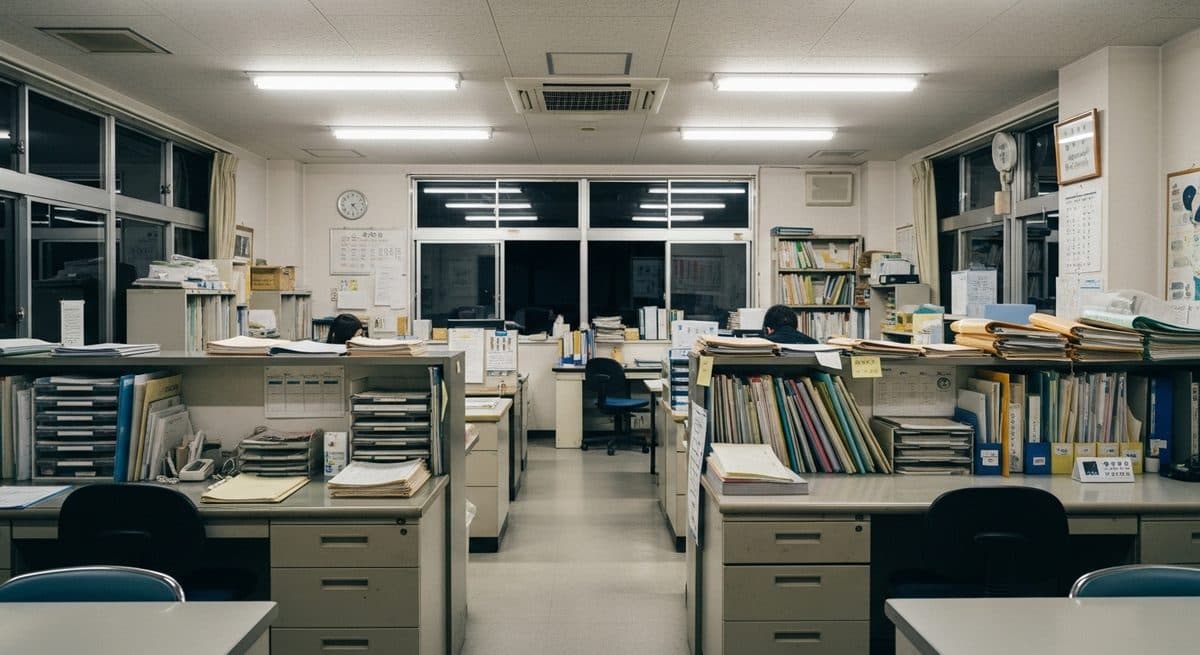
When Sick-Child Care Fails on the Day of Fever: Japan's Social-Security Gap
Only 60.4% of Japanese municipalities host a sick-child or post-illness care facility, and the national sick-child care association lists about 823 member sites. Set against roughly 12.78 million dual-income households, the access ratio is about 1 to 15,500. Katsushika Ward's design (¥2,000/day fee, 30-minute pre-registration, cancellation cap of three consecutive monthly cancellations) keeps the institution far from the day-of-fever reality. Contrasted with Germany's 15 sick-child leave days per child and Sweden's 120 days at 77.6% wage replacement, Japan's "social-security gap" appears as a design choice rather than an oversight.
TL;DR
- Only 60.4% of municipalities offer sick-child or post-illness care, and the national association lists about 823 member facilities
- Against about 12.78 million dual-income households, the supply shortfall surfaces as peak-season unavailability and same-day booking refusal
- Japan's child-care leave is capped at 5 days per child per year (10 days for multiple children), in contrast to Germany's 15 days plus 90% wage benefit and Sweden's 120 days plus 77.6% benefit
What Is Happening
~823 sick-child facilities for ~12.78M dual-income households — a 1:15,500 ratio. Katsushika Ward shows this fails the day-of-fever reality.
A dual-income household in Katsushika Ward, Tokyo, is raising a two-year-old and an infant. Their extended family lives in Ishikawa Prefecture, far away. The nearest sick-child care facility has a capacity of around four children, and during the influenza peak it is effectively unavailable. Using it requires a medical certificate, more than 30 minutes of pre-registration, and a stack of same-day paperwork. During a December flu wave, the parent ended up nursing a child who "vomited every five minutes" while running a fever themselves. FIRST-HAND Local (January 2026) documented the case in the first person. It is the silhouette of a service "formally provided but not functioning on the day of fever."
This is not an unlucky individual story. Lining up the supply-side figures reveals the structure. Sick-child or post-illness facilities exist within municipal boundaries in only 60.4% of municipalities, and not in 39.6%. Living in the remaining 40% leaves no institutional option from the start. The Council lists about 823 member facilities nationwide.
What about demand? Japan had about 12.78 million dual-income households in 2023, roughly 70% of married households. In a society where dual-income is the default, sick-child care remains lodged in private family solutions. Dividing 823 facilities by 12.78 million households yields about one facility per 15,500 households. That ratio is incompatible with the premise that "a slot is available the moment a fever appears."
The problem is compounded by the stack of access conditions. The Katsushika Ward page sets out annual pre-registration, a ¥2,000 daily user fee (waived for welfare and tax-exempt households; ¥1,000 reduction where the income-based tax is below ¥15,000). The contracted operator, the Tums Group, records a separate rule: "if three cancellations occur within a single month, use is suspended for the remainder of the month." For operators with a four-child capacity this is a rational anti-no-show device. From the user side, it carries a hidden message: cancelling itself is penalised. With infants whose morning condition is hard to predict and flu-season infection risk hard to manage, the three-cancellations rule and the lived reality of pediatric care do not sit comfortably together.
The Tums Group sick-child care unit in Katsushika Ward publishes the same-day usage flow. Same-day use requires a web-based "sick-child care illness report," a doctor's referral form (or hospital instruction sheet), a medication request form, and a copy of the health insurance card. FIRST-HAND Local (January 2026) records that a parent spent over 30 minutes on the pre-registration explanation alone. A parent holding a feverish child is expected to visit a pediatrician that morning, collect paperwork, travel back and forth to the facility, log temperature and medication, and repeat the process the next day. The paperwork itself does not assume a day-of-fever workflow.
Background & Context
Supply expanded in form from 1991 through 2024 while the 60.4% municipal gap persisted. Katsushika embeds structural access barriers.
Institutional History
Sick-child care was not designed from the outset as a core central-government programme. It was layered into the space between health and child-care over time. As MHLW's 2009 document records, the 1991 "Council on Maternal and Child Medicine" advisory was the starting point. The 1995 Angel Plan formalised it as a "temporary care service for sick infants and young children," and the 2000 Childcare Standards explicitly defined sick-child care. The National Sick-Child Care Council began the same period with 14 sites and reached 823 facilities as of February 2025.
The Reiwa era exposed weaknesses. The largest operational risk identified was revenue instability driven by infection waves and sudden cancellations. A March 2023 administrative notice on "responding to same-day cancellations" preceded the formal introduction of a "same-day cancellation supplement" later that year. From fiscal 2024, the base unit price was raised in recognition of the specialised duties of nursery staff. The supply side has been cushioned in successive rounds, but the demand-side experience of "the institution arriving on the day of fever" remains a separate, open issue.
- 1991Report of the review panel on maternal and child healththe starting point
- 1995Institutionalised under the Angel Plan as temporary care for infant health support
- 2000Formally defined as sick-child care in the revised nursery care guidelines
- As of 22 February 2025823 facilitiesthe national council began with 14
It was built up in the gap between medicine and childcare. A same-day cancellation allowance was introduced after a March 2023 notice, and the base unit price was raised from FY2024.
The Gaps Between Roles
Several institutions sit next to sick-child care in functional terms. Sick-child care (acute phase), post-illness care (recovery phase), family support (healthy-child pickup and short care), and statutory sick-child leave as a parental right. Each covers a defined slice, but stacking them still leaves a void.
Family support typically excludes sick children. Post-illness care is bounded by the recovery phase. Statutory sick-child leave is fixed at 5 days per child per year (10 days for multiple children) until the child enters elementary school, per the revised Childcare and Family Care Leave Act. The 2021 amendment improved usability by allowing hourly use and same-day application, but the cap of five days is an order of magnitude away from the reality of an influenza season. The scenario of "no slot at sick-child care that day, family support won't take a sick child, statutory leave already used, parent also feverish, family far away" is a crossroads where five overlapping institutions all step aside.
Supply Gaps and Urban Concentration
A The Council's related documents have positioned supply imbalance and staffing standards as national policy questions. The 60.4% municipal coverage figure, read in reverse, means that households in the remaining 39.6% of municipalities start with zero institutional options. In urban areas the constraint is capacity; in rural areas the constraint is the absence of operators. "The institution is hard to use" describes both, but the underlying geographic break is different.
In urban areas the private market has stepped in. Azukaru-kochan, renamed Theothe in April 2026, has pushed same-day booking and real-time availability via LINE and web, winning a Kids Design Award. Florence introduced Japan's first in-home, cooperative-style sick-child care in 2005, dispatching care staff to the home on a monthly-membership basis. Both have, in effect, socialised the limits of the public system. The risk is that the supplementing side selects users by ability to pay and information access. Dual-income households able to afford monthly memberships and unstable workers who struggle even to take statutory leave do not face the same supplements.
Reading the Structure
Leave exhaustion → absence → attrition frames this as a design failure. Germany (15d/90%) and Sweden (120d/77.6%) contrast Japan's 5d cap.
A "Social-Security Gap" Lens
A single concept can absorb these observations. The institution exists formally and is recorded in policy speech as "covered." But the conditions of use, namely pre-registration, the medical certificate, physical distance, capacity ceilings, infection-wave supply shocks, paperwork load and a three-consecutive-cancellations cap, stack on top of one another so that the day-of-fever reality is never reached. This is a second kind of absence, distinct from "no institution exists at all." I propose to name it the social-security gap.
"There is no institution" and "the institution exists but does not arrive" are different policy problems. The former calls for supply expansion. The latter calls for redesign at the access layer: rewriting use conditions, digitising paperwork, real-time same-day booking, and converting parental leave into a wage-replacement right. Japan's sick-child care has long been described in the language of the former while carrying the burden of the latter.
Labour-Economic Pathways of the Child-Rearing Penalty
The social-security gap also moves through concrete labour-economic channels. Suetomi and Sakurai define the child-rearing penalty as "the state in which politics, institutions, social customs and people's attitudes together impose a penalty on raising children." Sick-child care is one of the spots where that penalty fires most immediately.
The mechanism is simple. Five sick-child leave days are easily exhausted in a flu wave for a household with multiple children. The absences that follow attach directly to evaluations, promotions, wages and contract renewals. The motherhood penalty route concentrates here. Statutory leave use, sick-child care booking, pediatric clinic visits and paperwork filing skew heavily towards mothers in the current configuration. "Each fever costs the mother's career" is not an abstract inequality statement but a monthly, observable wage gap.
Comparative Design Choices
International comparison makes Japan's design choice visible. Germany's Kinderkrankengeld provides 15 paid days per child per year per parent (30 for single parents), up to 90% wage replacement (2026 daily cap €135.63), with children covered up to age 12. Sweden's VAB provides 120 days per child per year per parent (children under 12, from 8 months of age), 77.6% lost-income replacement (with a cap), with medical certificates required only from day 7. Application by phone and online is immediate, minimising paperwork friction. France, per The Japanese Society of Child Science, runs about 70% of child-care demand through certified family carers (assistantes maternelles), with 120 hours of training for certification; family-based care often absorbs sick-child episodes at the carer's discretion.
| Country | Design | Leave entitlement | Wage benefit |
|---|---|---|---|
| Sweden | Full parental leave guarantee | 120 days/yr per child (under 12) | 77.6% wage benefit |
| Germany | Parents stay home | 15 days/yr (single parent 30) | Up to 90% wage benefit |
| France | Family-based care includes sick care | ~70% via certified family carers | Discretion of certified carer |
| Japan | Facility-based + parental self-help | Sick-child leave 5 days/yr/child | No public wage benefit (often unpaid) |
The design choices sit on different axes. Germany and Sweden organise their institutions around "guarantee the parental right to be absent and protect income socially." France builds sick-child capacity into family-based care. Japan operates a facility-based sick-child care system, caps parental leave at five days, and provides no wage benefit. According to the Azets Nordic comparison, Sweden, Norway, Denmark and Finland all anchor their policy on paid parental leave rather than facility-based provision. The gap between "design that leans on parental self-help" and "design that protects parental leave rights" is a deliberate choice.
Design Options on the Table
Closing the social-security gap is not an abstract aim but a combination of concrete steps. First, nationwide rollout of online booking infrastructure. Same-day booking and real-time availability of the Theothe type can be integrated into municipal systems. Second, paperwork reduction: standardising and digitising the medical liaison form, linking with health insurance societies, and structurally lightening the morning paperwork load. Third, scaling in-home, cooperative-style sick-child care. The Florence model can be embedded into corporate benefits, with cooperative pricing smoothing the monthly fee. Fourth, expanding sick-child capacity inside regular nursery schools, extending the existing trust relationship, the line of argument the FHL report itself raises. Fifth, structural expansion of the sick-child leave system: more days, robust hourly use, and wage replacement. This is the connection to Germany's and Sweden's income-guarantee design.
Each option presses one of two axes: "parental leave rights and income guarantee" or "facility and market supplementation." The Cabinet Office of Children and Families' "Kodomo-mannaka Implementation Plan 2025" lists sick-child care among its priority items, but emphasis is on facility development and operator support; the parental-leave-rights and income-guarantee axis remains largely separate.
The Structure Beneath the Case
Return to the Katsushika Ward parent caring for two small children alone. This is not the misfortune of a family that happened to be far from Ishikawa. It is the intersection of 12.78 million dual-income households against 823 facilities, the 60.4% municipal coverage rate, the three-consecutive-cancellations cap and 30-minute pre-registration, the medical liaison form / medication request form / insurance card copy paperwork set, the five-day sick-child leave cap, and the four-child capacity ceiling during a flu wave. Each household type meets this crossroads with a different probability.
"The institution exists but does not arrive on fever day," translated into institutional grammar, reads: "a design that minimises the parental leave right and relies on facility supplements fails to keep pace with the day-of-fever reality and the paperwork reality, and the failure is absorbed by mothers' careers and household finances." What is being asked is not the parent's preparation or the family's choice, but the placement of the design: whose leave right and whose income the institution chooses not to protect.
Related Columns
- When Private After-School Care Outpaces Salaries(このサイトの記事) (F1: the market mechanism of the child-rearing penalty viewed from the after-school side)
- Behind Japan's 11.5% Child Poverty Rate(このサイトの記事) (the 44.5% single-parent reality and the working-poor paradox)
- The Triple Burden of the Child-Rearing Penalty(このサイトの記事) (housing, education and child allowance balance)
- The Effectiveness of the Cabinet Office of Children and Families Budget(このサイトの記事) (cost-effectiveness review including sick-child care)
- Welfare "Capture Rate" 20%(このサイトの記事) (an adjacent case where the institution exists formally but does not reach users)
Reference Books
- 末冨芳・桜井啓太『子育て罰 「親子に冷たい日本」を変えるには (光文社新書)(外部サイト、新しいタブで開きます)』(Kobunsha, 2021). The central Japanese statement of the "child-rearing penalty" concept and a key frame for this article.
- 駒崎弘樹『「社会を変える」を仕事にする――社会起業家という生き方(外部サイト、新しいタブで開きます)』(Eijipress, 2007). The founder of Florence, Japan's first in-home, cooperative-style sick-child care, recounts the dismissal case of a salaried mother that started the project.
- 前田正子『保育園問題 - 待機児童、保育士不足、建設反対運動 (中公新書 2429)(外部サイト、新しいタブで開きます)』(Chuokoron-Shinsha, 2017). The former Yokohama deputy mayor and researcher provides a systematic account of supply constraints and quality issues in the child-care infrastructure.
References
病児保育事業の運営状況に関する調査研究 報告書(令和5年度子ども・子育て支援等推進調査研究) — 三菱UFJリサーチ&コンサルティング(こども家庭庁補助事業) (2024). Children and Families Agency (こども家庭庁)
病児・病後児保育について(第27回社会保障審議会少子化対策特別部会資料) — 厚生労働省 (2009). Ministry of Health, Labour and Welfare (厚生労働省)
改正育児・介護休業法のあらまし — 厚生労働省 (2010). Ministry of Health, Labour and Welfare (厚生労働省)
共働き等世帯数の年次推移(令和5年版厚生労働白書 図表1-1-3) — 厚生労働省・JILPT (2023). Ministry of Health, Labour and Welfare (厚生労働省)
全国病児保育協議会 公式案内(加盟施設・設立沿革、令和7年2月22日現在) — 全国病児保育協議会 (2025). Zenkoku Byōji Hoiku Kyōgikai (全国病児保育協議会)
病児・病後児保育の概要(葛飾区公式) — 葛飾区 (2024). Katsushika City (葛飾区)
Child sickness benefit (Kinderkrankengeld) in Germany — IamExpat (2025). IamExpat Germany
Parents (Försäkringskassan: Temporary parental benefit / VAB) — Försäkringskassan (2025). Swedish Social Insurance Agency
Statistics cited in this article
- 1Cabinet Office of Children and Families, 'Survey research on operational status of sick-child care projects' (commissioned to Mitsubishi UFJ Research and Consulting), March 2024(March 2024) Open source
- 2National Sick-Child Care Council, about page (figure as of 22 February 2025)(February 2025) Open source
- 3JILPT, 'The State of Dual-Income Households' (Business Labor Trend, April 2025)(2023) Open source
- 4Katsushika Ward, 'Sick-Child and Post-Illness Care', official page (4 sick-child facilities and 8 post-illness facilities, each with a daily capacity of 4)(2024) Open source
- 5Cabinet Office of Children and Families and Mitsubishi UFJ Research and Consulting, 'Survey research on operational status of sick-child care projects'(March 2024) Open source
- 6Ministry of Health, Labour and Welfare, 'Outline of the revised Childcare and Family Care Leave Act'(Enacted 2010, amended 2021 to allow hourly use) Open source
- 7IamExpat, 'Child sickness benefit (Kinderkrankengeld) in Germany', based on the scheme as of 2025 and 2026(2025) Open source
- 8Försäkringskassan (Swedish Social Insurance Agency), official guidance(2025) Open source
- 9The Japanese Society of Child Science, 'PCS', overview of France's certified family carer system(2018) Open source