
Inherited Forest Land Without Clear Boundaries — Negative Assets and the Making of Owner-Unknown Land
A family in Imari, Saga inherited about 4,300 square meters of forest whose boundary survives only by word of mouth; timber is worth less than surveying, yet disaster liability stays with the owner. Owner-unknown land reached about 4.1 million hectares in 2016 (exceeding Kyushu's main island) and a projected 7.2 million by 2040, while the cadastral survey sits near 53%. This reads how the four faces of one piece of land—ownership, boundary, benefit, and liability—split apart while registration, cadastral survey, forest management, the environment tax, and treasury absorption each pursue them separately, and points to redesigning ownership.
TL;DR
- Inherited forest keeps its boundary only by word of mouth; timber is worth less than surveying, yet disaster liability stays with the owner
- Owner-unknown land was about 4.1 million hectares in 2016 (exceeding Kyushu's main island) and a projected 7.2 million by 2040, with forest land at its center
- Ownership, boundary, benefit, and liability split apart while registration, cadastral survey, forest management, the environment tax, and treasury absorption each run on their own; the base of unfixed boundaries and unclear liability does not mesh
Ownership, boundary, benefit, and liability are different faces of a single piece of land. Inheritance neglect splits them apart, and each is pursued by a separate system on its own timeline: the cadastral survey stuck near 53% (MLIT), mandatory registration from 2024, the Forest Management System from 2019, the Forest Environment Tax from 2024. Because benefit from the timber has vanished, the Forest Management System and the Forest Environment Tax socialize the carriers and the funding rather than restore the owner's profit. Liability alone stays with the owner, with little system to absorb it.
What Is Happening
Inherited forest keeps its boundary only by word of mouth; timber is worth less than surveying, yet disaster liability stays with the owner
In Imari, Saga Prefecture, a family holds about 4,300 square meters of mountain forest they inherited. As , a mountain the previous generation bought for one million yen in the hope of hot-spring development is now a negative asset. Cut and sell the timber, and it does not cover the cost of surveying to fix the boundary. Yet if heavy rain brings a landslide, the liability stays with the owner.
What stands out is not the price of the mountain. It is that no one knows the boundary. Where the family's forest begins and ends, the head of the house cannot say precisely. The boundary survives only by word of mouth, and the stones once used as markers no longer serve: the trees have grown over them, and no one quite remembers which stone marked what. The next generation inherits only the liability for damage, without once having seen the mountain.
This is not Imari's misfortune alone. Land whose owner cannot be readily identified from the registry after inheritance goes unregistered, or whose owner is known but cannot be reached, is called . By the estimate of the , such land amounted, as of 2016, to about 4.1 million hectares nationwide, roughly 20% of the land, exceeding the area of Kyushu's main island. Without countermeasures, it was projected to expand to about 7.2 million hectares by 2040, approaching the area of Hokkaido. Forest land sits at the center of that feeder pool.
Background & Context
Postwar planting stalled, forestry declined, inheritance went unregistered; the cadastral survey sits near 53% as boundaries and titles blur
Why did the mountain turn into a negative asset? After the war, cedar was planted all at once under national policy. On the Imari mountains too, that cedar is now 30 to 50 years old, past the right time to cut. Yet timber prices stayed low for years, and the cost of cutting and hauling increasingly exceeded the sale price. Where the numbers do not work, no hand enters the mountain. The people who carried forestry vanished from the region. Only the untended mountain remains.
On the ownership side, neglect breeds neglect. According to the , when inheritance repeats without dividing the estate, the number of owners to trace multiplies. Heirs across several generations line up on the title, and without everyone's consent the land can be neither sold nor lent. A mountain left unmanaged can harm its surroundings through the outflow of earth and the collapse of slopes. Even so, the administration is cautious about preventive spending on private land. The liability stays with the owner.
The boundary problem runs deeper still. The cadastral survey that officially fixes land boundaries has been completed for only about 53% of the country. And it lags especially in urban areas and in the forest land of mountain villages. A mountain with no public record of its boundary, resting on word of mouth alone, is not unique to Imari.
On registration, the system has begun to move. In April 2024, applying for inheritance registration became mandatory. Fail to register within three years of learning of the acquisition, and without a legitimate reason you become subject to a fine of up to 100,000 yen. It applies retroactively to inheritances before the effective date, requiring registration by the end of March 2027. The pressure to align titles with reality has, at last, grown stronger.
Reading the Structure
Ownership, boundary, benefit, and liability split apart, each chased by a separate system, and only liability stays with the owner
Seen as a single line, the trouble with inheriting forest land is that four faces of one piece of land—ownership, boundary, benefit, and liability—pass to the next generation still split apart. Whose land it is stays unclear. Where the boundary lies is unknown. There is no income from the trees, and yet the liability for management and disaster clings to the owner alone.
The systems chase these four separately. For tracing titles, the mandatory inheritance registration. For fixing boundaries, the cadastral survey. For carriers of upkeep, the , in which municipalities take management from owners, began in 2019. The municipality confirms the owner's intent and, once entrusted, connects the forest to a forestry operator or manages it itself. As its funding, the has been levied since FY2024 at 1,000 yen per person a year and distributed to municipalities. For owners who want to let go, the opened an exit in April 2023. For forest, the fee is calculated according to area.
Even with several schemes available, uncertain boundaries can hinder state-ownership applications or management agreements. Check what an owner in an unsurveyed area needs to use each scheme. Eligibility and the owner’s potential liability for disasters are separate questions.
ISVD's question stands here. How far can the premise hold that a mountain is a private asset to be carried by an individual to the very end? Who draws the boundary, who takes the benefit, who bears the liability? Could that allocation be reassembled at the community scale? We posed the same question for farm machinery. We wrote about the structure in which each household holds machines that run only days a year, as a question of separating ownership from use(このサイトの記事). Forest land, too, lies on the same line as an object for unbundling the design of ownership.
The number of people inheriting mountains whose boundaries are unknown will keep growing. The neglect of inheritance is not one person's mistake in judgment. It is the consequence of systems that treat ownership, boundary, benefit, and liability separately, and of the thin base that should tie them together. Deciding who draws the boundary is the very practice of a social vision: how to design public assets.
Further Reading
- 人口減少時代の土地問題 (Land Problems in an Era of Population Decline)(外部サイト、新しいタブで開きます) (Shoko Yoshihara, Chuko Shinsho, 2017) — the first book to address owner-unknown land head-on, tracing why inheritance is left unregistered from the side of the registration system. (In Japanese.)
- 絶望の林業 (Forestry in Despair)(外部サイト、新しいタブで開きます) (Atsuo Tanaka, Shinsensha, 2019) — refuses to romanticize forestry as a growth industry and coolly exposes the structure of subsidies and thin returns. (In Japanese.)
References
Owner-Unknown Land Problem Study Group, Final Report (Summary) — Owner-Unknown Land Problem Study Group (2017). Japan Land Planning Association
Owner-Unknown Land Guidebook: To Prevent Lost Land — Ministry of Land, Infrastructure, Transport and Tourism (2022). Ministry of Land, Infrastructure, Transport and Tourism
On the Mandatory Application for Inheritance Registration — Ministry of Justice, Civil Affairs Bureau (2024). Ministry of Justice
On the Forest Management System (Forest Management Act) — Forestry Agency (2019). Forestry Agency
Forest Environment Tax and Forest Environment Transfer Tax — Ministry of Internal Affairs and Communications (2024). Ministry of Internal Affairs and Communications
Statistics cited in this article
- 1Owner-Unknown Land Problem Study Group, Final Report(2017) Open source
- 2MLIT, Cadastral Survey Website(end of FY2023) Open source
- 3Ministry of Justice, On the Mandatory Application for Inheritance Registration(in force April 2024) Open source
- 4Ministry of Internal Affairs and Communications, Forest Environment Tax and Forest Environment Transfer Tax(taxation began FY2024) Open source
Questions to Reflect On
- In your area, are the boundaries and titles of forest and farmland fixed as public records
- Of ownership, boundary, benefit, and liability, which is most left hanging right now
- Which should come first, creating an exit to let go, or redrawing the boundary
Key Terms in This Article
- Owner-Unknown Land
- Land whose owner cannot be readily identified from the property registry, or whose owner is identified but cannot be reached. The main cause is the failure to register inheritance; when estates pass down without division, the number of owners to trace multiplies. As of 2016 it covered roughly 4.1 million hectares nationwide (about 20% of the land, exceeding the area of Kyushu's main island), projected to reach about 7.2 million hectares by 2040 without countermeasures.
Related Content
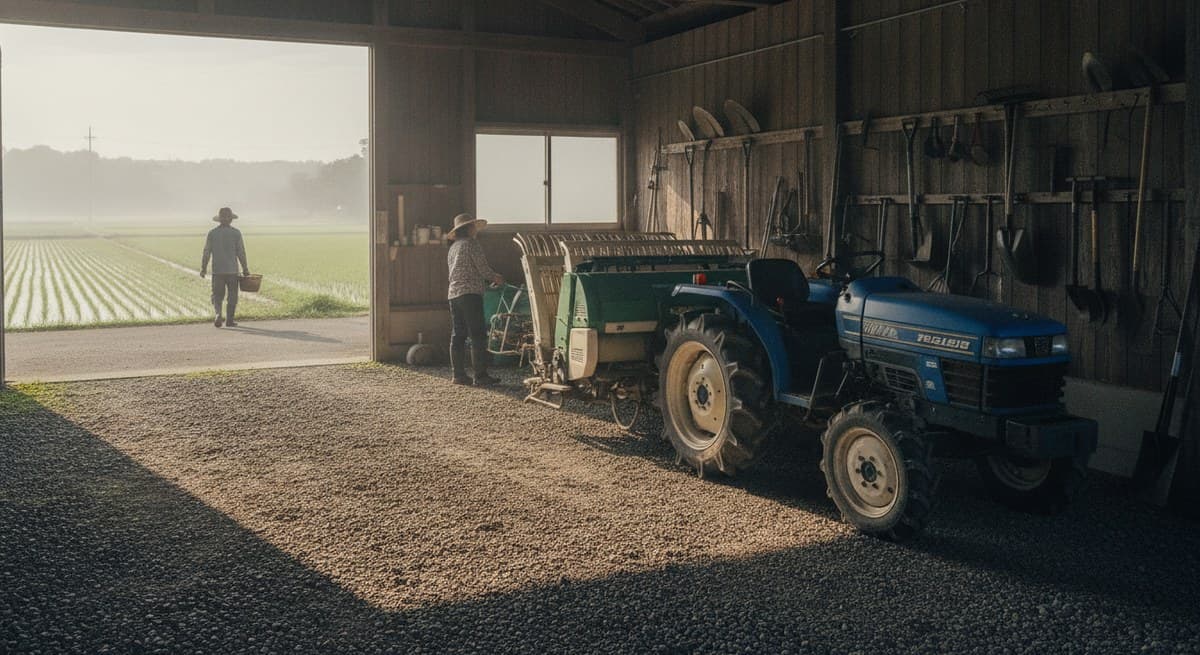
Farm Machinery That Runs Only Days a Year — The Structure That Keeps Individual Ownership Locked In
A newcomer farmer in Takamori, Kumamoto faces machinery worth millions of yen that runs only a few days a year. This is not bad luck. MAFF data—an average of 3.8 hectares per farm, 24.3% use of paid support services, 28.5% for equipment sharing—reveals why joint use fails to spread, and points to reframing farm machinery as a quasi-public good.
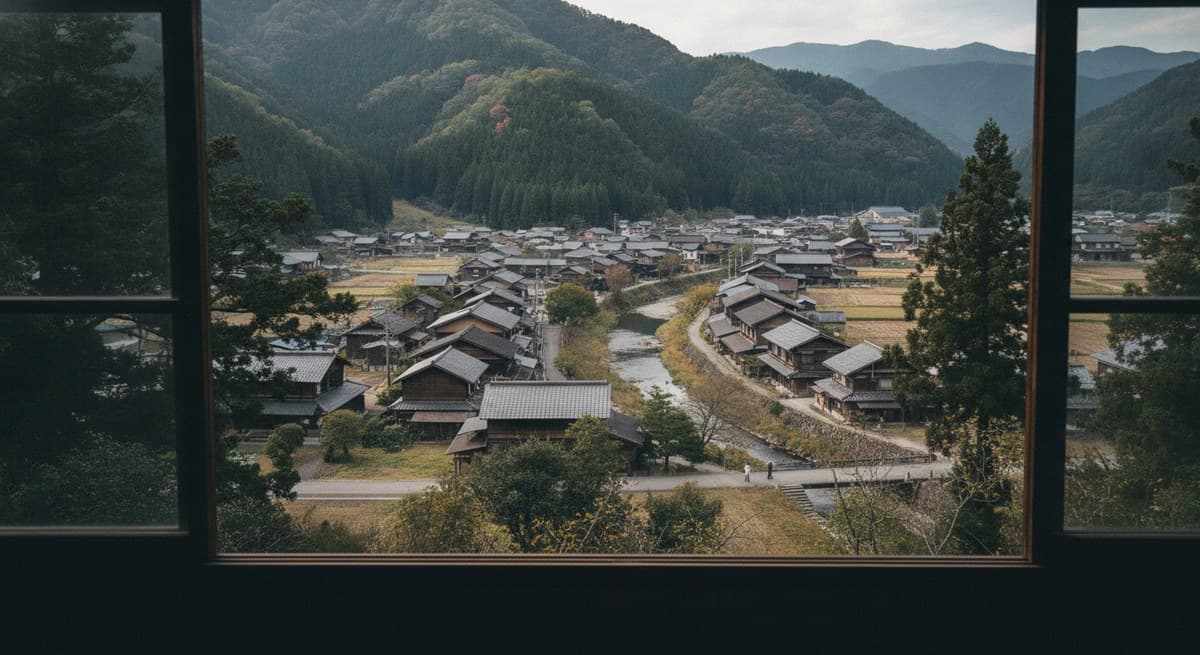
Bear Injuries Hit a Record 216 in Japan — Depopulation Has Emptied the Hands That Tended the Boundary
By Japan's Environment Ministry, bear-inflicted injuries hit a record 216, with 13 deaths, in FY2025, and sightings reached 50,801, 2.1 times FY2023. But a poor nut crop is only the trigger. Depopulation has drained the hands that tended the satoyama; abandoned farmland is turning, in quality, back into forest; and the buffer between people and the wild is dissolving from within. This reads not culling versus coexistence, but the vacancy of who manages the boundary.
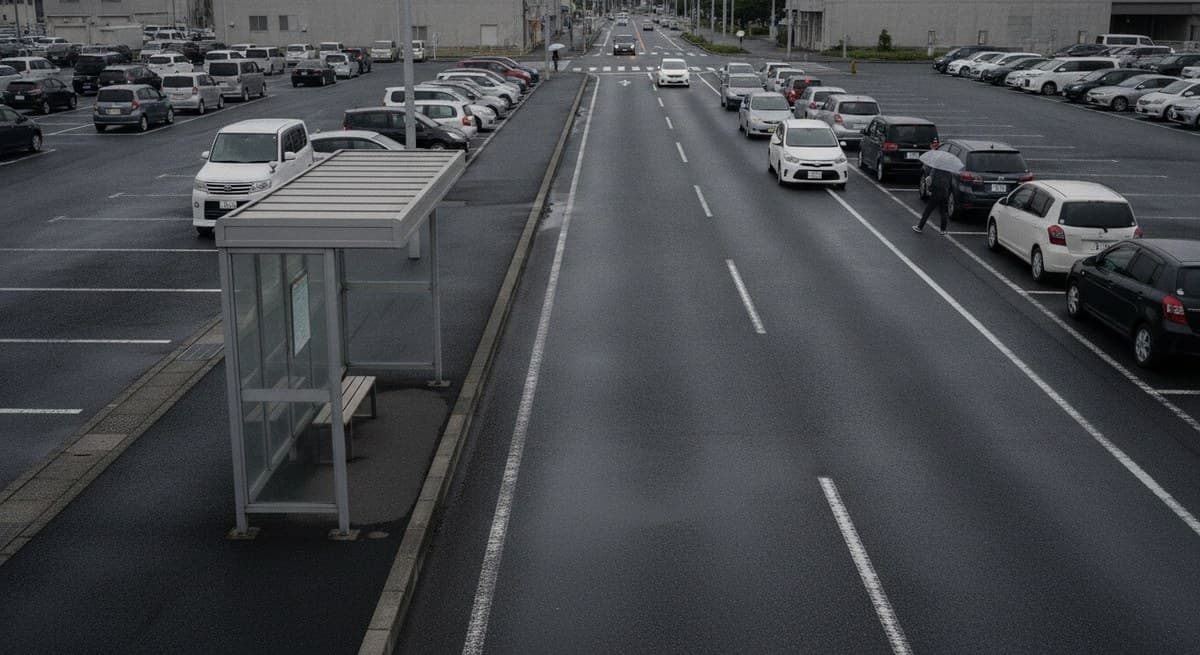
Kumamoto's Car Society Cannot Be Solved by Roads — Transit's Downward Spiral and Planning Backward from Where People Live
Congestion is worsening in the Kumamoto urban area, where semiconductor industry is concentrating. The Kumamoto Urban Area Person Trip Survey shows the car's mode share rising from 59.3% in 1997 to 67.3% in 2023, while the transit share fell to 5.2%. Yet total travel has fallen to 0.85 times its 2012 level, so congestion cannot be explained by the volume of traffic across the urban area. Adding roads does not clear congestion; in an expressway toll-free trial, traffic rose about 79%. This reads the downward spiral in which driver shortage leads to cuts, fewer riders, unprofitability, and withdrawal, and points to reconnecting where people live with transit by working backward, rather than widening roads.
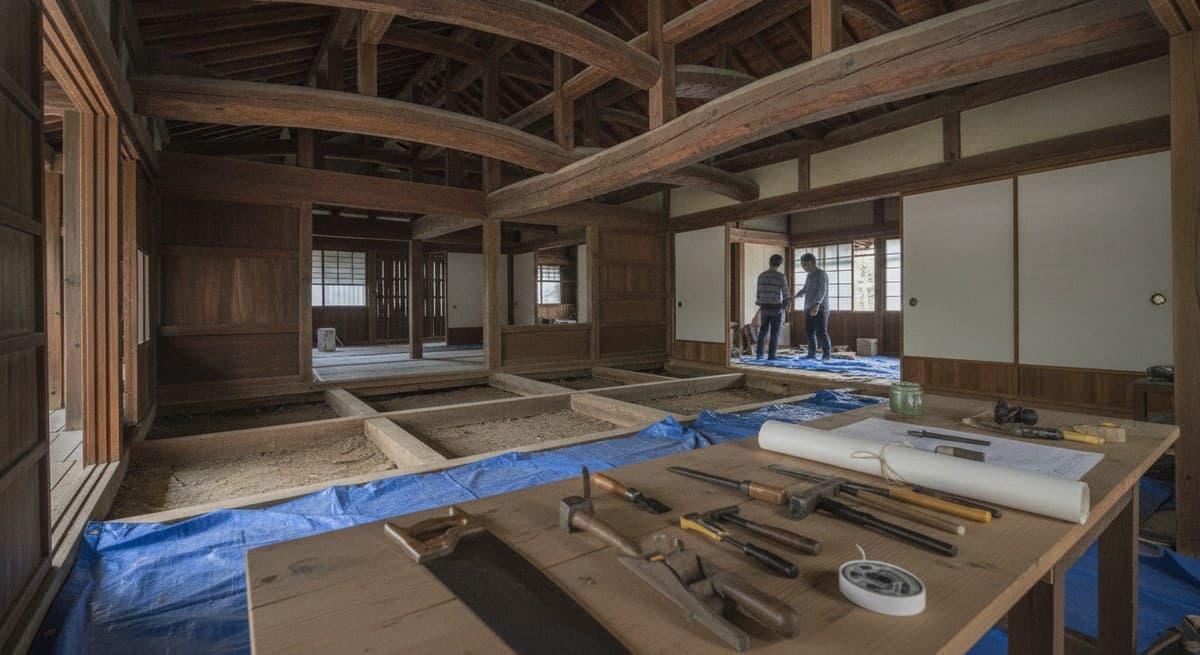
Repairs Keep Surfacing After You Buy a Kominka — The Information Gap Born of Inheritance and Aging
A newcomer who bought an old house in the mountains of Nara found, only after moving in, a well that ran dry for two months, mold, and drainage failures. Japan holds 9.002 million vacant homes at a 13.8% vacancy rate, 80.9% of vacant detached houses are the neglected kind, and more than seven in ten inherited vacant homes already carry decay or damage. Repairs surfacing after purchase are the consequence of a three-layer information gap: disclosure that stops at the state of provision of facilities, sellers who do not know the condition amid inheritance and aging, and vacant-house banks that only 3.3% of households registered with even among those that resolved a vacant home.
Previous
School Pools Are Disappearing — How Fiscal Gaps Between Municipalities Become Gaps in Learning to Swim
Next
Repairs Keep Surfacing After You Buy a Kominka — The Information Gap Born of Inheritance and Aging
Get new columns by email
1-2 social structure analysis columns per week. Free to subscribe.
Join ISVD's activities?
Sign up to receive the latest research and activity reports. Feel free to reach out about collaboration or project participation.
Support ISVD’s research and activities
Support ISVD’s research and publications with JPY5,000 per year. There is no automatic renewal.