
Bound by the Phone: The Structure That Distorts Nursing Labor Quality and Time Allocation
A nurse's primary work is direct patient care. Yet international time-motion studies have repeatedly shown that direct care occupies only 20-38% of total nursing work time. The remainder is consumed by documentation and coordination, especially the relentless phone calls to chase down family signatures within seven days. Starting from a Hyogo Prefecture case reported by FIRST-HAND Local in April 2026, this column layers Japan's MHLW research findings (daily nursing records are the leading cause of overtime), the operational gap of the Discharge Support Add-on A246 7-day requirement, and the Dutch Buurtzorg model record only what is meaningful principle to re-read nursing labor quality from the institutional design side.

TL;DR
- International time-motion studies consistently show direct care occupies only 20-38% of total nursing work time, with documentation, coordination, movement, and phone work consuming the rest
- The MHLW research grant project led by Suga Sakamoto (2018) concluded that daily nursing records are the largest single contributor to nurse overtime, exposing documentation volume as an institutional-design issue
- The Discharge Support Add-on A246 7-day requirement defines the confirmation period for discharge-difficulty factors, not a consent-acquisition deadline; however, the field interprets it as obtaining signed consent within one week, concentrating phone follow-up and document scanning on nurses
What Is Happening
Nurses are consumed by 1-week signature chases and scanning. Time-motion studies place direct care at only 20–38% of nursing time.
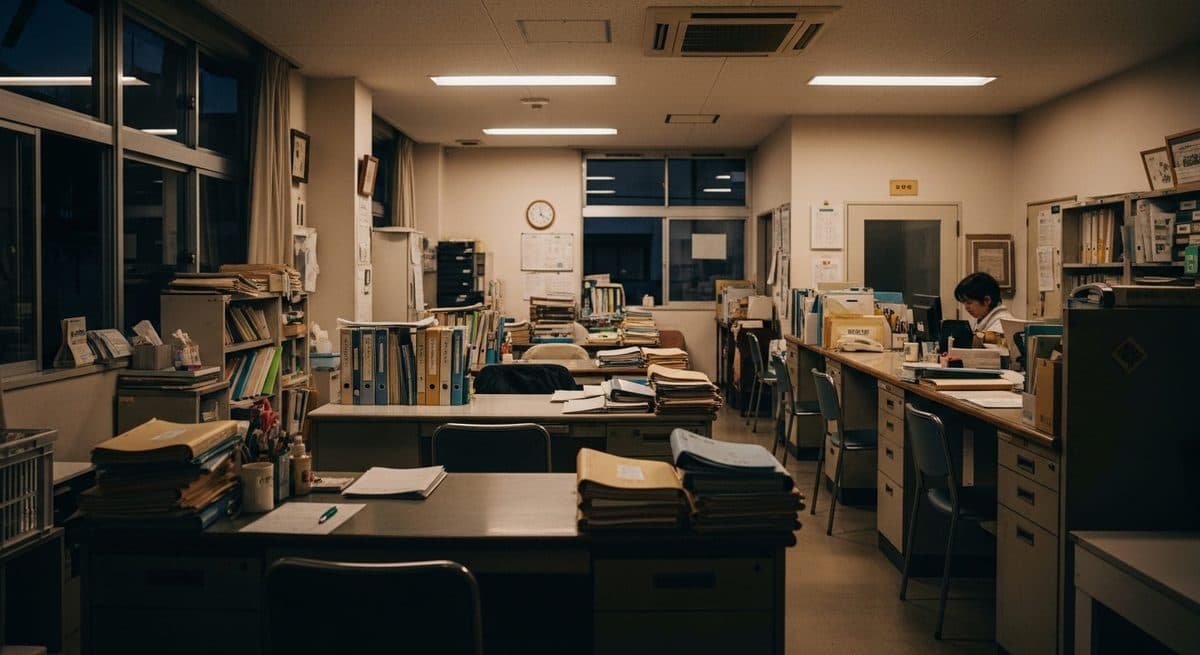
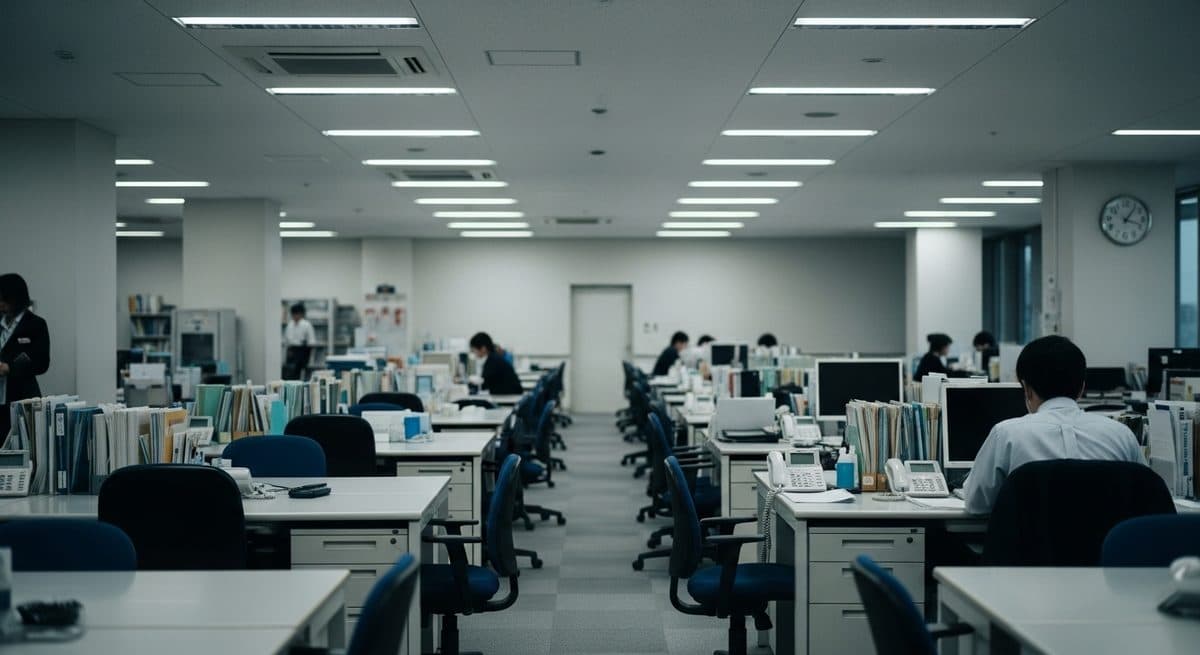
Inpatient nurses in Japan are drained by administrative work that has nothing to do with clinical decision-making. documented a case from a Hyogo Prefecture hospital and described the recurring tasks: tracking and chasing plan-completion status across multiple departments, repeated phone calls to families who do not answer, reading discharge support plans aloud over the phone, scheduling appointments between patients' families and physicians, addressing envelopes and mailing documents, scanning signed papers back into the system. None are medical judgments. All consume nursing work hours in fragments.
Not confined to one prefecture
The issue is not confined to one prefecture. The classified nursing tasks into 85 categories and conducted a time-motion study. The six most time-consuming categories over 24 hours were daily nursing records, excretion assistance, vital sign measurement, information gathering from patients, nurse-to-nurse handovers, and meal assistance. The study concluded that "daily nursing records are the single largest contributor to time spent on overtime work ." Documentation, an administrative task, does not fit within scheduled work hours and overflows into overtime.
Composition of Nursing Work (general wards, range across international time-motion studies)
Sources: Michel et al. (2021) J Adv Nurs / Korteland et al. (2025) HERD / MHLW Research Grant, Suga Sakamoto (2018)
International time-motion studies have rendered the scarcity of direct care even more starkly. 's internal medicine ward study, 's hospital design research, and ED-setting time-motion studies, taken together, place direct care at 20-38% of total nursing work time. In general wards, documentation accounts for roughly 18%, indirect care for 12%, and specialized communication for around 5%; in emergency departments, electronic health record work has been measured at 27%, with direct care at 25% and indirect care at 15%.
Against the social assumption that direct care is the core of nursing, actual time allocation positions documentation and coordination as equal or greater consumers of the workday. This article reads that fact not as a matter of individual nurse efficiency, but as a distortion generated from the institutional design side.
Background & Context
A246's 7-day rule misread as a consent deadline loads phone work on nurses. The 2024 Reform shifted tasks in without a secondary shift out.
The Discharge Support Add-on A246 and the "1-Week Signature" Translation
One major institutional pressure that concentrates administrative work is the Discharge Support Add-on A246 within the . According to the FY2024 revision overview, A246 requires hospitals to confirm the presence or absence of discharge-difficulty factors within 7 days of admission and to create a discharge support plan with the consent of the patient and family. Failure to satisfy the requirement means the hospital loses the add-on payment, which directly affects funding for discharge support and community liaison departments.
How within seven days is read
The interpretation of the requirement is where things bend. Strictly, "7 days" specifies the confirmation period for discharge-difficulty factors, not a consent-acquisition deadline. In practice, however, hospital operations translate the rule as "obtain signed consent for the discharge support plan within one week," and nurses end up carrying the execution cost of that translation. The FHL article describes exactly this translation: if the signature is not collected in time, the add-on cannot be billed; if the add-on cannot be billed, department budgets contract; that pressure concentrates in the work hours of nurses, who have the most direct family contact.
Gap Between Policy Intent and Operational Practice
Sources: MHLW FY2024 Diagnostic Fee Revision / MHLW Research Grant Suga Sakamoto (2018) / FIRST-HAND Local (2026)
This is where nursing phone work is born. The family does not pick up no matter how many times the nurse calls; when they finally answer, they cannot talk long during the workday; the discharge plan is read aloud over the phone; appointments are coordinated between patient and physician; signed documents are received by mail and scanned back into the system. None of these are clinical judgments, but all are necessary to claim the add-on. Invisible labor that leaves no trace in the nursing record yet steadily consumes work hours is structured here.
The Three-Layer Documentation Structure of Home-Visit Nursing
The concentration of administrative labor is not confined to inpatient wards. For home-visit nurses in community-based care, the issue is arguably more severe. According to , the number of nurses at home-visit nursing stations surged from 24,000 in 2002 to 68,000 in 2020 and continues to expand.
The administrative labor of home-visit nurses is structured by three layers of documentation. The first layer is the home-visit nursing instruction sheet received from the attending physician, whose validity period must be tracked. The second is the home-visit nursing plan, updated monthly per user. The third is the home-visit nursing report, sent monthly to the attending physician and care manager. On top of this base, claiming add-ons for terminal care, special management, or strengthened nurse-care-staff coordination requires further separate documentation.
From the care insurance side, the trio of care plan consent, service coordination meetings, and monitoring also consumes nurse coordination time. 's home-visit nursing survey continues to track station operations and multi-professional coordination, but the invisible labor of communication and coordination is not yet adequately measured. A framework that captures the indirect work time per visit (travel, documentation, coordination) as nursing labor time is currently underdeveloped.
Physician Work-Style Reform and the Consequence of One-Directional Task Shift
The April 2024 enforcement of overtime caps for physicians accelerated the task shift from physicians to nurses, including specific medical acts, drug administration, and blood drawing. is, in policy framing, a multi-professional redistribution; in field implementation, it has flowed one-directionally from physicians to nurses.
What should be happening in parallel on the nursing side is a secondary shift from nurses to nursing assistants and clerical staff. The published its "Capability Indicators for Nursing Assistant Tasks" in October 2024, providing the institutional basis for delegating tasks from nurses to assistants. Field implementation, however, lags. The categories the Sakamoto research identified as candidates for delegation by nurses themselves (linen changes, environmental maintenance, observation and accompaniment, dressing, and ME equipment management) remain largely in nurse hands in practice.
When task shift moves one-directionally from physicians to nurses, the nursing workload accumulates as a net increase. Physician Work-Style Reform protects physician work hours, but the resource for that protection is supplied from the work hours of nurses, generating a structural asymmetry.
Reading the Structure
Sakamoto (2018) — records are the top overtime driver. Documentation is a design issue. Dutch Buurtzorg shows reduction is possible.
The fact that direct care occupies only 20-40% of total nursing work time is not a problem of individual efficiency. It is the result of documentation volume, phone work, coordination, and add-on claim paperwork having been institutionally accumulated, while no mechanism for reduction was built in.
The bias toward structural criteria
First, the diagnostic fee system overweights structural evaluation. Designs that award add-on points for staffing ratios and documentation requirements operate only in the direction of expanding nurse workload. The 's criticism during the FY2024-2025 revision debates that "the current system overweights structural evaluation incentivizing generous staffing" applies isomorphically to documentation burden. A shift toward outcome-based evaluation could provide the institutional footing for documentation reduction.
Second, the fact that nursing record work overflows into overtime is itself an institutional-design problem of documentation volume. The Sakamoto research conclusion that "daily nursing records are the leading cause of overtime" is not a problem solvable through hospital-level workflow improvement. Without revisiting the structure by which documentation items accumulate as institutional requirements, no efficiency effort on the ground will fundamentally alter the time-allocation distortion.
How Buurtzorg solved it
Third, an international precedent has structurally solved this problem. The combined a self-managing team model with a principle of "recording only what is meaningful to the client and the team," achieving simultaneous reduction of documentation volume and administrative cost. 's case study reports Buurtzorg's overhead ratio at 8%, compared with the Dutch industry average of 25%. Whether the model directly transfers to Japan's home-visit nursing is a separate debate; the established fact that documentation volume can be reduced structurally from the institutional side carries weight on its own.
Fourth, a symmetrical design is needed for the one-directional effect of Physician Work-Style Reform. The physician-to-nurse task shift is incentivized with add-on points; the same weight of incentive must be designed for the secondary shift from nurses to nursing assistants and clerical staff. Without it, nurse workload expands at an accelerating pace. Codifying nursing assistant capabilities is the starting point, not the destination.
It comes back to care quality through turnover
Finally, the institutional design problem of documentation volume rebounds, via nurse burnout and turnover, onto the quality of patient care. The reports a regular-employee nurse turnover rate of 11.3% and the leading cause of new-graduate resignation as "health reasons (mental illness)" at 52.5%. These numbers are not unrelated to documentation volume. The erosion of direct care time erodes nursing professional identity and psychological reserve in parallel.
The problem is not "nurses are busy" as a matter of quantity. It is a matter of quality: that institutions have structurally expanded nurse administrative labor while building in no mechanism for reduction. As the thirty-year review of the Basic Policy on Securing Nurses now begins, documentation volume, record requirements, and add-on claim paperwork must be placed on the agenda with the same weight as staffing ratios and training enrollment numbers.
For readers interested in how documentation reduction connects to organizational design in home-visit settings, わかる・できる・使える訪問看護のためのICT : ケアの質向上/業務の効率化/多職種連携を実現する (ICT for Home-Visit Nursing: Realizing Care Quality, Operational Efficiency, and Multi-Professional Coordination)(外部サイト、新しいタブで開きます) (National Federation of Home-Visit Nursing Association, Japanese Nursing Association Publishing) offers a practitioner-side organization of how documentation volume and multi-professional coordination time can be redesigned in community-based care. For readers approaching the task-shift implementation problem from the inpatient ward side, タスクシフト・シェア実践ガイド: 「業務負担軽減」「患者のアウトカム向上」へを目指して/働きやすい・働きがいのある職場をつくる (ナーシングビジネス2022年春季増刊) (Task Shift/Share Practical Guide: Toward "Reducing Workload" and "Improving Patient Outcomes" / Building a Workplace Where People Want to Work)(外部サイト、新しいタブで開きます) (Suga Sakamoto, Sonoko Hontani, Yuki Horigome, Medica Publishing) discusses the connection between task delegation and outcome evaluation at a practical level.
Related Guides
- Designing Outcome Indicators — Evaluation Thinking Beyond KPI and KGI for Social Projects(このサイトの記事)
- Structural Analysis of Social Issues — Visualizing Why Problems Persist with Systems Thinking(このサイトの記事)
Related Columns
- 695,000 Licensed Nurses Not at Work — The Structure of Nurse Attrition and the 7-to-1 Staffing Trap(このサイトの記事)
- The Limits Shown by Japan's Emergency Care Reimbursement Revision: A Government Admission of Broken Safeguards(このサイトの記事)
- The Structure of Japan's Care Worker Crisis — The 'Invisible Roadmap' to 2040(このサイトの記事)
References
Survey Research for Promoting Efficient Nursing Operations — Suga Sakamoto (Tokyo Healthcare University) (2018). MHLW Research Grant Program
2024 Hospital Nursing Survey Report (Research Report No.101) — Japanese Nursing Association (2025). Japanese Nursing Association
FY2024 Home-Visit Nursing Survey for Diagnostic and Care Reimbursement Revision — Japanese Nursing Association (2023). Japanese Nursing Association
Nursing Workforce Supply-Demand Reference Materials (3rd Nursing Workforce Supply-Demand Subcommittee) — Ministry of Health, Labour and Welfare (2018). Ministry of Health, Labour and Welfare
FY2024 Diagnostic Fee Revision Overview (Discharge Support Add-on A246) — Ministry of Health, Labour and Welfare (2024). Ministry of Health, Labour and Welfare
How do nurses spend their time? A time and motion analysis of nursing activities in an internal medicine unit — Michel L, Waelli M, Allen D, Minvielle E (2021). Journal of Advanced Nursing
The Impact of Hospital Design on Time Spent on Nursing Tasks: A Time Motion Study — Korteland NM et al. (2025). HERD: Health Environments Research & Design Journal
Buurtzorg: Nurse-Led Community Care — Monsen KA, de Blok J (2013). Creative Nursing 19(3)
Home Care by Self-Governing Nursing Teams: The Netherlands' Buurtzorg Model — Commonwealth Fund (2015). Commonwealth Fund Case Study
Reference Books


Statistics cited in this article
- 1MHLW Research Grant 'Survey Research for Promoting Efficient Nursing Operations'(2018) Open source
- 2Michel et al. (2021) J Adv Nurs / Korteland et al. (2025) HERD Journal / additional international time-motion studies(2021-2025) Open source
- 3A Time and Motion Analysis of Nursing Workload and Electronic Health Record Use in the Emergency Department(2024) Open source
- 4MHLW FY2024 Diagnostic Fee Revision Overview(2024) Open source
- 5MHLW Nursing Workforce Supply-Demand Reference Materials(2018) Open source
- 6JNA 'FY2024 Home-Visit Nursing Survey for Diagnostic and Care Reimbursement Revision'(2023) Open source
- 7JNA 2024 Hospital Nursing Survey Report (Research Report No.101)(March 2025) Open source
Questions to Reflect On
- Given the fact that direct care occupies only 20-40% of total work time, what should the denominator be when discussing nurse-to-patient ratios?
- Is the field's translation of the A246 7-day requirement into a consent-acquisition deadline a problem of institutional design or of operational interpretation?
- How might the diagnostic fee system be redesigned to incentivize the secondary task shift from nurses to nursing assistants, in parallel with the existing physician-to-nurse task shift?
Key Terms in This Article
- Medical Fee Schedule
- The price set for each medical procedure under Japan's public health insurance. Revised periodically by the government, it directly determines the revenue of hospitals and clinics. It is a separate system from the care reimbursement schedule that prices long-term care services, with a different revision cycle and a different administering body.
Related Content

Time Asymmetry in Pediatric Care: How Japan's 71.9% Dual-Income Reality Collides with Medical Access
71.9% of Japan's married households are now dual-income: 13 million households strong. Maternal employment continuation after the first child has climbed to 69.5%. Yet pediatric care hours remain anchored to weekday daytime. Tottori at 187.3 vs. Chiba at 101.5: a 1.85x gap. Sick-child daycare is absent in 39.6% of municipalities. The 2024 physician work-style reform adds new tension. This article reads "time", the invisible third variable of medical access, through primary data.
Japan's National Pension Payment Rate Hits 79.6%, Rising for a 14th Year — Yet Fewer Months Are Actually Being Paid
The premium payment rate for Japan's National Pension reached 79.56% for fiscal 2025, according to figures the Ministry of Health, Labour and Welfare released in July 2026, rising for a fourteenth consecutive year. Yet the months actually paid fell from 71.28 million to 71.08 million. The rate rose because the denominator shrank by 7.18 million months. This piece reads the two channels draining that denominator, and what happens to those months in retirement.
While a Work-Injury Claim Waits, Nothing Bridges the Bereaved — Six-Month-Plus Backlog Doubled to 2,329 in Five Years
A report that a work-injury claim took "seven years" to certify misleads: that was one worst case, and the state's rough guide is about four months for death and bereaved claims. Yet claims undecided past six months number 2,329, nearly double in five years. A living worker who can no longer work can partly bridge the wait with health-insurance sickness allowance, but the family of a worker who has died has no bridge. This reads the asymmetry of livelihood support during the wait for certification.

Chemical Management and SDS Compliance: Legal Reform and the Burden Structure on Japanese SMEs
Japan's Industrial Safety and Health Act was amended in two phases (April 2023 and April 2024). The substances subject to labeling, SDS notification and risk assessment numbered 674 substances before the amendment (including 8 banned from manufacture and 123 already covered by the specified-chemicals rules), with 234 added in April 2024. The ministry says it will keep adding every substance the national GHS classification flags, and about 3,100 substances have been classified so far. The duty to appoint a chemical substance manager applies regardless of industry, scale, or quantity, and localizing SDS documents from overseas manufacturers has become the responsibility of importers. Starting from FIRST-HAND Local's reporting on a medical-research reagent SME in Tokyo, this article reads the burden structure of Japan's shift to autonomous chemical management from the perspective of small and medium-sized enterprises.
Previous
One Year After Japan's Loneliness and Isolation Countermeasures Act: Why Only 0.6% of Municipalities Set Up Regional Councils
Next
The Gender Wage Gap in International Comparison – Three Institutional Designs and the 134-Country Child Penalty Atlas
Get new columns by email
1-2 social structure analysis columns per week. Free to subscribe.
Join ISVD's activities?
Sign up to receive the latest research and activity reports. Feel free to reach out about collaboration or project participation.
Support ISVD’s research and activities
Support ISVD’s research and publications with JPY5,000 per year. There is no automatic renewal.