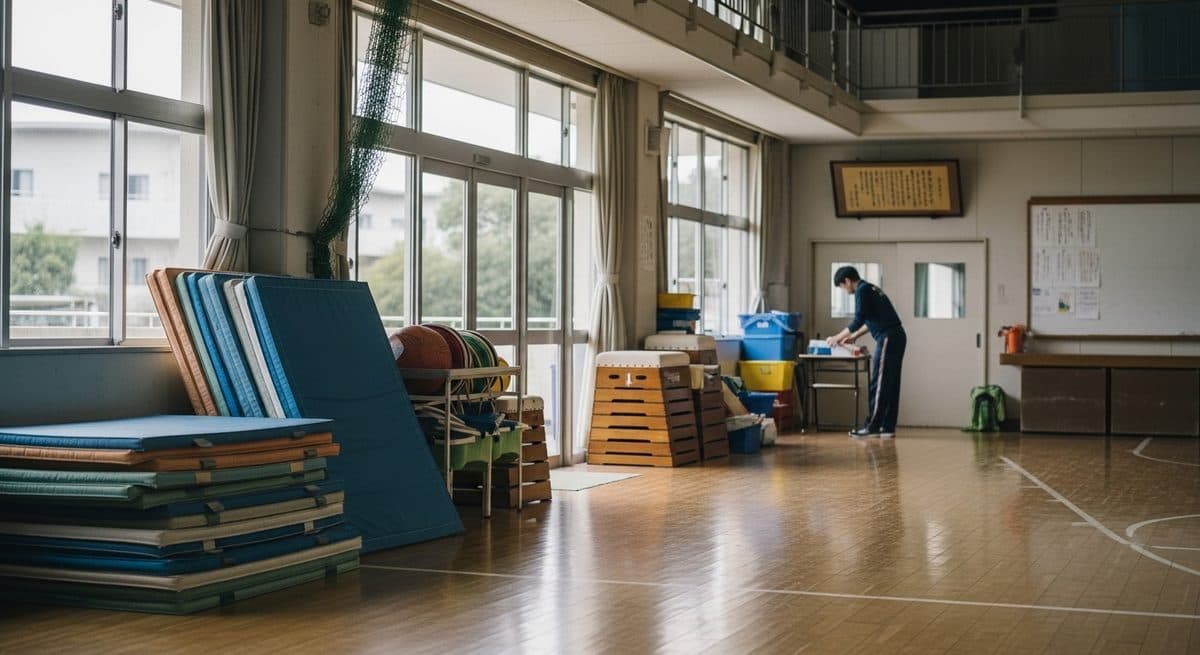
What Divides Japan's Teacher Shortage Is the Prefecture: A 4.4x Recruitment Gap and 43 Worsening Local Governments
Japan's MEXT FY2025 Teacher Shortage Survey reports 3,827 unfilled positions nationwide, yet the real story is not the total. Across 68 reporting entities, 43 worsened, 23 improved, and only 8 reported zero shortage. The recruitment ratio for elementary teachers ranges from 4.8x in Kochi to 1.1x in Akita — a 4.4-fold gap. Japan's teacher shortage has entered a phase of locked-in regional disparity.
TL;DR
- MEXT's FY2025 survey shows 3,827 unfilled public school teacher positions (0.45% shortage rate); special support schools lead at 0.71%
- Across 68 reporting entities, 43 worsened, 23 improved, and 8 maintained zero shortage, exposing a polarized distribution masked by the national average
- The elementary teacher recruitment ratio ranges from 4.8x in Kochi to 1.1x in Akita — a 4.4-fold gap. In near-1.0 prefectures, competitive selection effectively does not operate
- The Kyutokuho amendment (passed June 2025) and regional sports-club expansion are meant as relief measures, but in fiscally weak and depopulated areas they may widen the gap they were designed to close
What Is Happening
FY2025's 3,827 nationwide shortage masks a polarized split — 43 worsened, 23 improved, 8 at zero. Prefecture-level disparity is the story.
On March 5, 2026, Japan's Ministry of Education, Culture, Sports, Science and Technology (MEXT) released the FY2025 Teacher Shortage Survey. As of May 1, 2025, public schools reported 3,827 unfilled teaching positions, a shortage rate of 0.45%. Elementary schools accounted for 1,699 (0.44%), junior high schools 1,031 (0.47%), high schools 508 (0.33%), and special support schools 589 (0.71%). The highest shortage rate falls precisely on the schools serving children with the greatest need — a pattern earlier ISVD coverage has already documented.
The story of this article begins one level below that national total. The same MEXT survey aggregated data from 67 prefectures and designated cities plus one regional teacher personnel committee — 68 reporting entities in total. Compared with the previous FY2021 survey (2,065 unfilled positions, 0.25% shortage rate), 43 entities saw their shortage worsen, 23 saw it improve, and only 8 maintained zero shortage.
Shortage increased vs prior survey
Shortage decreased vs prior survey
Fully staffed
While 23 entities improved, twice as many (43) worsened. The national total (3,827) hides the imbalance distribution.
The figure 3,827 is the arithmetic sum across all 68 entities. Averages are useful, but they obscure what is happening inside each prefecture. With nearly twice as many entities worsening as improving, what coexists under the single national figure is a set of separately functioning prefecture-level labor markets, each with different pay scales, applicant pools, and policy responses.
The regional gap in recruitment ratios
The recruitment ratio shows that fracture most sharply. On December 18, 2025, MEXT published implementation data for the FY2024 teacher recruitment examination. The overall public elementary school ratio fell to 2.0x, a record low. Yet broken out by prefecture, Kochi reached 4.8x while Akita stood at 1.1x — a gap of about 4.4 times.
Kochi 4.8x ÷ Akita 1.1x ≈ 4.4x. A ratio near 1.0 means competitive selection effectively does not operate.
In a prefecture with a ratio near 1.0, the number of applicants barely exceeds the number of positions to fill. The exam shifts from selection to recruitment-by-default, and competitive screening of teaching candidates effectively does not operate. In prefectures with ratios above 4.0, candidates who fail are roughly as numerous as those who pass. The same country, the same profession — but the difficulty of becoming a teacher is, in practice, an entirely different threshold.
Background & Context
A 4.4x recruitment gap (Kochi 4.8x vs. Akita 1.1x), uneven special-support demand, and fiscal-bound Kyutokuho fracture the labor market.
Geography and Finance Behind the 4.4x Gap
A recruitment gap that wide reflects an entanglement of geography, demographics, and local fiscal capacity. Remote islands and depopulated municipalities struggle to attract applicants, and temporary substitute teachers are harder still to secure. Urban prefectures offer larger recruitment quotas but burden teachers with housing costs and commutes, undermining long-term retention. Rural prefectures, in turn, see their own teaching pipelines thin as population decline shrinks the cohort of education-major graduates.
Local fiscal capacity layers on top of this geography. Housing allowances, regional cost-of-living top-ups, and relocation stipends are typically funded from each prefecture's general budget. The basic plus additional staffing quotas under the Act on Class Sizes and Standard Staffing for Compulsory Education add up to roughly 680,000 positions nationally. But what each prefecture can stack on top — in pay, benefits, and incentives — depends on its fiscal capacity index. Fiscally constrained prefectures cannot match the offers that wealthier neighbors put on the table.
Uneven Special Support Demand
The school category with the highest shortage rate is also the one whose demand is changing fastest. MEXT's compilation from the School Basic Survey puts enrollment in special support classes at 353,438 in FY2022, 372,795 in FY2023, and 394,785 in FY2024, climbing by roughly 20,000 students a year.
Under the Standards Act, special support classes are capped at 8 students per class. Enrollment increases translate directly into staffing requirements, pressing against the supplementary quota of roughly 53,000 positions. Because enrollment growth and individual support needs vary widely across prefectures, demand-side imbalance feeds directly into the supply-demand gap.
Erosion of the Profession's Appeal
The conditions that push people away from teaching are documented in working-time and health data. The 2025 release of TALIS 2024 reports that junior high school teachers in Japan spent 55.1 hours a week on their work, against 59.1 hours in the 2018 round, and 14.7 hours more than the 40.4-hour OECD average across 27 countries and economies. Elementary teachers spent 52.1 hours, against 56.1 in 2018, above the 41.0-hour average across the 12 participating countries and economies. Both fell by about four hours since 2018, and both remain the longest among participating countries.
Leaves of absence due to mental illness remain at near-record levels. MEXT's HR Administration Survey reports that 7,087 public school teachers were on leave due to mental illness in FY2024 — essentially flat against the prior year's record high of 7,119. Including sick-leave absences of one month or more, the figure rises to 13,310, up 265 from the prior year. Elementary teachers account for about half (3,458), and the largest age bracket is the thirties (2,118). Concentration in early-career cohorts suggests that regional gaps may widen further as departures outpace inflows.
The Kyutokuho Amendment and the "Senior Teacher" Track
A major compensation reform also took shape in 2025. The Kyutokuho amendment — formally amending the Special Measures Act on Salaries of Educational Personnel — was enacted on June 11, 2025. It raises the teaching adjustment allowance in stages from the current 4% to 10% by January 2031. This is the first revision since the original Kyutokuho was enacted in 1971, more than 50 years ago.
The amendment also creates a new "senior teacher" (主務教諭) position bridging the gap between administrators and classroom teachers, adds homeroom-teacher allowances, and obligates each prefecture to formulate and publish a "Workload Management and Health Assurance Implementation Plan." According to materials by the House of Councillors Research Office, the government has set a target ceiling of about 30 hours of overtime per month per teacher. The amendment follows the August 27, 2024 report of the Central Council for Education, "Comprehensive Measures for Securing Quality Teachers Supporting 'Reiwa-Era Japanese-Style School Education.'"
Yet while the federal portion of the adjustment increase is uniform, additional local allowances — housing, regional, and relocation top-ups — depend on each prefecture's general budget. Prefectures with strong fiscal capacity can attract teachers with top-ups; those with weaker finances cannot match offers beyond the national-funded portion. The compensation reform, in other words, may end up widening the very disparity it was meant to close.
Academic Reading: 50 Years of Institutional Design
A long-run academic reading of Japan's teacher shortage comes from the sociologist of education Ono (2024). Ono argues that the neoliberal reforms of the 1990s and afterward — deregulation, decentralization, and a turn toward market mechanisms — simultaneously eroded the supply of teachers, their working conditions, and the profession's appeal. The expanding share of temporary appointees has turned the teaching workforce into something resembling a precariat. The original 1974 Personnel Securement Act framework, which once protected teacher compensation, has lost its grip in successive waves of marketization. That lens matters when evaluating whether the Kyutokuho amendment will, by itself, reverse the trend.
Reading the Structure
Japan's shortage is hardening into a structure that locks educational opportunity to the prefecture a child lives in.
Putting these strands together, Japan's teacher shortage is best read not as "3,827 missing nationally" but as a structural skew in which shortage concentrates in particular places. Decomposing it along four axes makes the skeleton visible.
Kochi 4.8x ↔ Akita 1.1x. A near-1.0 ratio prevents quality selection and creates downstream quality gaps.
Remote and depopulated areas attract few applicants. Housing and commuting allowances depend on local fiscal capacity.
Special support enrollment rose 5.5% from FY2022 to FY2023. The 8-student class cap directly forces staffing increases.
The Kyutokuho amendment raises the national adjustment rate, but additional local allowances depend on prefectural budgets, potentially widening gaps.
The four axes
The first axis is the prefecture-level fracture in recruitment ratios. A 4.8x versus 1.1x gap is not a quantitative difference — it is a qualitative one. Where ratios are high, applicants can be selected. Where they hover near one, applicants become teachers by default. Even nominally identical credentials carry different professional assumptions depending on the prefecture. The second axis is the bind of geography and finance. Remote islands and depopulated regions struggle to attract applicants in the first place, and the general budget available for housing or relocation support is itself constrained. The third axis is the surge in special support demand. The 8-student class cap converts enrollment growth directly into staffing demand, so an essentially positive social development — the advance of inclusive education — paradoxically deepens supply-demand gaps. The fourth axis is the effective reach of policy response. The Kyutokuho adjustment increase is funded nationally; the local top-ups that determine real competitiveness are not. Reform does not land uniformly.
The interaction of these axes produces two distinct shortages. The first is "pure shortage" — situations where employers want to hire but applicants do not exist, observed most clearly in prefectures with ratios near 1.0. The second is "placement failure" — situations where regular positions are filled but maternity, parental, and sick leaves cannot be backfilled because the temporary teacher pool is dry. The two demand different remedies. Pure shortage calls for raising the profession's appeal and expanding teacher-training capacity; placement failure calls for activating retired teachers, holders of special permits, and re-engaged former teachers. Conflating the two under the single phrase "teacher shortage" leaves policy disconnected from the situation on the ground.
The regional expansion of school sports clubs deserves a second look in this framework. The Japan Sports Agency designated FY2026 onward as the "Reform Implementation Period" and, in May 2025, renamed the program from "regional transition" to "regional expansion." Participating municipalities grew from 339 in FY2023 to 510 in FY2024. Yet roughly 70% of municipalities cite "securing instructors" as a key obstacle, and around 60% cite "sustainable revenue structure." In areas where receiving organizations are scarce, the receiving organization itself does not exist. A policy intended to relieve teacher workload risks widening the very regional gap it might claim to address.
Recast it as distribution, not a total
As long as the conversation stays at the national-total level, the figure of 3,827 will drift each year but never quite cohere into a story. Re-anchored at the distribution level, the picture sharpens: Japan's teacher shortage is hardening into a phase in which the quality of education a child can access is determined by where they happen to live. The year 2026 — with the Kyutokuho amendment and the regional sports-club expansion both in motion — is a hinge. The right metric for both reforms is not the national average. It is how much the gap between the 43 worsening entities and the 8 zero-shortage entities narrows from here.
Related Guides
Related Columns
- Japan's 4,317 Teacher Shortage — Why No One Wants to Teach(このサイトの記事)
- The Structure of Free High School Tuition(このサイトの記事)
- Cross-Analysis of School Non-Attendance(このサイトの記事)
References
FY2025 Teacher Shortage Survey — Ministry of Education, Culture, Sports, Science and Technology (2026). MEXT
Implementation Status of Public School Teacher Recruitment Exams for FY2025 (held in FY2024) — Ministry of Education, Culture, Sports, Science and Technology (2025). MEXT
FY2024 HR Administration Status Survey of Public School Teachers and Staff — Ministry of Education, Culture, Sports, Science and Technology (2025). MEXT
Bill to Amend the Special Measures Act on Educational Personnel Salaries and the Educational Public Service Personnel Act — House of Councillors Research Office (2025). Legislation and Research
50 years after the Securing Educational Personnel Act (1974): Why Japan faces teacher shortage — Ono, Y. (2024). Journal of Education for Teaching, Vol.50, No.5
The Demands of Teaching: Results from TALIS 2024 — OECD (2025). OECD Publishing
Recommended Reading
Statistics cited in this article
- 1MEXT 'FY2025 Teacher Shortage Survey'(Published March 2026) Open source
- 2MEXT 'Implementation Status of Public School Teacher Recruitment Exams for FY2025 (held in FY2024)'(Published December 2025) Open source
- 3MEXT, Special Needs Education Data (FY2024), Part 1(published January 2026) Open source
- 4NIER, Key Points of the OECD TALIS 2024 Report(published 2025) Open source
- 5MEXT 'FY2024 HR Administration Status Survey of Public School Teachers and Staff'(Published December 22, 2025) Open source
- 6MEXT 'FY2024 HR Administration Status Survey of Public School Teachers and Staff'(Published December 22, 2025) Open source